Six leading AI companies have promised the White House that independent outsiders will review their most advanced models, but questions remain over how much influence the companies will retain over those checks.
What the companies promised
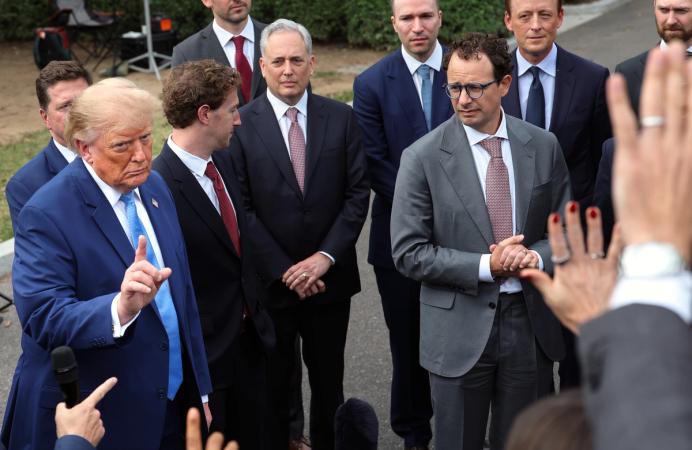
Nvidia, OpenAI, Anthropic, Google, Meta and xAI signed an accord on Sept. 29 covering advanced AI models. U.S. President Donald Trump described the agreement as “morally binding.” Under the accord, each company committed to working with an independent external auditor or evaluator. Independent directors are also expected to review audit reports and ensure that identified problems are addressed.
The commitments are intended to bring outside scrutiny to systems whose capabilities and risks are difficult for the public to assess. However, the accord does not specify who selects the auditors, what they may examine, or whether any results must be disclosed. It also sets out no penalty for failing to follow the commitments.
That leaves the companies with substantial control over the process. In practice, each developer can choose its auditor and determine which information or parts of a model are made available for review. According to CoinDesk, the central criticism is that an audit may be limited if the party being examined controls the questions, access and publication of findings.
Lessons from corporate auditing
The concerns echo problems that emerged in the accounting industry. In 2000, Enron paid Arthur Andersen $25 million for auditing and a further $27 million for tax and consulting services. Arthur Andersen was then one of the five largest international accounting firms; after its collapse, the industry became known as the “Big Four.” Both Enron and Andersen collapsed within two years.
The source argues that Andersen’s failure was not primarily a lack of technical expertise. Instead, the financial relationship with its client created an incentive to avoid examining the company too aggressively. The episode led Congress to pass the Sarbanes-Oxley Act. Among other changes, the law removed the choice of auditor from company management, restricted auditors from providing many other services to audit clients and established a public board to inspect audit firms.
The history of voluntary AI commitments has also raised doubts about relying on promises alone. In 2023, leading AI companies agreed to voluntary measures that included allowing outside experts to test their systems before release. A later assessment by researchers from Stanford, Harvard and Brown scored 16 companies against those commitments. Their average score was 53%, while eight companies received a zero on the promise to help outsiders identify and report problems.
Access remains the practical challenge
Independent testing can be difficult because a trained AI model is essentially a very large file of numbers. The source says that producing one can cost more than $100 million, and giving an outside party a copy would create a security risk.
That has traditionally forced developers and testers into an uncomfortable trade-off. If testers provide their questions in advance, the company can see the examination before the model takes it. If the company provides the model, the testers gain access to the system itself.
The nonprofit organization METR illustrated the limits of restricted access in its pre-release testing of OpenAI’s o3 model. METR said the evaluation lasted only three weeks, involved limited information about the model and did not provide access to its step-by-step reasoning. OpenAI did permit the test, but the example demonstrates how strongly the developer’s conditions can shape the review.
A different approach was demonstrated by Google DeepMind in August. Working with Singapore’s AI Safety Institute and three other external groups, DeepMind conducted what it called the first double-blind test of an AI model. The system ran on sealed computer hardware, allowing outside testers to keep their questions from Google while preventing them from seeing the model. Google said both sides could mathematically verify that their materials remained private.
The arrangement shifts some of the trust to the hardware. The source notes that researchers breached this type of sealed equipment last year using less than $1,000 of equipment, although physical access to the server was required. That vulnerability remains relevant, but it is presented as a narrower challenge than permitting unrestricted access to the model itself.
What stronger audits could require
The Decentralization Research Center said its report, “Alternatives to Concentrated AI,” was based on interviews with 36 people and an examination of nearly 30 working alternatives to concentrated control of AI. Its stated conclusion was that advanced systems can now be scrutinized without outsiders taking possession of the model or its data.
That finding underpins the report’s recommendation that auditors, rather than AI companies, should decide what they test. Companies should also identify their auditors and disclose the scope of each review, even if detailed findings remain confidential. The source compares this with public companies naming their auditors without revealing trade secrets.
It further argues that board committees reviewing audit reports should be accountable to an outside body. Sarbanes-Oxley created oversight for the auditors themselves; the White House accord contains no comparable mechanism. The source therefore says Congress should determine how that gap is addressed.
Moneyiar market picture
Moneyiar data at 21:28 on Oct. 17, 2026, shows AI Rig Complex (ARC) at $0.0385987409, up 9.14% over 24 hours but down 37.27% over seven days. Incentiv (CENT) was priced at $0.0036503361 at 08:43 on Oct. 13, 2026, down 10.41% over both 24 hours and seven days.