
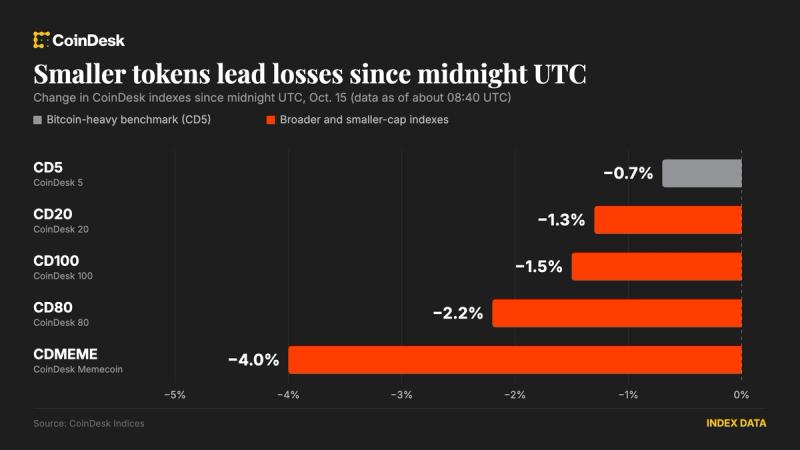
Bitcoin briefly fell to just above $80,000 before recovering, while altcoins suffered deeper losses as a sharp decline in Asian equities weighed on broader risk appetite. South Korea’s Kospi dropped 8% and triggered circuit breakers, while Nasdaq 100 futures fell about 1%, extending pressure that had already pushed the Nasdaq Composite down 1.9% on Wednesday, according to CoinDesk.
Bitcoin was trading near $81,200 after cutting an earlier 1% decline to around 0.5% since midnight UTC. The move lower came at about 02:30 UTC, when buyers appeared just above $80,000. That level was close to bitcoin’s Oct. 8 low of approximately $80,300. Ether performed worse, falling 2% to near $2,370.
The broader crypto market showed a similar split between larger, more established assets and smaller tokens. The CoinDesk 80 index declined 2.2%, compared with a loss of about 0.7% for the bitcoin-heavy CoinDesk 5. Nearly all members of the CoinDesk 100 were lower, with only six avoiding declines.
Risk aversion spreads from equities to crypto
The market move came as investors reacted to weakness in Asian equities and reassessed the outlook for U.S. interest rates. South Korea’s Kospi suffered its steepest decline in the session, falling 8% and activating circuit breakers. U.S. Nasdaq 100 futures also weakened, adding to the previous day’s technology-stock losses.
Interest-rate expectations were unsettled after a hotter-than-expected U.S. inflation report on Wednesday. The probability of an October Federal Reserve rate increase, as measured by CME’s FedWatch tool, had risen to almost 47% from roughly 22% before the report. It later eased to around 26%.
That shift leaves Treasury yields and the market’s pricing for a possible rate increase among the signals traders are watching ahead of the U.S. trading session. Higher interest-rate expectations can weigh on assets viewed as sensitive to changes in liquidity and risk appetite, including cryptocurrencies, although the source material does not establish a direct cause for each individual token’s move.
Derivatives show heavy liquidations and defensive positioning
Crypto derivatives activity intensified after the inflation data. Almost $1 billion in crypto futures positions were liquidated over 24 hours, up sharply from about $136 million during the preceding day. Ether accounted for $200 million of liquidated long positions, compared with $115 million for bitcoin, indicating that ether had carried heavier long leverage into the market decline.
Total 24-hour crypto futures volume reached $252 billion, a 61% increase over the period, while open interest remained broadly stable at $139.6 billion. That combination suggests that much of the activity involved positions being closed or exchanged rather than a large fresh expansion of leverage. Short positions represented 51.67% of taker volume, little changed from about 52% a day earlier.
Bitcoin’s dollar-denominated futures open interest rose 1.6% even as its spot price fell more than 2% over 24 hours. Because open interest is measured in dollars, that implies the number of contracts increased by roughly 3.7%. Negative cumulative volume delta readings suggest that the new positions may have been predominantly short, although open interest alone does not identify whether positions are long or short. Bitcoin’s perpetual funding rate remained positive, meaning long traders were still paying to hold positions.
Ether and solana showed a comparable pattern: their futures open interest stayed broadly steady while spot prices fell more sharply than bitcoin. By contrast, DOGE and NEAR saw open interest decline by more than their spot prices, consistent with positions being closed and capital leaving those contracts.
Bitcoin’s implied-volatility index remained just above 40% for a second consecutive day, up from recent lows near 34%. Options activity was mixed, with bitcoin calls at the $90,000 and $86,000 strikes among the most traded contracts, alongside puts used for downside protection. Ether options were more defensive, with puts leading the trading rankings.
Token moves and Moneyiar market picture
Lower-cap and ecosystem tokens absorbed some of the largest losses. Pump.fun’s PUMP fell 9.4%, the biggest decline in the CoinDesk 100, while the CoinDesk Memecoin Index dropped 4%. Within the Solana ecosystem, Jito lost 6.2% and Jupiter fell 6.1%, although Solana itself declined 1.1% to about $103.
Some tokens moved against the broader market. Pyth Network gained 2.8%, extending a rally that began after its DAO voted on Oct. 8 to direct all product revenue into monthly buybacks. Starknet rose 11% after falling 17% on Oct. 13. Larger tokens were comparatively resilient: Tron was little changed, Monero declined 0.55% and Hyperliquid fell 0.96% to about $80.
Moneyiar market data at 20:59 Tehran time on Oct. 15 showed Bitcoin at $81,977.545106897, up 0.39% over 24 hours and 0.27% over seven days. Litecoin was $60.3248195848, up 1.47% over 24 hours but down 4.35% over seven days. JUST stood at $0.1323187626, down 6.32% over 24 hours and 4.14% over seven days, while Lighter was $3.0712808896, down 1.2% over 24 hours and 15.86% over seven days.




