
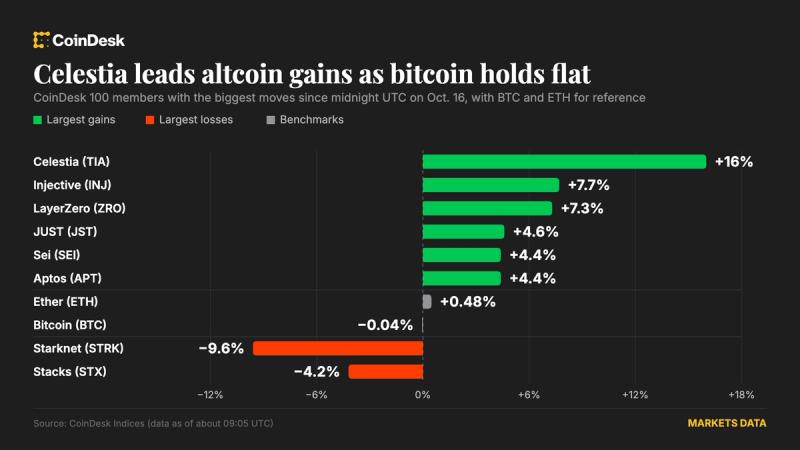
Altcoins moved ahead of bitcoin on Friday, led by a sharp rally in Celestia, Injective and LayerZero, while bitcoin remained close to $82,100. The broader crypto market also responded to a softer outlook for a possible U.S. interest-rate increase this month after Federal Reserve Chair Kevin Warsh avoided giving guidance on the central bank’s next decision.
According to CoinDesk, Celestia’s TIA token rose 16% to about $0.68, its strongest level of 2026. Injective gained 7.7% to roughly $9.19, while LayerZero added 7.3% to around $2.24. More than two-thirds of the constituents in the CoinDesk 100 index were trading higher, and four out of five members had gained.
Bitcoin was little changed from midnight UTC, trading near $82,100 after recovering from a move to approximately $81,600 at about 03:30 UTC. The largest cryptocurrency remained above the $80,000 level it briefly lost on Thursday, its first move below that mark in a month.
Ether rose 0.5% to about $2,450, while the broader, altcoin-heavy CoinDesk 80 index advanced 0.46%. The bitcoin-focused CoinDesk 5 index was flat. CoinMarketCap’s Altcoin Season index increased to 60 from 50 a day earlier, indicating that the day’s gains were concentrated more heavily among alternative cryptocurrencies than bitcoin.
Rate outlook adds to market focus
Warsh did not indicate what the Federal Reserve might do at its meeting later in October during a speech at the International Monetary Fund and World Bank meetings in Bangkok. Market pricing tracked by the CME FedWatch tool put the probability of an October rate increase at about 15%, down from roughly 30% previously.
Treasury yields were mostly stable. In other markets, South Korea’s Kospi closed 2.05% higher and Japan’s Nikkei gained 1.39% after the previous day’s sell-off. S&P 500 futures were little changed after the U.S. benchmark ended a three-session losing streak.
Interest-rate expectations can affect digital assets because they influence the wider appetite for risk and the relative attractiveness of cash and bonds. In this session, however, bitcoin’s limited move contrasted with stronger performances from several smaller tokens.
Celestia’s advance came alongside attention on the network’s reported technology and proposed economic changes. Celestia Fibre reached 3.07 terabits per second in a throughput benchmark, while the project introduced a proposed upgrade called the Sustainable Blob Economy. TIA has gained about 59% over four weeks, according to the source material.
Injective, a finance-focused layer-1 token, also recorded heavier trading. CoinMarketCap put its 24-hour volume at $289.7 million, up 128% from the previous day. Three U.S. exchange-traded fund applications linked to INJ are pending, although the report identified no single overriding explanation for the day’s move.
LayerZero’s rally extended a rise associated with its ATLAS trading infrastructure. The infrastructure directs most of its fees toward buying and burning ZRO tokens, according to the report. Ether.fi, a liquid-restaking token, rose 4.2%.
Not every altcoin advanced. Starknet was the weakest CoinDesk 100 member, dropping 9.6% to $0.08 after gaining 11% on Thursday. Stacks fell 4.2%. Among larger cryptocurrencies, Solana gained 1.2% to about $107, XRP rose 0.5%, and Monero increased 2.9% to approximately $565. BNB was barely changed.
Derivatives point to short covering rather than fresh buying
Crypto futures trading became quieter even as prices rose. Twenty-four-hour futures volume fell 20% to $200 billion, while open interest—the total value of outstanding contracts—increased 2% to $142.21 billion. Liquidations dropped to $311 million from almost $1 billion the previous day.
The combination suggested that some forced selling had eased, but it did not show a strong wave of new bullish positions. Bitcoin’s open interest rose only 0.3% against a 1% price gain. Ether and Solana showed a similar relationship, with open interest increasing less than their spot prices. The report said this pattern appeared more consistent with traders closing short positions than opening new longs.
XRP’s open interest fell 1% while its price rose 1.4%, another sign that contracts were being closed during the rally. Its open-interest-adjusted cumulative volume delta was negative, indicating limited support from aggressive derivatives buying.
Zcash showed a different pattern. Its futures open interest jumped 14% while the token gained 11.5%, and its cumulative volume delta was the strongest among major tokens. TRX, XAUT and ether also had positive readings, while bitcoin was neutral and UNI, HBAR and XRP were negative.
Perpetual futures funding rates for major tokens ranged from 5% to 10% on an annualized basis. That reflected a long bias without indicating excessive leverage. Bitcoin’s 30-day implied-volatility index, BVIV, fell to 38% from 42% the previous day, while ether’s implied volatility also declined.
Options activity still showed demand for protection. A large bitcoin put spread reportedly targeted a decline to $78,000, and the $80,000 bitcoin put was the most traded option on Deribit. For ether, the $2,600 call was the most traded option over the previous 24 hours.
Moneyiar market picture
Moneyiar market data recorded later, at around 21:33-21:34 on October 17, 2026, showed bitcoin at $80,923.35, down 0.89% over 24 hours and 2.50% over seven days. Litecoin traded at $58.34, down 1.86% in 24 hours and 8.85% over seven days.
NEAR Protocol stood at $4.87, with a 24-hour decline of 2.78% and a seven-day fall of 9.39%. Lighter was priced at $3.11, down 2.78% over 24 hours and 15.65% over seven days. These figures are Moneyiar data at the stated times and reflect a later market snapshot than the session described above.




