
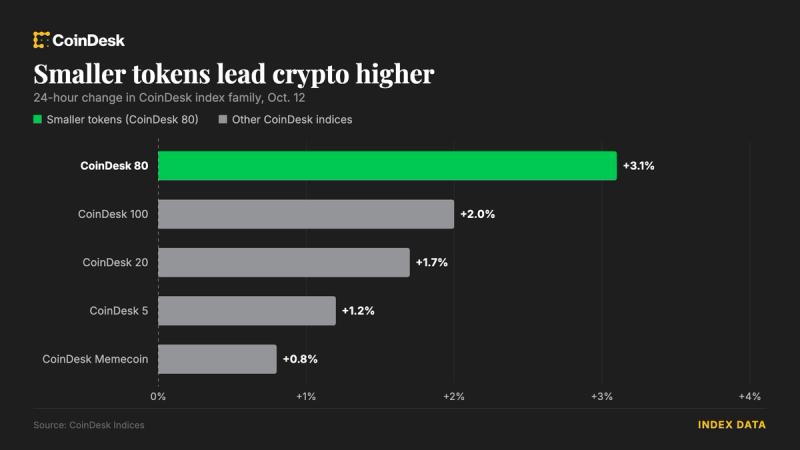
Smaller cryptocurrencies rallied faster than bitcoin at the start of the week, even as trading conditions remained relatively thin and institutional flows weakened. The CoinDesk 80 index gained about 3% over 24 hours, more than twice the 1.2% increase in the CoinDesk 5, while bitcoin traded below $83,500 after reaching above $84,000 on Sunday. Ether rose about 2.5% to $2,560. According to CoinDesk, the move is taking place as liquidity in many altcoins deteriorates and investors await the next major U.S. inflation reading.
Altcoins lead as market depth narrows
The rally has been concentrated outside the largest digital assets. CoinDesk research found that bitcoin and ether order books have recovered, in dollar terms, to levels seen before the October 10, 2025 flash crash. By contrast, liquidity for altcoins has continued to decline.
Order-book depth measures the amount of buying and selling available near the current price. When depth is limited, relatively modest orders can have a greater effect on prices, potentially making gains and losses more pronounced. Joshua de Vos, CoinDesk’s research lead, said in a Saturday report that market makers had returned to the major tokens.
The divergence helps explain why smaller coins were advancing more quickly than bitcoin and ether. However, the stronger performance of altcoins was not accompanied by a broad return of institutional money. U.S.-listed spot bitcoin exchange-traded funds recorded $681 million in net withdrawals last week, according to SoSoValue. That was the largest weekly outflow since June, with most of the selling occurring on Wednesday and Thursday.
Spot ether ETFs also remained under pressure. They had recorded no day of inflows since September 28, extending their outflow streak to nine days, the longest since June. ETF flows are closely watched because they provide a visible measure of demand from investors using regulated exchange-traded products, although they do not represent the entire crypto market.
Derivatives show faster trading, limited new leverage
Futures activity increased sharply, but the data did not show a comparable buildup of open positions. Twenty-four-hour derivatives volume reached $126 billion, up 81%, while open interest rose only 2.44% to $145.8 billion. Open interest represents the dollar value of outstanding contracts. The difference suggests that traders were changing positions more actively, rather than adding large amounts of new exposure.
Long positions accounted for 52% of 24-hour taker volume, compared with 48% the previous week. Taker trades are executed immediately against available orders, so this measure indicates that buyers were slightly more aggressive than sellers during the period.
Some individual tokens attracted stronger speculative interest. Zcash rose 6%, with $5.46 billion in futures volume over 24 hours, making it the fourth-largest cryptocurrency by that measure behind bitcoin, ether and SOL. Its open interest increased 7%, although the rise in the token’s price means only about 1% more contracts were opened after adjusting for that effect. Annualized funding was 10%, meaning long traders were paying a premium to short traders.
NEAR showed more evidence of fresh positioning. Its price climbed 10%, while open interest rose 17%, equivalent to roughly 6% more open contracts after accounting for the price increase. Positive funding and the token’s high open-interest-adjusted cumulative volume delta indicated that buyers were driving the move. NEAR reached its highest price since December.
Leverage demand for bitcoin and ether remained subdued. Open interest in both was little changed over 24 hours and stayed well below levels reached earlier in the year. Options markets also pointed to relatively restrained expectations: bitcoin’s implied-volatility index struggled to move above 40% after rebounding from a year-to-date low near 34% the previous week, while ether showed a similar pattern.
Investors await inflation data as risk signals diverge
The next major scheduled focus is Wednesday’s U.S. consumer price index. The inflation report may influence expectations for interest rates and broader risk appetite, making it an important event for traders in digital assets as well as other markets.
Oil prices also eased during the session. WTI futures fell about 2% to roughly $90 a barrel after President Donald Trump said Russia would supply 300,000 metric tons of diesel to global markets as sanctions were partly eased.
Options positioning showed that some traders were still seeking downside protection. Bitcoin puts with strike prices between $55,000 and $80,000 dominated 24-hour options volume. A put generally gains value when the underlying asset falls, so such contracts can be used to hedge against declines. Ether options activity was more balanced, with both calls and puts among the five most-traded contracts.
Moneyiar market data at 09:39 on October 13, 2026, showed bitcoin at $83,524.01, up 0.16% over 24 hours but down 2.79% over seven days. Litecoin was at $61.53, down 5.32% over 24 hours and 12.29% over the week. Altlayer stood at $0.00802, down 5.42% on the day but up 1.46% over seven days, while Loaded Lions traded at $0.001292, down 7.10% in 24 hours and 15.38% over the week.
The broader altcoin mood was reflected in CoinMarketCap’s Altcoin Season indicator, which stood at 66 out of 100, its highest level in more than a year. The indicator rose as traders placed speculative bets while bitcoin consolidated between $80,000 and $88,000. The combination of stronger gains in smaller tokens, thinner liquidity and weak ETF flows leaves the market’s advance dependent on a relatively narrow and more volatile part of the crypto market.




