
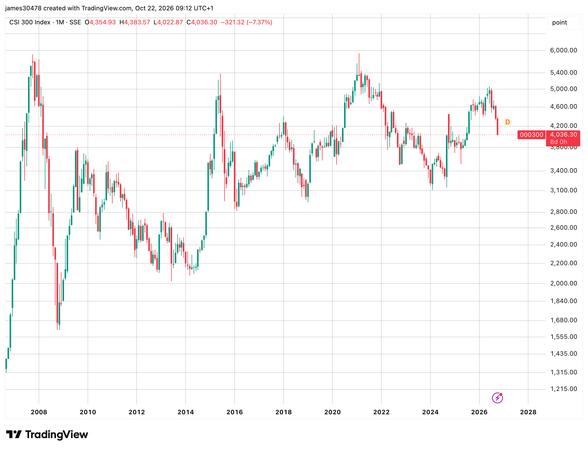
Asian equities suffered a broad selloff on Thursday as China’s CSI 300 index entered bear-market territory, technology shares weakened and oil prices climbed sharply. Bitcoin also reversed an earlier gain, while declines in gold, silver and U.S. stock futures pointed to a wider retreat from risk assets.
China’s benchmark crosses bear-market threshold
The CSI 300, which represents 300 of the largest companies listed in Shanghai and Shenzhen, fell 2%. That took its decline from a June peak to 20%, the threshold commonly used to describe a bear market.
Losses spread across the region. Japan’s Nikkei 225 dropped about 3%, South Korea’s Kospi fell 3.5%, Taiwan’s benchmark declined 2% and Hong Kong’s Hang Seng lost 3%.
Chinese technology stocks listed in Hong Kong recorded their weakest session since President Donald Trump’s April 2025 “Liberation Day” tariff announcement, according to reporting cited by CoinDesk. The sector’s benchmark has fallen more than 40% from its peak, almost wiping out gains recorded after Beijing’s September 24 stimulus package. Forward valuations have also contracted to about 13 times earnings.
A bear-market designation describes the size of a market decline rather than guaranteeing what happens next. In this case, the 20% drop underscored the extent of the pressure facing Chinese equities as investors reassessed technology stocks and the broader regional outlook.
U.S. earnings and oil add to market pressure
Mixed third-quarter results from U.S. companies increased uncertainty around spending on artificial intelligence. Tesla shares fell about 3% in after-hours trading after the electric-vehicle maker reduced its capital-spending forecast. Meta Platforms, by contrast, raised the lower end of its spending guidance.
The contrasting updates added to questions about the scale and durability of corporate investment in artificial intelligence. Those concerns were reflected in U.S. equity futures, with Nasdaq 100 futures down almost 2%.
Energy prices moved in the opposite direction. WTI crude rose above $100 a barrel, while Brent crude climbed beyond $112, reaching its highest level since May. Higher oil prices added another source of pressure for investors already dealing with falling share prices and uncertainty over corporate spending.
The selloff continued even as U.S. Treasury yields eased. The 10-year Treasury yield was near 5.077%, below its recent high of about 5.4%. Lower yields can, in general, make equities relatively more attractive, but that support was not enough to prevent the regional decline.
Market volatility also increased. The Cboe Volatility Index, known as the VIX, rose 10% to around 18, approximately 30% above its September low. The index is widely used as a gauge of expected volatility in U.S. equities.
Bitcoin gives back its advance
Bitcoin retreated toward $82,000 after briefly moving above $84,000. The decline came alongside weakness in several traditional market assets: gold fell more than 1% to below $4,100 an ounce, while silver dropped more than 3.5% to around $55.
The simultaneous moves showed that the session’s pressure extended beyond stocks and into commodities and digital assets. Bitcoin’s retreat also came as technology-focused equities and Nasdaq futures weakened, although the available reporting does not establish a single cause for the cryptocurrency’s move.
Moneyiar market data at 11:04 p.m. local time on October 22 showed Bitcoin at $81,260.48, down 3.68% over 24 hours and 1.19% over seven days. The data also recorded Ark at $0.1751, down 5.31% in 24 hours and 4.34% over seven days; ShareX at $2.6080, up 4.14% over 24 hours and 9.10% over seven days; and Ren at $0.8044, up 29,270.65% over 24 hours and 28,690.80% over seven days. Ren’s latest figure was timestamped at 7:54 a.m. local time on October 20, while the other quoted crypto prices were timestamped on October 22.
Thursday’s market action therefore combined a formal bear-market milestone in Chinese large-cap stocks, steep declines across major Asian exchanges, renewed debate over artificial-intelligence investment and a sharp rise in energy prices. Together, those developments left investors facing pressure across equities, commodities and cryptocurrencies at the same time.




