
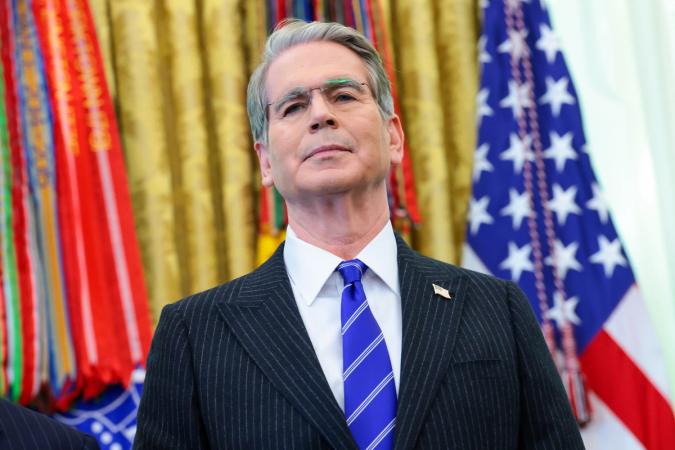
U.S. Treasury Secretary Scott Bessent said digital assets could become an important part of the infrastructure supporting the dollar’s position in the global economy, linking America’s leadership in cryptocurrencies to its broader technological and financial influence.
Speaking Tuesday at Ripple’s Swell conference alongside Ripple Chief Executive Brad Garlinghouse, Bessent said the foundations of monetary power were historically associated with military strength but are increasingly tied to technology. He described the competition between U.S. and Chinese technology systems, including artificial intelligence and semiconductors, as a model for understanding the strategic importance of digital assets.
“We will keep our military umbrella, but I think more and more it’s becoming a technology umbrella,” Bessent said. He added that the United States would “win in the digital asset stack,” arguing that such leadership could further strengthen the dollar.
Stablecoins and demand for U.S. assets
Bessent’s comments placed cryptocurrency within the Trump administration’s broader effort to bring digital-asset businesses and infrastructure into the United States. The argument is not limited to crypto trading. It also focuses on how digital payment systems and dollar-linked tokens could expand the currency’s use internationally.
The administration has secured passage of the GENIUS Act, which establishes a federal regulatory framework for stablecoins. These are digital tokens designed to maintain a fixed value against a fiat currency, such as the U.S. dollar.
Bessent said stablecoins could make dollars more accessible in countries where local currencies experience inflation or sharp declines in value. According to his remarks, more than 90% of stablecoins are backed by U.S. dollars, while issuers commonly hold U.S. government securities as reserves.
That connection could have implications for the Treasury market. If stablecoin use expands, issuers may need larger reserves, potentially increasing demand for the government securities they hold. Bessent described this as a possible additional source of financing for the federal government, saying stablecoins could become “an important source of funding for the Treasury.”
He rejected the idea that stablecoins would simply replace dollars already held by users. Instead, he said they could introduce dollar-based financial products to new users in emerging markets who are seeking protection from currency devaluation. “I think we are opening up new markets all around the world,” he said.
Regulation after the Clarity Act setback
The administration’s push for a wider federal framework encountered a setback when Congress failed to pass the Clarity Act. The legislation would have created a federal regulatory structure for the digital-asset industry.
Bessent called the failure disappointing but said the Treasury Department could work with the Securities and Exchange Commission and the Commodity Futures Trading Commission to provide greater clarity through agency action. He described both regulators as strong partners and said Treasury had significant convening authority to help coordinate their work.
Rules developed by agencies could give crypto companies a clearer operating framework and potentially serve as a model for other countries. However, agency rules would not have the same permanence as legislation, leaving an important distinction between regulatory action and a law passed by Congress.
Debanking concerns and market picture
Bessent also addressed “debanking,” a term used when financial institutions cut off banking services to digital-asset companies. He said the failed Clarity Act could have helped prevent a return to those practices, but maintained that regulators could still establish safeguards.
“I think we can set up regulatory best practices, guardrails that will prevent that from happening again,” Bessent said. His comments indicate that the administration is considering regulatory protections for access to financial services even without the broader congressional framework it had sought.
Moneyiar market data, recorded on October 25, 2026, at the stated times, shows XRP at $1.2991099051, up 0.56% over 24 hours and 0.09% over seven days as of 22:38 +03:30. Filecoin was priced at $0.9256286118, down 0.70% in 24 hours and 10.35% over seven days as of 22:39 +03:30. Sentient stood at $0.0204390365, with a 3.86% daily decline and a 7.85% seven-day decline at 22:39 +03:30. Nexus was at $0.0000006151, up 1.61% over 24 hours but down 13.97% over seven days at 22:38 +03:30.
According to CoinDesk, Bessent’s remarks frame digital assets as more than a new financial sector: they are part of a technological contest that the Treasury secretary believes could influence the dollar’s future reach, demand for U.S. government debt and the way countries connect to global finance.





