
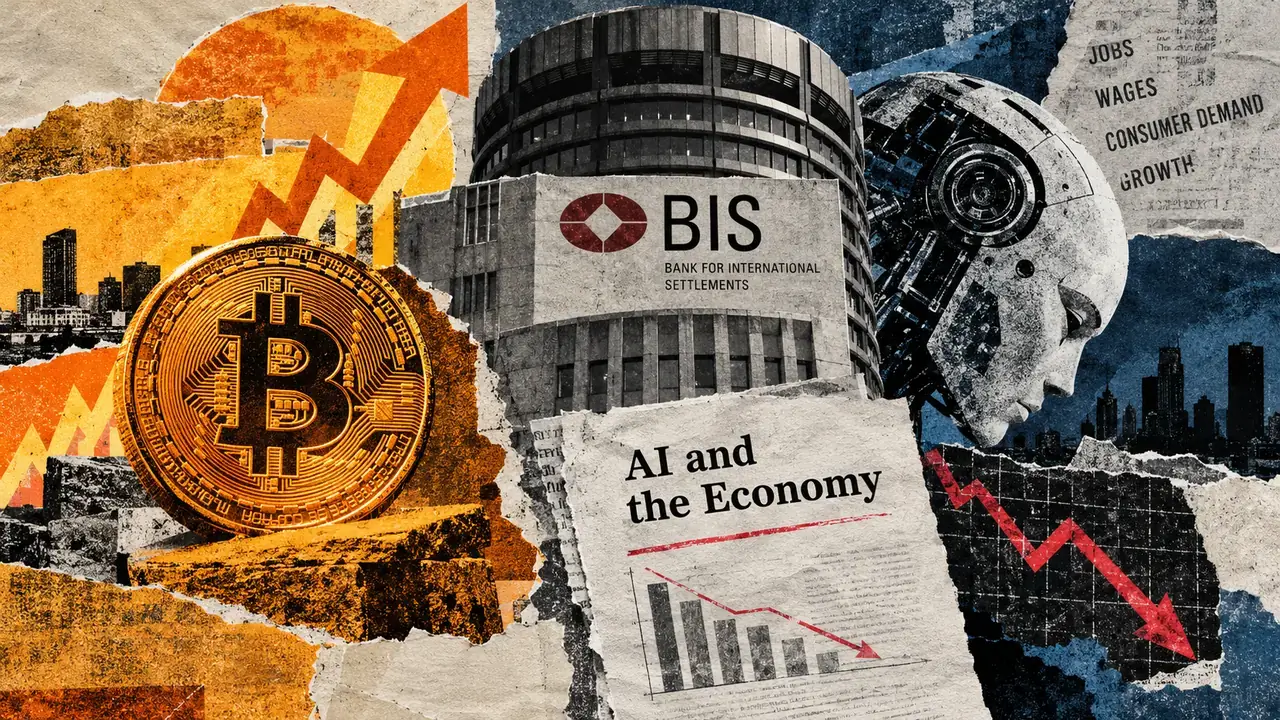
Bitcoin’s case for long-term gains from artificial intelligence is being challenged by a less discussed possibility: AI may increase production while weakening the consumer demand needed to sustain growth.
Bitwise Chief Investment Officer Matt Hougan argued in an October 14 memo that several possible economic outcomes could ultimately support Bitcoin. These include an AI-led productivity boom that makes scarce assets more valuable, a burst investment bubble followed by recession and monetary easing, and a slower-growth environment in which exchange-traded fund demand and institutional allocations continue to build.
But a Bank for International Settlements working paper published two days earlier describes a different path. The paper models an economy in which automation raises output and encourages heavy investment in machinery and computing capacity, while reducing the share of income devoted to consumption. If the market for consumer demand becomes too narrow, additional AI investment may become less profitable and long-term growth may weaken.
The demand bottleneck behind the AI risk
BIS Working Paper No. 1381, titled “Transformative AI and demand bottlenecks” and written by Phurichai Rungcharoenkitkul, focuses on consumption’s share of economic output. In its calibrated scenario, that share falls from roughly 69% before further innovation to 62.1% when additional innovation is no longer profitable.
The paper’s model does not suggest that total consumption must immediately decline. Instead, consumption can continue to rise in absolute terms while making up a smaller portion of a faster-growing economy. For example, if output increases by 10% while consumption’s share drops from 69% to 62.1%, the consumer-market index rises from 69 to only 68.31. That represents a 1% contraction in the consumer market even as the economy produces 10% more.
In the calibrated case, sustainable long-run growth falls from a pre-AI baseline of 2% to about 1.6%. Output growth initially peaks at just under 2.4% around 15 years into the AI era and remains above 2% for roughly 35 years, as companies continue building productive capacity while the underlying innovation cycle loses momentum. The paper also includes a much stronger scenario in which output grows by about 5.5% annually two decades into the transition and continues accelerating.
Wages, interest rates and uneven gains
The model estimates that labor’s share of tasks could fall from 60% to between 15% and 50% over three decades. Under the demand-bottleneck calibration, real wages settle about 15% below the level they would otherwise have reached. Those results depend on assumptions including a fixed labor supply, a static set of tasks available to workers and wages linked to marginal productivity.
Interest rates could move in both directions during the transition. Strong capital demand may lift the natural rate during the investment boom, while weaker consumption and a later bottleneck could push it lower. The paper uses a pre-AI reference rate of 1.65%, a median estimate of 1.2% after 20 years and a 90% model range from -0.6% to 4.4%.
Early economic signals do not yet establish which path is emerging. The Federal Reserve’s October 14 Beige Book said businesses in five of 12 districts reported reducing headcount through attrition, delaying hiring or expecting fewer jobs as AI-related productivity gains arrive. Consumer spending was broadly flat, with more than half of districts saying higher-income households were driving that activity. Employment was broadly stable: three districts reported modest increases, five slight increases and four no change.
The US trade deficit widened to $105.6 billion in August, partly because of strong imports of AI hardware. Economist Dean Maki estimated that about 70% of AI-related capital spending went to imports, meaning overseas suppliers captured a substantial portion of equipment demand and manufacturing revenue.
Why the debate matters for Bitcoin
Bitcoin’s supply is fixed, so its price depends heavily on demand, purchasing power and liquidity. If AI gains are concentrated among investors and institutions, that group could continue buying Bitcoin even while wage growth and household consumption weaken. In that case, new capital flowing into the asset could offset reduced purchasing power elsewhere.
The opposite outcome would create a more difficult backdrop. If automation weakens hiring and wages, a shrinking consumption share could eventually affect corporate earnings and financial-market liquidity. Higher real yields generated by strong productivity could also compete with Bitcoin, while falling rates caused by weak demand or financial stress could coincide with deleveraging rather than fresh investment.
AI-related equities already showed sensitivity to financing conditions on October 14 after a hotter consumer-price reading. CoreWeave fell about 16%, while Nebius and Dell each declined about 11% and Oracle dropped about 9%. Borrowing yields for AI infrastructure debt were also elevated. These moves point to the near-term importance of capital costs, separate from the BIS paper’s longer-term demand mechanism.
For Bitcoin, the key question is whether AI wealth reaches holders who are willing and able to invest faster than wages, consumption and liquidity deteriorate. Continued ETF subscriptions alongside stronger productivity and real wages would support the more optimistic scarcity argument. Stalling ETF flows while AI spending continues could instead indicate that investment is expanding faster than the demand base supporting it.
Current market picture
Moneyiar data at 21:39 on October 15, 2026, showed Bitcoin at $82,232.394858308, up 0.5% over 24 hours and 0.67% over seven days. Cronos was $0.0580691814, up 0.14% in 24 hours but down 3.92% over seven days. NEAR Protocol stood at $5.3284676682, rising 10.15% over 24 hours and 17.67% over seven days. ApeCoin was $0.1437108349, up 0.31% over 24 hours and 2.25% over seven days.




