
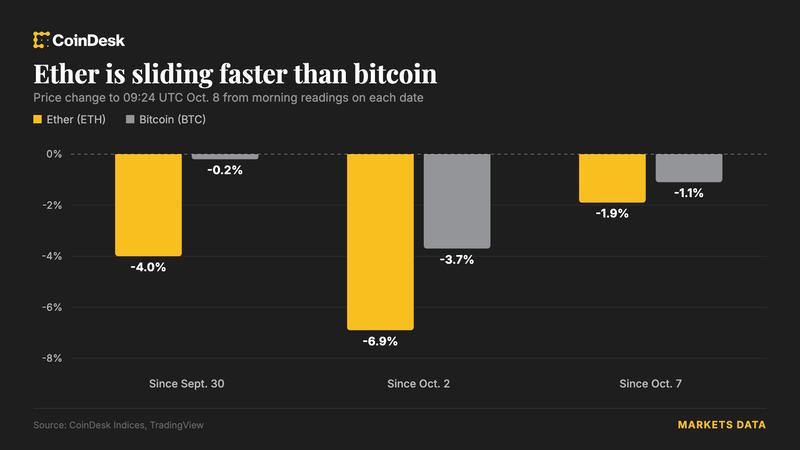
Bitcoin extended its decline during Asian trading hours on Thursday, briefly falling to about $82,300 before recovering to roughly $82,800. That left the cryptocurrency about 4% below Tuesday’s high near $86,600, while the CoinDesk 100 index was down close to 2% over 24 hours.
The move came as traders weighed a warning from Ethereum Foundation researcher Justin Drake that advances in artificial intelligence could eventually threaten the mathematical systems used to protect cryptocurrency wallets. The warning drew a divided response from industry figures and arrived alongside renewed pressure in US government bond markets.
Drake calls for “bunker mode”
Drake urged the crypto industry to begin preparing for what he described as “bunker mode” in a post on X that had been viewed almost 4 million times. His proposal involves gradually moving funds to new wallet addresses whose public keys have never been exposed.
The concern centers on elliptic-curve signatures, a cryptographic technology used to secure bitcoin and ether wallets. Drake argued that AI-assisted progress in mathematics could make it reasonable to prepare for a possible break of that protection “in months not years.” He cited 722 mathematical results released by OpenAI during the week as evidence of the pace of progress.
A public key is information used to receive or verify transactions, while a private key is used to authorize them. Moving funds to addresses with unexposed public keys is intended to reduce the risk associated with publicly available cryptographic information if the underlying protection were ever compromised. Drake’s comments, however, were a call for preparation rather than a report that such a break had already occurred.
Ethereum co-founder Vitalik Buterin agreed that the potential effect of AI-accelerated mathematics should be taken seriously, but pushed back against an urgent rush by holders to move their assets. Samson Mow, chief executive of bitcoin technology company Jan3, was more dismissive, telling followers there was no need to panic over comments from an Ethereum researcher.
The contrasting reactions underlined the uncertainty surrounding the issue: the possibility is being discussed as a longer-term security challenge, but the source material does not indicate that wallet cryptography has been broken.
Bond yields add pressure to risk assets
Crypto markets were also responding to developments in US government debt. The yield on the 30-year Treasury rose four basis points to 5.71%, while the 10-year yield reached 5.32%, according to CNBC. The moves came ahead of a $22 billion auction of 30-year Treasury bonds later Thursday.
Higher government bond yields can influence financial markets by changing the return investors demand from other assets. In this case, the rise in yields added to a broader backdrop of caution while digital assets were already trading lower.
Minutes from the Federal Reserve’s September meeting, released Wednesday, showed that all 19 officials supported the rate increase delivered the previous month. Most officials also viewed another increase by the end of the year as likely appropriate. The September consumer-price index report, due October 14, is the last inflation reading before the Fed’s October 28 decision.
Derivatives show deleveraging, with some exceptions
Futures data suggested that sellers retained an advantage, although forced selling eased. The 24-hour taker long-to-short ratio stood at 48% to 52%, with short sellers holding the larger share. Crypto futures open interest fell 1% to $150 billion, while trading volume was broadly unchanged at $187 billion. Liquidations declined to $400 million from $548 million the previous day.
Open interest measures the value of active futures positions. Across bitcoin, ether, HYPE, XRP and DOGE, notional open interest fell by as much as, or more than, spot prices. That pattern points to traders reducing exposure rather than building a large wave of new bearish positions as prices declined.
Solana was a partial exception. Its notional open interest rose 1.5% while SOL fell 2%, a combination that typically suggests new short positions were being opened. Selling pressure also remained visible in 24-hour cumulative volume delta readings for most major cryptocurrencies, including bitcoin and ether. NEAR and SUI were the exceptions.
NEAR gained 4% over 24 hours, with notional open interest rising 11% to $1.70 billion. Slightly negative funding indicated that short traders were paying to maintain positions, while NEAR’s open-interest-adjusted cumulative volume delta was the most positive among major tokens, pointing to aggressive buying.
Bitcoin’s 30-day implied-volatility index, BVIV, rose 5% from its yearly lows. One-week bitcoin put-call skew increased to 10%, while one- and two-month readings turned slightly positive. The shift indicated greater demand for puts, which are commonly used to seek downside protection. Ether options showed a similar defensive tilt.
Moneyiar market picture
Moneyiar data at 21:39 on October 8, 2026, showed bitcoin at $81,671.14, down 1.88% over 24 hours and 3.36% over seven days. Ethereum traded at $2,475.70, down 3.55% over 24 hours and 8.01% over the week.
Shiba Inu was priced at $0.0000052984, down 1.84% in 24 hours and 7.79% over seven days. Uniswap stood at $7.3458, down 5.09% on the day and 18.65% over the week.
According to CoinDesk, token performance elsewhere was mixed. Solana-related decentralized-finance tokens rebounded, with Jupiter up 15%, Raydium gaining 14% and Jito rising 10% over 24 hours, even as SOL slipped. Algorand rose 9% and Starknet gained 4%, while several artificial-intelligence-linked tokens continued to fall.




