
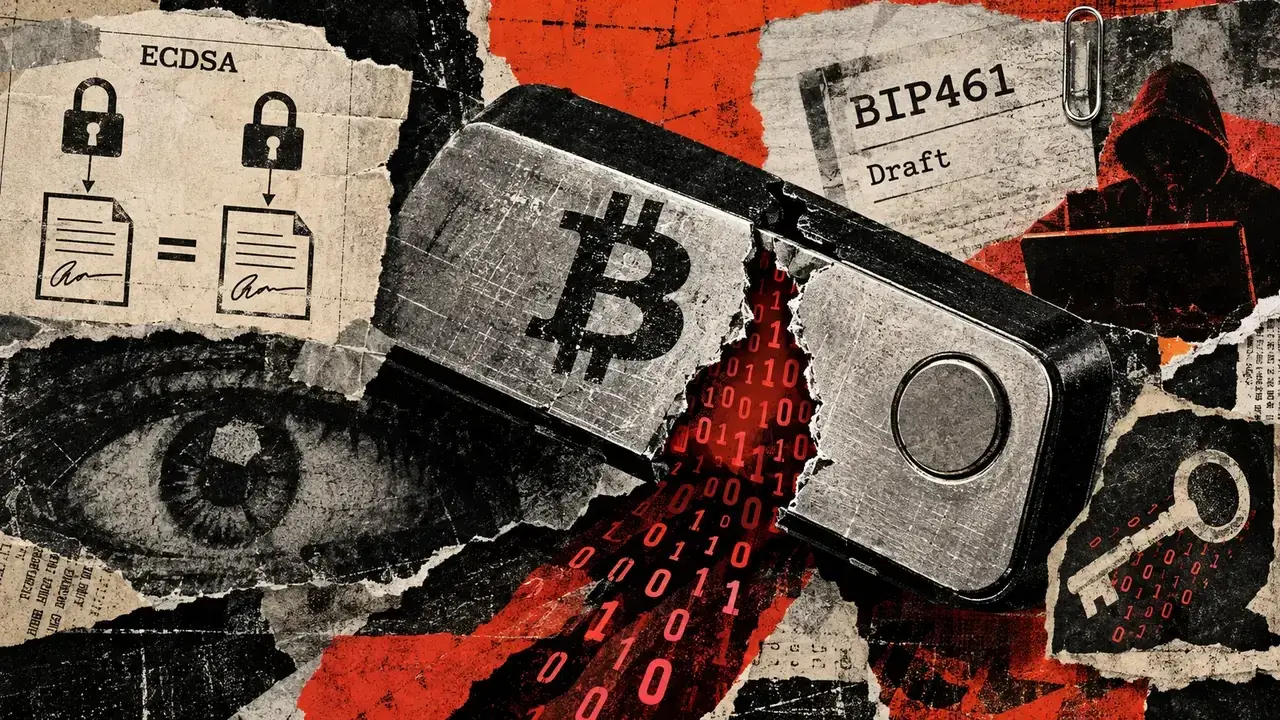
A proposed Bitcoin improvement could give wallet developers a clearer way to detect whether signing devices are following a common procedure or departing from it in ways that could conceal secret-key leaks. BIP461, authored by Liam Gilligan, was merged into the Bitcoin BIPs repository on Sept. 16 but remains a Draft.
According to CryptoSlate, the proposal standardizes how ECDSA signatures are generated while staying within Bitcoin’s existing consensus rules. That means adopting the procedure would not require a change to the rules used by the network to decide whether transactions are valid.
How BIP461 would make signatures comparable
ECDSA is one of the signature systems used in Bitcoin. A signature proves that someone controlling a private key authorized a message, such as a transaction. The process includes a temporary value known as a nonce. Under existing procedures, a signer can make choices during signature generation and still produce a signature that Bitcoin accepts.
That flexibility creates a potential channel for compromised or malicious firmware. A device could alter its signing behavior to encode pieces of wallet seed material or other secret information into signatures, while continuing to generate signatures that pass Bitcoin’s normal verification checks.
BIP461 addresses the lack of a common reference output by specifying a deterministic signing procedure. If two independent, compliant signers use the same private key and the same message hash, they should produce identical signatures. A difference would indicate that at least one signer is not using BIP461’s procedure.
The proposed standard also limits signatures to a maximum of 70 bytes in standard DER encoding, not including Bitcoin’s separate one-byte sighash flag. That gives implementations another defined characteristic against which to check their output.
A detection tool, not proof of theft
The comparison process has important limitations. To reproduce a signature, another independent signer must have access to the same secret key. That creates a practical security cost because handling or exposing a private key can itself introduce risk.
A mismatch would establish that at least one signer is not complying with BIP461, but it would not by itself show that a device is malicious or that a key has been stolen. An honest implementation using another valid ECDSA method could also generate a different signature. Any discrepancy would therefore require further investigation rather than serving as conclusive evidence of wrongdoing.
Matching test results are not definitive either. A compromised device could behave normally for selected test transactions and activate a leak only under particular conditions. As a result, a device might produce signatures that match the expected output during a check while using a different process for another transaction.
Relationship to the Dark Skippy disclosure
The proposal’s relevance is linked to the Dark Skippy disclosure, which described how corrupted firmware could hide seed material in transaction signatures. In its original disclosure, the researchers said they had not observed the technique being used in the wild.
However, BIP461 does not directly standardize a fix for every aspect of that demonstration. Dark Skippy’s original example used Schnorr signing, while BIP461 covers ECDSA. Taproot uses the separate BIP340 Schnorr scheme, so the draft does not directly address the signing method featured in that demonstration.
The proposal is instead aimed at creating a shared benchmark for ECDSA implementations. That benchmark could make deviations easier to notice, provided wallets implement the procedure correctly and comparisons are conducted in a way that recognizes the risks of exposing private keys.
At the time of the Sept. 16 repository merge, a reviewer said BIP461 needed test vectors and a reference implementation before it could progress to Complete. Its current Draft status means the proposal is not yet presented as a finished Bitcoin standard.
Current market picture
Moneyiar market data recorded at 09:44 on Oct. 1, 2026, shows Bitcoin at $83,826.60, up 0.39% over 24 hours and 0.83% over seven days. Bitcoin is ranked No. 1 by market capitalization in the supplied market information.
Among the other assets tracked in the same data, Ethena was priced at $0.261157, down 0.16% over 24 hours but up 29.92% over seven days, as of 09:43. Compound stood at $24.3976, down 3.83% over 24 hours and up 5.73% over seven days. AKEDO was at $0.0327703, down 8.28% over 24 hours and 29.06% over seven days, as of 09:44.




