
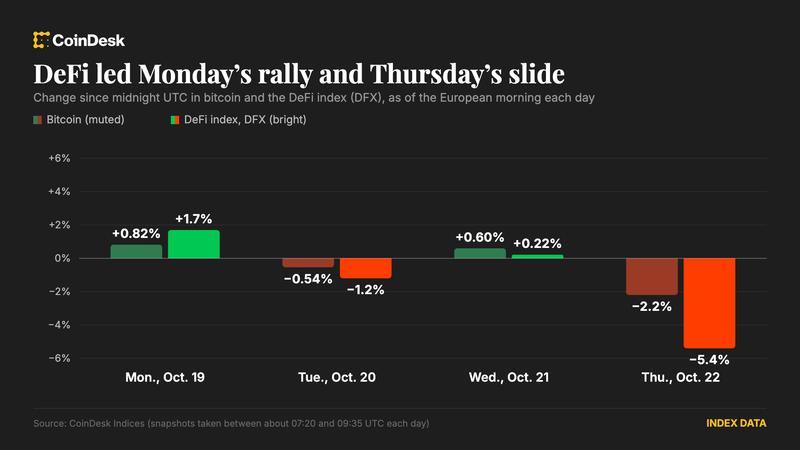
Bitcoin dropped below $82,000 on Thursday as renewed doubts about heavy artificial-intelligence spending pressured technology stocks and spread across digital-asset markets. The decline reversed part of a late-Wednesday rally that had briefly taken bitcoin close to $84,800.
According to CoinDesk, bitcoin fell as much as 2.9% from midnight UTC to about $81,600 before trading near $81,800, down 2.7% at the time of its report. The move represented bitcoin’s sharpest decline in two weeks. Ether also weakened, losing 2.6% to trade near $2,400.
The selling came as mixed results from Tesla and Meta Platforms revived investor concerns about whether the large sums being committed to AI will produce sufficient returns. The renewed uncertainty weighed on equities in Asia and on U.S. equity futures, adding pressure to risk-sensitive assets such as cryptocurrencies.
Technology-led pressure spreads across markets
Market declines were broad. Nasdaq 100 futures fell 1.32%, while S&P 500 futures slipped 0.66%. Hong Kong’s Hang Seng index dropped more than 3%, South Korea’s Kospi lost 3.5% and Japan’s Nikkei 225 declined 2.7%. Chinese stocks entered a bear market, according to the source material.
Crypto’s broader market performed worse than bitcoin. The CoinDesk 80 index was recently down 3.2%, compared with a 2.5% decline for the CoinDesk 5, which tracks a smaller group of major digital assets. Decentralized-finance tokens suffered the steepest losses, with the CoinDesk DeFi index falling 5.6%.
Individual DeFi assets reflected that weakness. Curve fell 8.2% to about 37 cents, Ethena declined 7.2% and Uniswap lost 5%. Uniswap remained down about 20% in October despite record fee revenue in September, according to Token Terminal. Pump.fun, a Solana-based memecoin launchpad token, dropped 6% and was down about 19% for the month.
Other tokens also fell. Celestia declined 3.7%, extending its weekly loss to 9%, while LayerZero dropped 4.2% and Worldcoin fell 7.3%. The declines came ahead of a scheduled Oct. 31 unlock of 5.58 million TIA tokens for Celestia.
Derivatives show active trading but limited new risk
Crypto derivatives trading increased 19% to $226.6 billion, while open interest—the value of outstanding futures and options contracts—fell 2.46% to $141.8 billion. Liquidations rose 52% to $431.1 million.
The combination suggests that traders were active but were mainly closing or adjusting existing positions rather than building substantial new exposure. Long and short positions were described as roughly balanced, meaning the liquidation pressure was not concentrated on one side of the market.
Bitcoin and ether trading volumes rose 36% and 27%, respectively, even as open interest declined by roughly the same scale as their prices. Funding rates were only slightly positive, offering no clear sign of a heavily crowded bullish or bearish trade.
Several altcoins saw open interest decline faster than their prices. Zcash open interest dropped 6.99% as its price fell 2.34%, while open interest in Near and Uniswap declined 8.83% and 10.17%, respectively. That pattern is consistent with positions being closed during the decline.
Commodity-linked perpetual contracts moved in the opposite direction. Open interest in gold rose 12% while its price slipped, and tokenized gold and silver contracts also recorded increases. Crude-oil open interest rose 6.29%, with a negative funding rate of -0.0126%, indicating that short-position holders were paying to remain in those trades.
Privacy tokens diverge and options retain downside protection
Monero was a notable exception to the broader selloff. XMR rose 4.9% to around $651 and was one of only five CoinDesk 100 constituents to gain since midnight UTC. It had risen about 19% over the month, while its futures open interest exceeded $300 million during the week, near its January record, based on SoSoValue data.
Zcash moved in the opposite direction, falling 4.8% to approximately $1,252. Monero also stood out in funding markets: its annualized funding rate was around 70%, far above other tokens. That indicated that long traders were paying a substantial premium to maintain positions.
Options activity showed competing expectations. The $85,000 and $86,000 bitcoin calls expiring Oct. 30 were the most-traded Deribit contracts over the preceding 24 hours. However, short-term options skews still favored puts, meaning downside protection cost more than comparable upside exposure. Bitcoin and ether implied-volatility measures remained just above their 2026 lows.
Spot bitcoin exchange-traded funds attracted more than $1 billion during the first three days of the week, according to SoSoValue data. Solana’s Alpenglow upgrade also went live overnight, although SOL fell 2.4% to around $104. U.S. jobless-claims data was due later on Thursday.
Moneyiar market picture
Moneyiar market data at 23:04 on Oct. 22, 2026, showed bitcoin at $81,260.48, down 3.68% over 24 hours and 1.19% over seven days. Ethereum Name Service traded at $5.4872, down 5.02% in 24 hours and 5% over seven days.
Nesa was priced at $0.11243, down 0.30% over 24 hours and 19.05% over seven days. The Index stood at $0.03576, down 14.44% over 24 hours but up 31.84% over seven days. The figures show that the latest daily selloff was uneven across assets, even as several smaller tokens remained sharply weaker over the week.




