
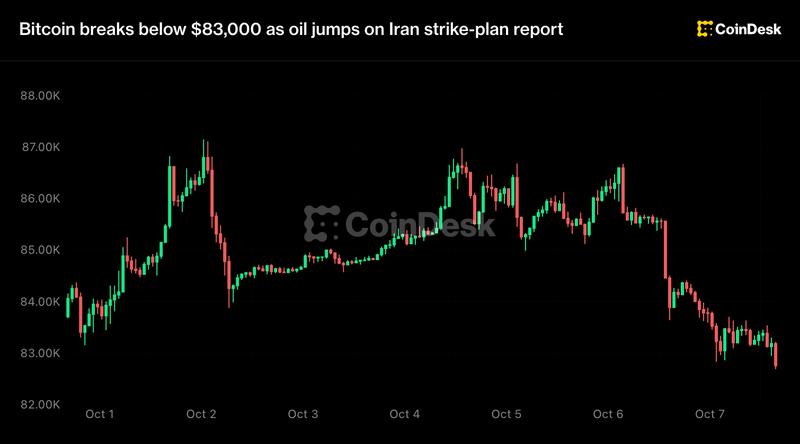
Bitcoin dropped below $83,000 in Asian trading on Thursday as a report that the White House had asked the Pentagon for options for possible strikes against Iran helped drive oil prices higher and pushed U.S. Treasury yields back toward levels last seen in 2002.
The cryptocurrency fell 1.6% to just under $82,800, according to CoinDesk, breaking a level that analysts at FxPro had identified as important. The move came after a sharp wave of leveraged-position liquidations and as higher energy prices added pressure to risk-sensitive assets, including cryptocurrencies and stocks.
Bitcoin slips below a closely watched level
FxPro said earlier in the week that a move below $83,000 would indicate that sellers had taken control of the market. The firm also said such a break could create a relatively quick route toward $80,000. That level has not been reached in the source material, and the firm’s comment was presented as a technical market assessment rather than a forecast of what will necessarily happen next.
The decline followed the liquidation of roughly $550 million in leveraged crypto positions a day earlier, based on CoinGlass data. Most of the liquidated trades were positions taken by investors who were betting that prices would rise. A liquidation occurs when an exchange closes a leveraged position after losses reduce the trader’s collateral too far, potentially adding to market selling during a sharp move.
Losses were broad among major digital assets. XRP was the weakest of the major cryptocurrencies listed, falling nearly 4% to about $1.42. Dogecoin declined 3% to just below 9 cents, while ether lost 3% to approximately $2,570. HYPE and Solana each fell more than 2%, and Zcash slipped by less than 1%.
BNB and TRX moved against the broader trend, with each gaining less than 1%, according to CoinDesk data. The combination of bitcoin’s break below $83,000 and the previous day’s liquidations left traders focused on whether selling pressure would continue.
Oil and yields rise amid geopolitical and supply concerns
Brent crude rose 2% to above $102 a barrel. The immediate market reaction followed reporting that the White House had asked the Pentagon to prepare strike options involving Iran. The source material does not say that strikes had taken place; it identifies the reported request as one factor behind the oil-market move.
Other developments also supported crude prices. A storm shut some U.S. oil production, while Iran-backed Houthi rebels struck two airports in Saudi Arabia, killing three people. Together, the geopolitical developments and disruptions to supply added to concern about the availability of oil.
The rise in crude coincided with a move higher in U.S. government bond yields. The yield on the 10-year Treasury increased by two basis points to 5.31%, returning it closer to its highest level since 2002. Higher yields can put pressure on assets whose valuations are more sensitive to financial conditions, while a rise in energy costs can also increase concern about inflation.
The wider market weakened as well. U.S. stock benchmarks fell on Wednesday, one day after closing at record highs, and Asian shares followed with a 1% decline. The MSCI All Country World Index dropped 0.2% and moved farther from the record it had approached earlier in the week, when it was within 1.5% of that peak.
Moneyiar market picture
Moneyiar market data at 09:04 on October 8, 2026, showed Bitcoin at $82,917.845147988, down 1.22% over 24 hours and 0.76% over seven days. The reading was above the level reported in the earlier Asian-market snapshot but remained below $83,000.
Other assets in the Moneyiar data showed mixed performance:
- Ethereum Name Service was at $6.5863821038, up 1.01% in 24 hours but down 4.77% over seven days, as of 09:03.
- Aethir was at $0.0067558027, down 0.41% in 24 hours and up 13.27% over seven days, as of 09:04.
- XPR Network was at $0.0022843047, down 0.58% in 24 hours and 4.9% over seven days, as of 09:03.
Bitcoin’s last two losing sessions in the source material occurred while oil prices and Treasury yields were rising. The report noted that a fall in Brent crude back below $100, where it traded on Tuesday, could reduce that particular source of pressure on the cryptocurrency and broader markets.




