
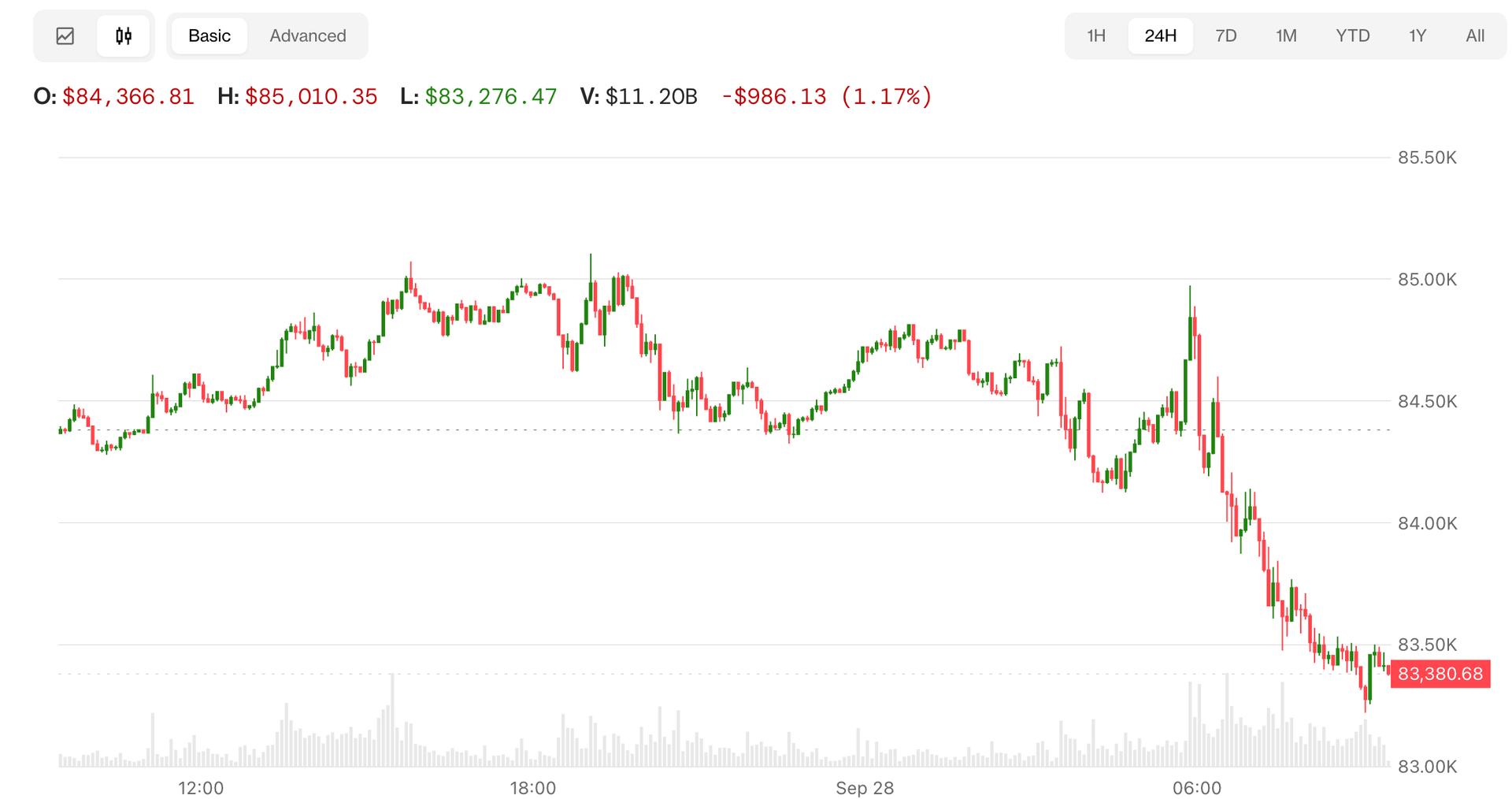
Bitcoin and Nasdaq futures started the week lower after President Donald Trump declined to rule out additional U.S. military strikes on Iran before the early November midterm elections, while crude oil prices moved higher amid renewed geopolitical uncertainty.
At 03:30 UTC, bitcoin was down 1.3% at $83,324. Ether, XRP and solana were also recording losses, while futures linked to the technology-heavy Nasdaq-100 index were 0.7% lower. West Texas Intermediate crude futures rose by almost 1% to $93.28 a barrel, with Brent crude showing similar gains.
Trump keeps military option open
Trump said on Sunday that he expected the war with Iran to end “very soon,” but stopped short of ruling out a resumption of military action before the midterm elections. Asked whether further strikes were possible, he said: “I don't want to say that. I don't want to say that. I mean, it's possible, but I just don't want to say that,” according to Fox News.
The president said the United States would prevail through a combination of military and economic pressure. He also said Iran could not be allowed to obtain a nuclear weapon.
Iranian Foreign Minister Abbas Araghchi said Iran was “fully prepared” for a renewed conflict and warned that the country could withstand what he described as a potential “doomsday war.”
The two sides also remained apart over a diplomatic proposal presented by Iran at the United Nations General Assembly. Iran proposed reopening the Strait of Hormuz for seven days and pausing the fighting, with broader negotiations to follow. The strait is a major route for oil shipments and has been disrupted by the war.
Trump rejected the proposal, arguing that Iran was seeking an agreement because it was under significant pressure. The unresolved dispute has kept investors focused on the possibility of further disruption to energy supplies and on the broader economic effects of the conflict.
Why markets are reacting
Higher oil prices can add to inflation concerns by raising energy costs across the economy. Since the war began in early March, those concerns have contributed to higher U.S. Treasury yields. The 10-year Treasury yield has climbed 127 basis points to 5.20%, its highest level since 2007, according to the source material.
The rise in yields has reflected a combination of inflation worries, expectations surrounding possible Federal Reserve interest-rate increases and concerns about government debt. Higher yields can also make riskier assets less attractive in relative terms, although the market response can vary across assets and over time.
Bitcoin has nevertheless performed strongly over the third quarter. Its price has risen 42% in three months, outperforming major assets including the Nasdaq and gold, despite the geopolitical and interest-rate uncertainty. The latest decline shows that the cryptocurrency remains sensitive to developments affecting expectations for inflation, monetary policy and risk appetite.
Investors are now waiting for several U.S. economic releases scheduled for this week. The personal consumption expenditures inflation report, the Institute for Supply Management manufacturing data and nonfarm payrolls could influence expectations for the Federal Reserve’s next steps and increase market volatility.
Bitcoin levels and Moneyiar market picture
Vikram Subburaj, chief executive of India-based Giottus exchange, said the $83,800-$84,000 area was an important near-term support zone for bitcoin, while $85,000-$85,800 represented immediate resistance. He cautioned against chasing the recent rally at current levels and said traders were monitoring exchange-traded fund flows, Treasury yields and incoming U.S. inflation data.
Moneyiar market data recorded bitcoin at $83,820.05, down 0.61% over 24 hours but up 3.2% over seven days, as of September 25, 2026, at 22:04 +03:30. The figures differ from the earlier CoinDesk market snapshot because they were captured at a different time.
The same Moneyiar data showed the Official Trump token at $2.0852, down 1.03% over 24 hours and 0.9% over seven days, as of September 25 at 22:03 +03:30. Sun [New] was priced at $0.01719, down 0.45% over 24 hours and up 1.22% over seven days, while SOON stood at $0.2011, up 1.19% over 24 hours and 5.27% over seven days. These are Moneyiar market data figures at the stated times, not live prices.
With military uncertainty still unresolved, oil moving higher and key inflation and employment indicators due, markets are entering the week with several potential sources of volatility. The immediate direction of bitcoin and technology stocks may depend on how investors weigh geopolitical risks against the cryptocurrency’s recent gains and the incoming U.S. economic data.




