
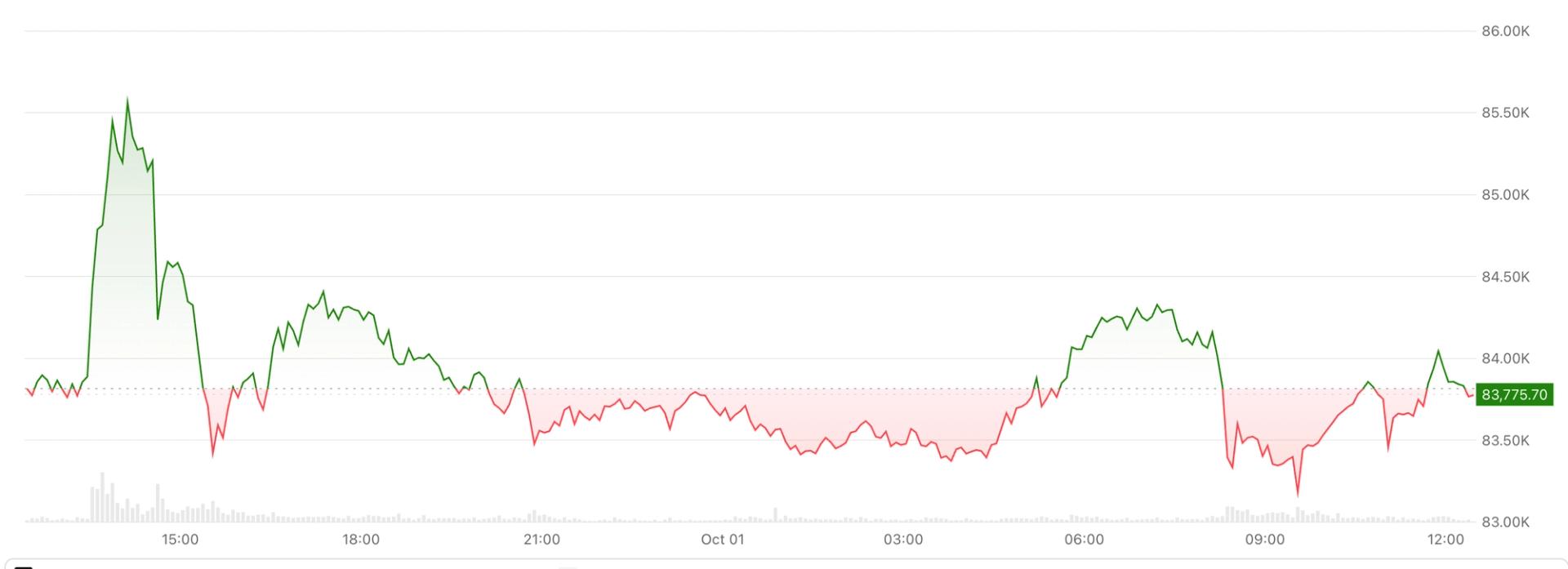
Bitcoin entered the new quarter with little sign of breaking out of its established trading range, after a brief move above $85,000 failed to hold. The cryptocurrency was trading around $84,629.01 in the source market snapshot, while weaker-than-expected U.S. inflation temporarily reduced expectations for further Federal Reserve rate increases.
The move higher was followed by renewed pressure from the spot exchange-traded fund market. According to CoinDesk, U.S.-listed Bitcoin ETFs recorded net outflows of $148.7 million on Wednesday, ending a nine-day run of inflows worth a combined $3.08 billion. That inflow streak was the largest of the year in dollar terms, based on data from SoSoValue.
ETF momentum loses strength
Bitcoin has spent more than a week moving unevenly between roughly $82,000 and $85,000. The failure to sustain a break above the upper end of that range highlights the importance of fresh demand, particularly from the U.S.-listed spot ETFs, which allow investors to gain exposure to Bitcoin through regulated exchange-traded products rather than holding the cryptocurrency directly.
The ETF inflow sequence had already begun to weaken before Wednesday’s outflow. Daily purchases peaked at close to $1 billion on Sept. 21 and declined during the days that followed. Analysts at Bitfinex said the pace of daily inflows would need to improve for Bitcoin to continue climbing.
“Daily pace remains the key determinant for clearing overhead supply,” the analysts wrote in a market note.
Their assessment refers to selling pressure from holders whose positions are concentrated at higher prices. Bitfinex’s Bitcoin Absorption-to-Emission Ratio, or BAER, compares the amount of Bitcoin purchased by ETFs during a session with the roughly 450 BTC produced by miners each day. The ratio fell from 25.6 times on Sept. 21 to 1.8 times on Sept. 29.
Bitfinex said the market would need BAER to recover toward 5.0 times—equivalent to about $190 million a day—to absorb an estimated 1.39 million BTC of breakeven supply positioned between $84,000 and $86,500. In practical terms, that zone represents a concentration of holders who may be willing to sell when prices return to levels at which they can break even.
Macro risks and derivatives positioning
The inflation data provided an initial lift because softer-than-expected U.S. price pressures reduced bets on additional Federal Reserve rate hikes. However, broader financial-market conditions remain a concern. Alex Kuptsikevich, chief analyst at FxPro, pointed to the continuing sell-off in bonds as a risk that could spread quickly across markets. He also said it was impossible to know when caution might turn into panic.
Derivative indicators showed a mixed picture. Bitcoin open interest eased to $20.9 billion from $21.8 billion, while funding remained broadly stable near 3% annualized across trading venues. At the same time, the three-month annualized basis on Deribit rose from below 5% to above 6%, a modest steepening that indicated firmer demand for leveraged long positions.
Options activity also leaned bullish, with the 24-hour call-to-put ratio moving to 83% in favor of calls from a previous 66%-to-34% split. Yet the one-week delta skew eased to about 4% from approximately 15%, and the options term structure remained in contango, with implied volatility around 29.5% at the front end and close to 40% farther out to mid-2027. The combination pointed to heavy call activity without traders paying a large premium for upside protection or exposure.
Coinglass data showed $100 million in liquidations over 24 hours, split evenly between long and short positions. Bitcoin, Ethereum and other assets were listed with notional liquidations of $100 million, $51 million and $26 million, respectively. Binance’s liquidation heatmap identified $84,800 as a key level to watch if Bitcoin rises.
Selective gains beyond Bitcoin
The wider digital-asset market did not move as one group. The CoinDesk DeFi Select Index was the only major index cited as gaining 1% over 24 hours. The Computing Select Index rose 0.3%, while the CoinDesk 80 Index added 0.2%; the remaining indexes were slightly lower.
Some individual tokens posted much stronger moves. Stacks’ STX rose around 26% over 24 hours to about $0.39, while Midnight’s NIGHT gained roughly 23% to around $0.04. Ethena’s ENA and Near Protocol’s NEAR climbed about 11% and 10%, respectively. Quant was trading near $290 and was roughly 9% higher in some market snapshots, although its recent performance remained volatile. Avalanche and Internet Computer moved in the opposite direction, falling about 5% and 4%.
Moneyiar market picture
Moneyiar market data recorded Bitcoin at $84,637.778663684 at 09:09 on Oct. 3, 2026, Tehran time. It was down 1.74% over 24 hours but up 0.57% over seven days. Among the other assets tracked at that time, AKEDO stood at $0.0325061732, up 3.89% over 24 hours and down 1.4% over seven days; Nesa was $0.1472153077, down 4.86% and 9.94%; and Movement was $0.0100826745, down 0.83% over 24 hours and up 3.57% over seven days. These figures are Moneyiar data at the stated time and provide a later market snapshot than the trading conditions described above.




