
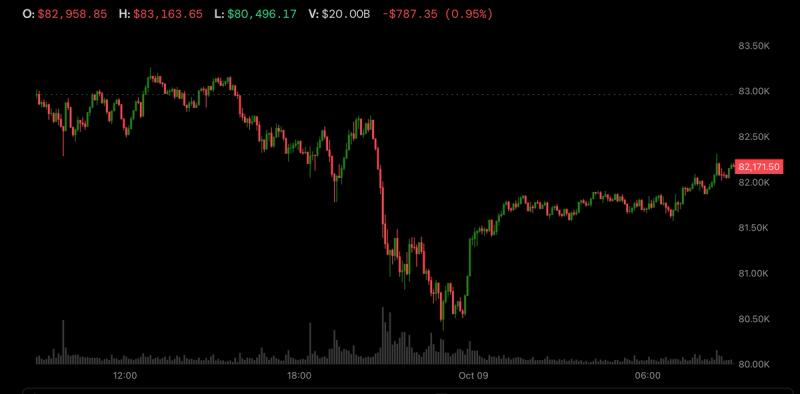
Bitcoin recovered to about $82,000 on Friday after President Donald Trump said the United States would not attack Iran before the Nov. 3 midterm elections, easing fears of an imminent military escalation that had pushed oil higher and cryptocurrencies lower.
The rebound followed a sharp reversal in markets. Bitcoin selling appeared to lose momentum near $80,300 after Trump published a statement on Truth Social at 12:17 p.m. ET. He said discussions with Iran had been “productive,” while adding that the U.S. blockade would remain “in full force and effect.”
Ether, XRP, solana and other major digital assets also recovered part of their losses from Thursday. The move underscored how quickly cryptocurrency prices can respond to changes in geopolitical expectations, particularly when those expectations affect energy markets and broader investor risk sentiment.
Geopolitical fears drove the earlier sell-off
The crypto decline began roughly a day before the rebound, as investors reacted to concerns about a possible renewal of military conflict between the United States and Iran. According to CoinDesk, an Axios report published on Oct. 7 said the Pentagon had instructed U.S. Central Command to prepare for a possible resumption of major combat operations in Iran.
The report contributed to a rise in crude prices. WTI futures moved from $89 to $93.20 before falling sharply after Trump’s statement. Crude futures were trading at $90.69 at the time covered by the report.
Oil prices often become a market focus during periods of geopolitical tension because concerns about supply disruptions can affect inflation expectations and the outlook for economic growth. In this case, the reduction in expectations of an immediate U.S. strike coincided with a recovery in bitcoin and other cryptocurrencies.
Trump’s statement did not signal an end to the blockade. Instead, it ruled out an attack before the U.S. midterm elections while describing the talks with Iran as productive. That distinction remained part of the market backdrop as digital assets recovered.
Debate grows over crypto “bunker mode”
Geopolitical concerns were not the only source of pressure on digital assets. The market also faced anxiety about whether advances in artificial intelligence could eventually weaken the cryptographic systems used to protect bitcoin and ether transactions.
The resulting discussion included calls for “bunker mode,” a precautionary migration of crypto holdings to new wallet addresses whose public keys have not previously been exposed on-chain. The proposal was raised earlier in the week by Justin Drake, a researcher at the Ethereum Foundation, amid concerns that AI-assisted mathematical advances could challenge elliptic-curve cryptography before quantum computers are capable of breaking it.
Crypto security specialists disagreed about the immediacy and nature of that risk. Coinbase chief cryptographer Yehuda Lindell described the concerns as “FUD” and said there was no evidence that the long-standing assumptions behind elliptic-curve cryptography had been broken.
Dragonfly’s Haseeb Qureshi characterized the warning as a “very sober call.” Ethereum co-founder Vitalik Buterin said the risk from AI-accelerated mathematics was real, but pointed to lattices rather than elliptic curves. The differing views added to uncertainty during Thursday’s decline, even as experts challenged the idea that an immediate breakdown in bitcoin or Ethereum security had occurred.
Bitcoin levels and Moneyiar market picture
Analysts were monitoring $81,000 as an important bitcoin support level after the recovery. Vikram Subburaj, chief executive of India-based Giottus exchange, said a move below that level could expose the market to $80,000 and then to on-chain support near $77,200. He also identified $83,300 and $85,500 as higher levels that would need to be reclaimed for a stronger recovery, alongside stronger exchange-traded fund inflows.
BitDelta identified $82,000 as resistance. Lead analyst Purvang Mashru said a sustained move back above that level, combined with ether trading above $2,500 and narrower losses among alternative coins, would improve the market setup. Mashru also pointed to $80,316 as a level where a break could increase downside risk.
Moneyiar market data at 11:04 a.m. local time on Oct. 9 showed bitcoin at $82,434.62, down 0.17% over 24 hours and 4.56% over seven days. The Official Trump token was priced at $1.8398, down 0.73% in 24 hours and 13.87% over seven days. Ore traded at $99.8896, with a 24-hour decline of 9.44% and a seven-day decline of 14.60%.
Those figures show that bitcoin’s rebound had not fully erased its recent losses, while selected digital assets remained under pressure. The market therefore entered the latest session with geopolitical fears temporarily eased, but with technical thresholds and continuing debate over crypto security still shaping sentiment.




