
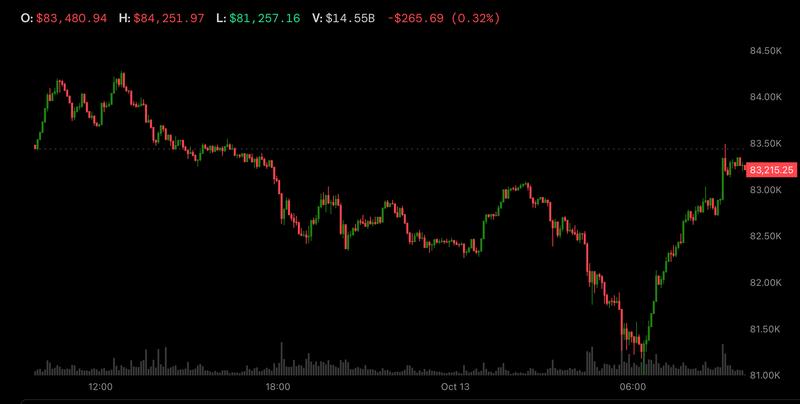
Bitcoin recovered above $83,000 on Tuesday after briefly dropping below $81,000, showing resilience as a sharp decline in South Korean chip stocks and weaker Nasdaq futures unsettled broader risk markets. Traders are now focused on Thursday’s U.S. consumer price index report, while elevated oil prices are adding to inflation and interest-rate concerns.
Bitcoin rebounds after early decline
Bitcoin fell to just under $81,000 at 00:50 UTC before moving back above $83,000, according to CoinDesk data. The cryptocurrency was trading at $83,696.96 in the source report as it recovered from the early weakness.
The move came as investors reduced exposure to parts of the technology and semiconductor sectors. Bitcoin has often traded alongside other risk-sensitive assets, meaning sharp moves in equities and expectations for interest rates can influence digital-asset prices. On this occasion, however, it regained ground while several major market indicators remained under pressure.
Ether bounced from five-day lows, while XRP turned higher after reaching a three-week low. Zcash, Solana and several other large tokens also followed the broader pattern of an initial decline followed by a recovery.
The market reaction is taking place ahead of a key U.S. inflation release. The consumer price index is closely watched because it provides information about the pace of price increases and can affect expectations for Federal Reserve interest-rate policy. Higher rates can weigh on assets such as cryptocurrencies by making cash and other interest-bearing investments relatively more attractive.
Korean chip stocks lead equity sell-off
South Korea’s KOSPI index fell by more than 6% during the session, dropping below 6,000 and reaching its lowest level since late July. It remained down by roughly 6% in morning trading.
Semiconductor companies were at the centre of the decline. Samsung Electronics and SK Hynix each lost roughly 8%, extending their declines to a fifth consecutive session. The sell-off reflected investor concerns about valuations linked to artificial intelligence and growing competition from Chinese memory-chip producers.
The weakness was not limited to South Korea. Hong Kong’s Hang Seng slipped 0.4%, while Nasdaq futures fell 0.6%, extending the technology-heavy index’s 0.78% decline on Monday.
This created a contrast with Bitcoin’s recovery. The cryptocurrency initially responded to the deterioration in risk appetite but later moved in the opposite direction, at least temporarily decoupling from the weakness in Asian technology shares and U.S. technology futures.
Oil and the dollar keep inflation risks in view
Energy markets remained another source of concern for investors. West Texas Intermediate crude traded near $92.67, holding most of Monday’s sharp rebound from below $90. Brent crude hovered around $106 a barrel after a three-day rally.
The gains in oil followed fresh attacks in Saudi Arabia and continued threats to shipping through the Strait of Hormuz. Traders were weighing the possibility of supply disruptions against expectations of additional Russian diesel exports.
Higher energy prices can increase inflation pressure, potentially strengthening the case for higher Federal Reserve interest rates. That prospect is generally considered a headwind for cryptocurrencies and other assets that are sensitive to financial conditions.
The Dollar Index, which measures the U.S. currency against a group of major currencies, held near 102.50, its highest level since April last year. A stronger dollar can also contribute to tighter financial conditions for investors globally.
CPI report becomes the next market test
Thursday’s U.S. CPI report is now the main scheduled event for crypto traders. The data could influence views on inflation, the Federal Reserve’s policy direction and the broader appetite for risk across markets.
Some market participants expect large institutional investors to protect their cryptocurrency positions with derivatives instead of selling their underlying holdings. Paul Howard, senior director at market-making firm Wincent, said institutional investors may focus on adding protection through hedging strategies while retaining their core exposure.
Hedging uses financial contracts to reduce the effect of adverse price movements. In this case, the approach described by Howard would allow investors to keep their existing crypto positions while seeking downside protection during a period of heightened uncertainty. His comments were reported in the source material.
Moneyiar market picture
Moneyiar market data at 09:29 on October 13, 2026, showed Bitcoin at $83,353.88, up 0.01% over 24 hours but down 2.79% over seven days.
Other assets in the supplied Moneyiar data were mixed:
- USD.AI (CHIP) traded at $0.05942, down 6.15% over 24 hours and up 12.33% over seven days.
- Nesa (NES) was $0.13944, down 1.99% in 24 hours and 1.51% over seven days.
- Ore (ORE) stood at $112.80, down 2.84% in 24 hours but up 2.94% over seven days.
These figures provide a market snapshot after Bitcoin’s rebound, but the direction of trading remains closely tied to the upcoming inflation report and changing expectations for interest rates.




