
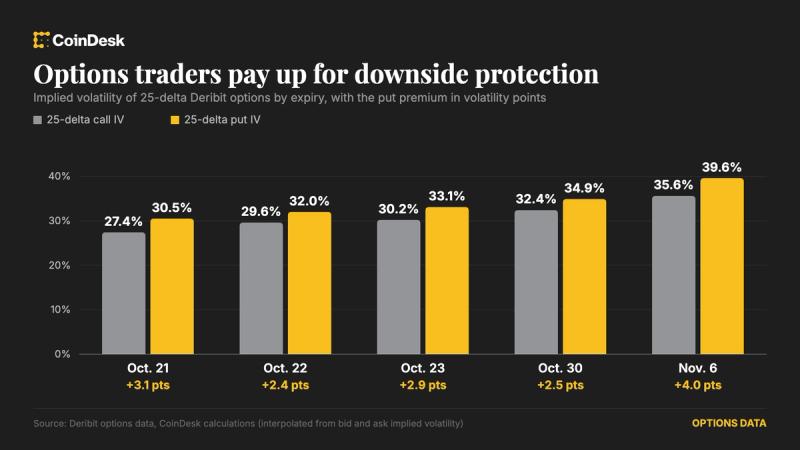
Bitcoin fell to about $81,400 on Tuesday despite a sizeable inflow into U.S. spot bitcoin exchange-traded funds, as a sharp decline in South Korean technology shares added to a cautious tone across risk assets. Options markets also showed investors paying more for protection against a further decline.
According to CoinDesk, bitcoin was down 0.5% since midnight UTC after U.S. spot bitcoin ETFs attracted $526.6 million on Monday. That was the funds’ largest single-day inflow in nearly a month, but it was not enough to prevent the cryptocurrency from weakening as Asian markets set a negative tone.
Asian technology sell-off weighs on sentiment
South Korea’s Kospi index dropped 3.73%, recording its lowest close since April 7. Shares of SK Hynix and Samsung Electronics fell as renewed concerns about the outlook for artificial-intelligence spending pressured chipmakers. Nasdaq 100 futures were also down 0.31%.
The move placed bitcoin’s decline within a broader retreat across technology-sensitive and risk-oriented markets. The cryptocurrency’s performance was softer despite the ETF inflows, suggesting that fresh institutional buying did not fully offset the impact of weaker sentiment elsewhere.
Other major digital assets also moved lower. Ether fell 0.9% to about $2,385. The CoinDesk 80 index, which tracks a broader group of crypto assets, declined 0.34%, while the bitcoin-heavy CoinDesk 5 index slipped 0.33%. Decentralized-finance tokens were among the weakest areas: the relevant CoinDesk sector index fell 1.2% after outperforming on Monday.
Markets were also watching other potential sources of volatility. Brent crude was near $110 a barrel as Houthi attacks on Saudi Arabia kept supply risks in focus. In equities, around 70 S&P 500 companies were scheduled to report earnings during the week, including General Motors before the bell and United Airlines after the close.
Options point to demand for downside protection
Derivatives positioning presented a mixed picture. Bitcoin open interest on Coinalyze fell 0.6% over 24 hours to $27.4 billion. The aggregated funding rate was about 8.8% annualized, while ether’s funding rate was approximately 3.9% annualized. Positive funding rates generally indicate that traders holding long positions are paying those holding short positions.
Long positions represented about 55% of bitcoin positions on Coinalyze, producing a long-to-short ratio of 1.24. Binance’s top traders showed a similar preference, with a BTC-USDT position ratio of 1.78 on CoinGlass.
However, activity in the options market showed stronger concern about declines. On Deribit, puts outnumbered calls by more than two to one over the previous 24 hours. The busiest contract was the October 30 $80,000 put, which gives its holder protection linked to a fall below that strike price at expiry.
Out-of-the-money puts also traded at a premium to comparable calls. The difference ranged from 2.5 to 4 volatility points across expiries, a pattern known as bearish skew. It indicates that traders were willing to pay relatively more for downside protection, even though open interest was concentrated around call strikes between $90,000 and $100,000 for October 30.
Liquidations were lower than the previous day. CoinGlass recorded $155.1 million in liquidations over 24 hours, down 54.7%. Long positions accounted for about 69% of the total in CoinMarketCap’s tally. Coinalyze recorded roughly $30 million of liquidations each for bitcoin and ether, together representing around half of its $120.6 million total.
Token moves remain uneven
The wider token market produced both gains and losses. Celestia’s TIA rose 2.2% to about 63 cents, making it the strongest performer on the CoinDesk 100 index. It had gained about 42% over the month. That advance coincided with Celestia’s October 1 benchmark, which showed its Fibre scaling system averaging 3.07 terabits per second, and with derivatives exchange Derive selecting Celestia for data availability in its V3 release. Tokenomist lists an unlock of 5.58 million TIA for October 31.
Sandbox’s SAND was the weakest CoinDesk 100 constituent, falling 4.5% to about 6 cents. The token remained up roughly 30% over the month after South Korean exchanges Upbit, Bithumb and Coinone lifted trading cautions imposed in August following a bridge exploit.
Layer-2 tokens also struggled. Arbitrum fell 3.6% and Starknet declined 3.2%, although Starknet was still up about 29% over the month after a sharp rise on October 9 and 10, when its network said it was considering becoming a standalone, quantum-resistant layer-1 by 2027.
Uniswap dropped 2.3% to around $7.14 and Morpho fell 2.5% to about $2.50, extending weakness among decentralized-finance assets. Uniswap has declined about 20% over the month even though its fee switch helped protocol revenue reach $14.81 million in September, its strongest month since it began retaining fees, according to Token Terminal. Ethena fell 1.9%, extending a roughly 30% monthly decline from its late-September peak near 29 cents. USDe supply stood at about $4.7 billion, below the $7.5 billion threshold at which ENA buybacks would begin.
Moneyiar market picture
Moneyiar data at 08:32-08:33 on October 21, 2026, showed bitcoin at $83,135.94, up 2.17% over 24 hours but down 0.72% over seven days. Dai was priced at $0.99957, with a 0.06% 24-hour gain and a 0.03% seven-day decline.
NEAR Protocol stood at $5.1809, up 9.46% over 24 hours and 2.63% over seven days. Monad was priced at $0.02217, up 6.2% on the day but down 11.28% over the week.




