
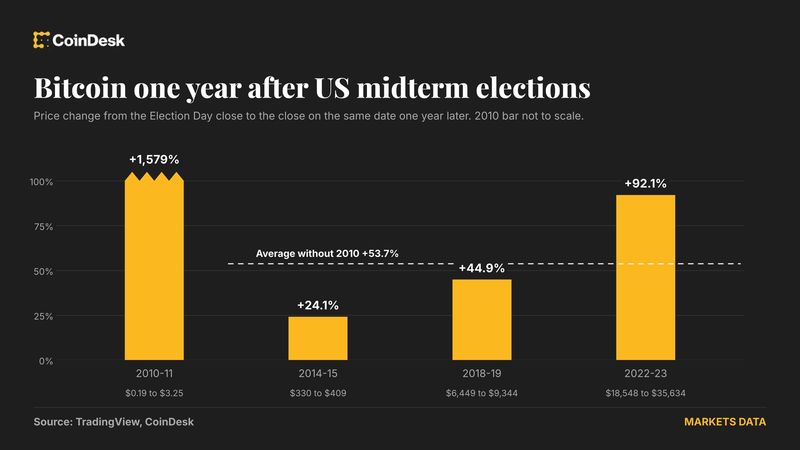
Bitcoin and U.S. stocks could see strong performance in the year following the Nov. 3 midterm elections, based on historical data, although the forces behind the cryptocurrency’s pattern remain uncertain. According to CoinDesk, bitcoin rose an average of 53.7% in the 12 months after three of the four U.S. midterm elections held since its creation, excluding the unusually small and immature market of 2010. The S&P 500 has also historically performed better after midterms, recording an average gain of 15.17% in the following year since 1950.\n\n## Bitcoin’s limited post-election record\n\nBitcoin’s post-midterm history is based on only a small number of observations. Since the cryptocurrency was launched in 2009, four U.S. midterm elections have taken place. The 2010 election is excluded from the comparison because bitcoin was still a fringe asset with a very small market, making its subsequent move difficult to compare with later periods.\n\nBitcoin climbed 1,579% in the 12 months after the 2010 midterms, but that extraordinary result is not considered reliable for the analysis. Across the other three elections, the average gain was 53.7%. The calculation measures the change from bitcoin’s daily close at 00:00 UTC on Election Day to its close on the same date one year later.\n\nThe historical pattern comes as bitcoin has traded in a relatively subdued range near $80,000. The cryptocurrency had already recovered more than 35% from a low below $60,000 in June, according to the source material. A repeat of the historical pattern would imply another advance after the election, but the limited sample does not establish that midterm elections caused the gains.\n\n## Halving cycles may be the bigger factor\n\nBitcoin’s post-midterm performance may reflect its supply cycle rather than U.S. politics. The network’s mining reward is cut by 50% approximately every four years through a process known as a halving. The reduction lowers the number of new bitcoins distributed to miners for each block.\n\nBitcoin has undergone four halvings. After each one, the cryptocurrency rose sharply, reached a peak roughly 12 to 18 months later and then entered a bear market. Those downturns occurred during midterm-election years—2014, 2018, 2022 and 2026. On that view, rebounds after midterms may have marked the beginning of a new halving-related cycle rather than a direct response to the election result.\n\nThat distinction matters because the available bitcoin record is short and overlaps with the asset’s recurring four-year pattern. Historical returns therefore show an association between midterm years and subsequent gains, but they do not identify politics as the cause.\n\n## The S&P 500 has a longer record\n\nThe stock-market evidence is more extensive. Data from Hartford Funds show that the S&P 500 has gained an average of 15.17% during the year after U.S. midterm elections since 1950. In all other years, its average gain was 7.30%.\n\nThe S&P 500 is a broad index of large U.S. companies, while bitcoin is a digital asset with a much shorter trading history. Their different histories mean the two sets of figures are not directly comparable, but both point to stronger average performance in the period after midterms. Past performance, however, does not determine what will happen after the 2026 vote.\n\n## What the 2026 election could change\n\nThe election could affect the political environment during President Donald Trump’s final two years in the White House. A Democratic takeover of one or both chambers of Congress could intensify disputes over several issues, including federal debt, the unresolved debt-limit question and defense spending. The source material says Trump’s proposal for $350 billion in mandatory defense funding could face obstacles, while Democrats could use legislative procedures to challenge funding connected to escalations in the Middle East.\n\nCrypto-related scrutiny could also increase. Democratic committee chairs may investigate potential conflicts of interest involving Trump’s personal crypto profits, his family’s business ventures and the memecoin launched in January 2025. Democratic lawmakers have already sent oversight letters concerning those ties, while the memecoin has resulted in heavy losses for retail investors, according to the source material.\n\nAt the same time, the Supreme Court’s ruling in Trump v. Slaughter left most financial regulators under White House control. That could limit Congress’s ability to prevent the administration from promoting crypto. Markets have largely priced in divided government, with Democrats expected to regain at least one chamber, meaning the election result may not produce a major surprise for investors.\n\n## Moneyiar market picture\n\nMoneyiar market data at the given time, Oct. 25, 2026, showed bitcoin at $80,430.51, down 0.08% over 24 hours and 1.32% over seven days. Other listed assets were trading as follows:\n\n- Plasma (XPL): $0.07382, up 0.12% in 24 hours and down 2.89% over seven days.\n- Four (FORM): $0.22101, up 0.66% in 24 hours and down 7.29% over seven days.\n- Propy (PRO): $0.33188, up 1.70% in 24 hours and down 3.95% over seven days.\n\nThe bitcoin figure was recorded at 22:39 on Oct. 25, while the other timestamps ranged from 17:19 to 22:39 that day, all in the +03:30 time zone.




