
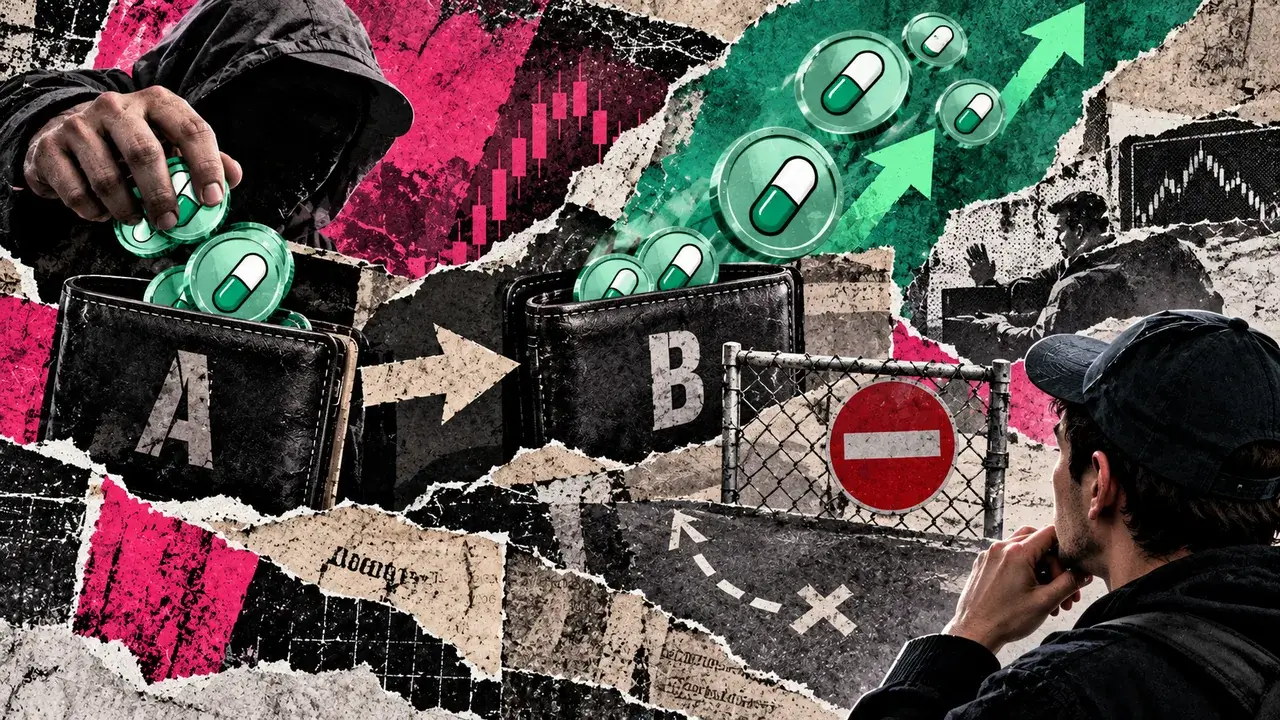
A large share of the biggest reported gains among Pump.fun memecoin wallets may not represent trades that outside investors could reproduce, according to blockchain research cited by CryptoSlate. The findings raise questions about how wallet leaderboards measure performance and whether automated copy-trading systems can deliver comparable results.
Bitquery examined 3,170 wallet-token positions that showed reported gains of at least $100,000 between October 2025 and August 2026. Together, the positions represented $752.5 million in apparent gains. Only 26% passed Bitquery’s checks for conventional market trading.
The analysis found that 51% of the gains involved wallets selling tokens that had been transferred to them from other addresses. A further 13% displayed patterns that could indicate coordinated trading, while 10% could not be conclusively classified. The figures mean that the source of the reported profits was not clear enough to treat most of the sample as ordinary, independently executed trading.
Why transferred tokens matter
Copy-trading platforms generally watch for purchases made by a selected wallet and then attempt to mirror those transactions. That approach becomes difficult when the wallet later selling the tokens did not buy them on the open market.
A wallet can receive tokens from another address and subsequently sell them after their value rises. Its recorded history may then show a large sale and a substantial apparent profit, even though the wallet itself has no matching purchase for a follower to copy. The true return for the owner would depend on the price paid by the wallet that originally acquired the tokens.
Bitquery identified 1,579 profitable positions in which most of the sold tokens had arrived through transfers rather than purchases recorded by the selling wallet. Of these, 1,104 were traceable to addresses connected to the token creator, either directly or through intermediary wallets.
The research also found that this pattern became more common during the period studied. Sales of transferred tokens represented seven out of every 10 large wallet wins in August. Before July, the number of such cases had stayed below 100 per month.
The transfer activity does not by itself prove wrongdoing. Wallets controlled by the same legitimate investor can move assets between addresses. But it can make address-level profitability difficult to interpret because analytics systems commonly calculate gains by comparing recorded purchases with sales.
Coordinated activity adds another complication
Bitquery found 423 creator-linked transfers that involved additional signing addresses. In one example concerning the UOTF token, four temporary wallets each received almost eight million tokens and later forwarded them to addresses that sold the holdings. One recipient sold its allocation for $1.59 million, creating a large apparent gain without a corresponding recorded market purchase.
The study also examined the largest reported winners for signs of wash loops, a pattern in which concentrated buying activity occurs alongside direct financial connections between wallets. Fifteen of the 25 biggest reported gains met Bitquery’s criteria for such activity.
One example involved the Arena token. A wallet spent $4,223 and later recorded about $4.92 million in sales. Another address, which had previously received funding from the apparent winning wallet, generated 99% of the buying activity while the position was held. The seller had transferred more than $1.4 million in SOL to that buyer during the two preceding days.
These links raise the question of whether an unrelated follower could have achieved the same result without access to the connected buying activity. At the same time, identifying a financial relationship between wallets does not, on its own, establish that a trade was fabricated or manipulated.
What the findings mean for copy-trading platforms
The results put additional focus on wallet analytics and services such as GMGN, which lets users monitor addresses and automatically attempt to replicate their transactions. GMGN’s documentation includes “Didn’t buy” and “Sold > Bought” warnings for wallets that receive tokens without purchasing them or sell more tokens than their recorded acquisitions.
Those warnings can identify an unusual transaction history, but they do not show whether a displayed gain was available to followers. GMGN’s copy-trading system bases purchases on buying transactions made by the monitored wallet, while its proportional selling feature applies to tokens acquired through the copy-trading service. A transferred token therefore may have no corresponding purchase signal for an automated follower.
Even when a monitored wallet makes a conventional purchase, execution may differ. Users can set liquidity, market-capitalization and transaction-size filters that prevent some orders from being copied. GMGN also charges a 1% handling fee per transaction, excluding network and priority costs. Slippage and delays can create further differences between the original wallet’s result and a follower’s execution.
Not every result in the sample involved transfers or suspected coordination. Bitquery identified a SOULGUY position that generated $3.3 million across 3,632 trades. Reproducing that outcome would require a follower to complete a large number of transactions at competitive prices.
Bitquery did not measure the actual returns achieved by copy traders, so it could not determine how much of the $752.5 million in sampled gains was replicable. In addition, 2,943 other six-figure winning positions closed after the August cutoff and were not included in the transfer analysis.
Moneyiar market picture
Moneyiar data at 22:39 on October 25, 2026, showed Pump.fun (PUMP) at $0.0042620684, down 0.56% over 24 hours but up 4.2% over seven days. Nexus (NEX) was $0.0000006151, up 1.61% in 24 hours and down 13.97% over seven days.
FUNToken (FUN) stood at $0.0089182414, up 1.62% over 24 hours and 0.08% over seven days. Loaded Lions (LION) was $0.0011817703, down 2.39% over 24 hours and 3.06% over seven days. These prices and percentage changes are Moneyiar market data at the stated times.





