
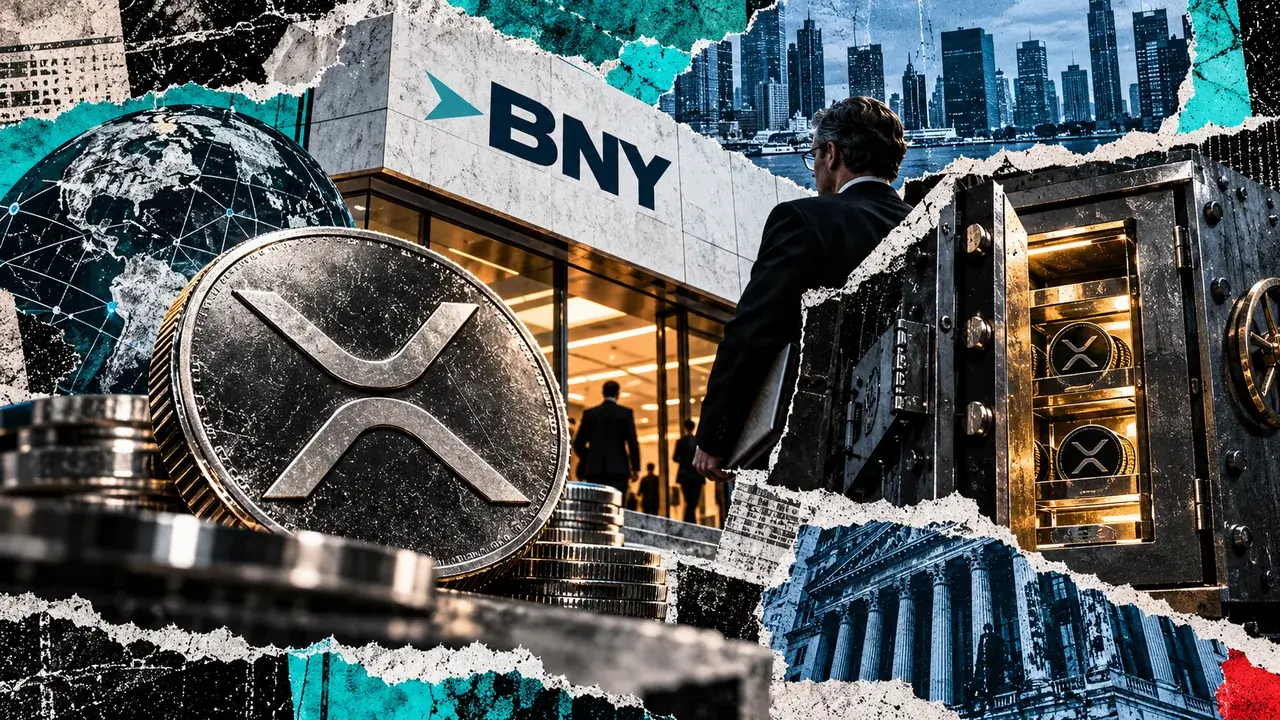
BNY has added custody support for XRP and Ripple’s RLUSD stablecoin for eligible institutional clients, creating another banking channel for holding and transferring the assets. The announcement, reported by CryptoSlate based on Ripple’s Oct. 27 disclosure, does not identify a funded XRP custody customer, disclose a balance held by the bank or indicate that BNY has purchased XRP for its own account.
What BNY’s XRP custody service means
BNY’s platform combines custody with functions including settlement, accounting and asset servicing. In practical terms, the service is intended to give institutions a banking infrastructure for safeguarding digital assets and managing related operational tasks. BNY says its broader custody platform uses segregated wallets, operational controls and oversight, while presenting digital and traditional holdings in a combined environment.
That setup could make administration and reconciliation easier for institutions that are already permitted to hold digital assets. However, the availability of custody does not show that all institutions have the necessary approvals, investment mandates or willingness to buy XRP.
The announcement does not provide an XRP-specific list of eligible customers or jurisdictions. BNY states that the availability of its accounts, products and services depends on the customer and location. Its earlier European custody expansion was described as being for selected institutions, but that announcement does not establish that the new XRP service is available throughout the European Union.
BNY already has a relationship with Ripple in another part of the digital-asset ecosystem. In July 2025, Ripple announced that BNY had been selected as the primary custodian for reserves supporting RLUSD. The latest disclosure also refers to BNY’s custody relationship with Ripple Prime.
Custody access is not the same as new XRP demand
A key unanswered question is whether the new service will lead to additional XRP purchases. The announcement provides no evidence of a funded XRP custody account, no figure for XRP held on behalf of clients and no confirmation of a new acquisition.
Those distinctions matter because a client could transfer XRP from another custodian to BNY. Such a move would increase the amount held at BNY without increasing the total number of tokens owned by that client or creating a new purchase in the market.
A new allocation by an institution would represent a different development. Even then, proving that the BNY service caused the purchase would require evidence linking the institution’s investment decision to the new custody arrangement.
The value of assets in custody would also need to be interpreted carefully. A rise in the dollar value of XRP held at the bank could result from a higher token price rather than an increase in the number of XRP. Token balances, client activity and evidence of new acquisitions would provide a clearer picture than a valuation alone.
BNY’s role as a custodian should likewise not be treated as proof that the bank is buying XRP for its own balance sheet. Safekeeping assets for clients and acquiring tokens for a bank’s proprietary holdings are separate activities.
C2FO plans a limited RLUSD settlement rollout
A separate initiative announced by Ripple and C2FO concerns settlement on the XRP Ledger. C2FO operates a working-capital platform that helps businesses receive early payment on approved invoices. The companies plan to bring financing and settlement connected with C2FO Instant Pay onto the XRP Ledger, using RLUSD as the settlement asset.
The proposed arrangement is intended to reduce the delay after an early payment is arranged. C2FO’s product page says businesses can join a waitlist, with access expanding through a limited rollout over the coming months. The service is scheduled to be available only in the United States at launch.
The announcement does not provide verified Instant Pay settlement volumes on the XRP Ledger. It also does not show that invoice principal will be purchased or held in XRP. Because RLUSD, rather than XRP, is identified as the settlement asset, the size of any XRP liquidity or inventory requirement cannot be inferred from the value of invoices. Any such requirement would depend on how the service operates in practice.
Ripple and BNY are also examining a C2FO supply-chain financing initiative intended to broaden investor access to approved receivables, subject to client requirements. The companies said they intend to expand support for assets issued on the XRP Ledger and work toward direct RLUSD minting and redemption for BNY clients. Those are plans and do not establish that the proposed services have begun.
The XRP Ledger’s documentation lists a current minimum fee of 10 drops for a standard transaction, with the possibility of higher fees under network load. The fee is destroyed. Its reserve documentation lists a base reserve of 1 XRP and generally 0.2 XRP for each qualifying owned ledger item, subject to exceptions. These requirements do not increase dollar-for-dollar with the principal amount of an invoice settled in RLUSD.
Moneyiar market picture
Moneyiar data recorded at 22:38 on Oct. 25, 2026, showed XRP at $1.2991099051, up 0.56% over 24 hours and 0.09% over seven days. The same data showed Ethereum Name Service at $5.2749448818, down 0.45% over 24 hours and 2.02% over seven days; Nexus at $0.0000006151, up 1.61% and down 13.97%; and WOULD at $0.0351412837, up 0.33% and 10.6%, respectively.
The BNY announcement establishes expanded custody availability, while the C2FO plan points to a limited future settlement rollout. Funded client balances, additional acquisitions and actual settlement activity will be needed to measure how much practical demand these initiatives generate.





