
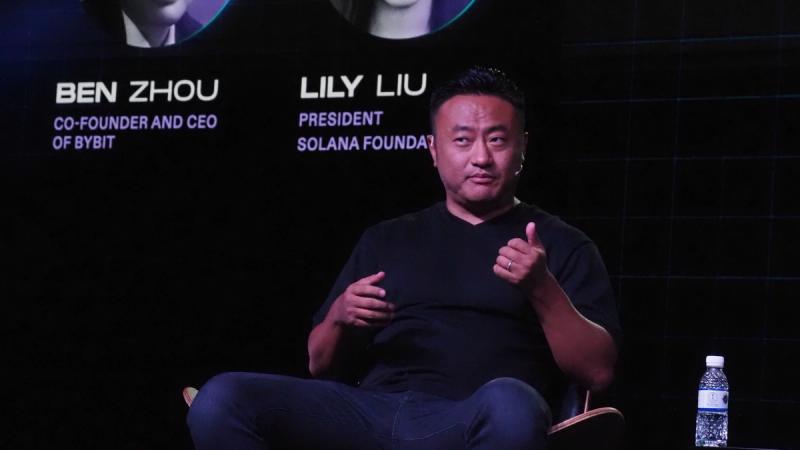
Bybit is considering a partnership with an established U.S. financial company as it evaluates entering the world’s largest economy, CEO Ben Zhou said. The cryptocurrency exchange would prefer to work with a firm that already has a substantial American customer base but has not yet entered the digital-asset market.
Zhou cited Interactive Brokers as an example of the type of partner Bybit could consider. According to CoinDesk, he said partnerships are part of Bybit’s usual method for entering new territories, allowing the exchange to combine its crypto infrastructure with an existing company’s local reach and regulatory knowledge.
“It’s best at this stage to work with a partner who wants to enter the crypto field and who already has a client base in the U.S.,” Zhou said in an interview. He named “IB or one of those guys who haven't gone into crypto and have a good U.S. base” as possible examples.
A cautious route into the U.S. market
Bybit is the second-largest cryptocurrency exchange by trading volume, according to the source material, and has more than 80 million registered users across over 180 countries and regions. The company has been accumulating licenses internationally as it prepares to offer a broader selection of regulated products.
A U.S. partnership could provide an alternative to building a nationwide operation independently. Crypto businesses seeking to operate across the country may need to navigate a complex framework involving state-level money-transfer licensing. The process can include separate applications and requirements in different jurisdictions.
Zhou estimated that pursuing licenses state by state could take two to three years. He contrasted that prospect with waiting for greater clarity from the proposed Clarity Act and for a clearer understanding of the future regulatory structure. He also raised the possibility that the Securities and Exchange Commission could eventually become the main federal regulator, creating a system with one federal license covering the country.
Bybit has not yet attempted to establish a U.S. presence. Zhou said that this absence could benefit the exchange because it has what he described as a “completely clear record” in the country. Rather than entering quickly because competitors are expanding, he said Bybit would prefer to wait for a suitable regulatory and commercial moment.
The strategy reflects the difficulty of competing in a market where cryptocurrency exchanges and retail-investing platforms already have significant visibility. Zhou described the U.S. as large and important, but also highly competitive and saturated. He pointed to Coinbase’s established position and Robinhood Markets’ growing importance as examples of the challenge facing a new entrant.
Bybit also examining the U.K.
The United States is not the only market under review. Bybit is also examining the United Kingdom, which Zhou described as attractive because competition among global crypto exchanges is less concentrated than in some other regions.
Coinbase is probably the leading player in the U.K., according to Zhou, while no global exchange has established a dominant position there. That could create an opening for Bybit, although the company expects the cost of entering the market to be high—potentially comparable to the effort required to obtain a license under the European Union’s Markets in Crypto-Assets, or MiCA, framework.
“The U.K. is looking towards a new regime for crypto, and none of the global exchanges are dominant there,” Zhou said. “So from a preliminary look, it seems like a very untapped market. But again, the cost to enter is very high and would almost take the same effort as a MiCA license in the EU. But we're looking into it.”
Earlier in the year, Zhou was invited to meet government-linked bodies, including the Financial Conduct Authority and members of the House of Lords. Bybit is considering a London office but has not decided on its location, he said.
The company is also planning an “everything app” in Europe, with derivatives and tokenized stocks expected to be deployed as early as the first quarter of next year. The planned expansion shows how Bybit is seeking regulated products and broader financial functionality while deciding where its next major market entry should take place.
Moneyiar market picture
Moneyiar data at the stated times showed mixed performance among the four tracked crypto assets:
- AKEDO (AKE) was priced at $0.0312714921 at 23:08 on October 22, 2026, up 29.44% over 24 hours but down 5.6% over seven days.
- ONEchain (ONE) stood at $0.1013518567 at 23:09, down 1.86% in 24 hours and 4.88% over seven days.
- Ampleforth (AMPL) was $1.1879343932 at 23:09, down 2.21% over 24 hours but up 12.23% over seven days.
- Amp (AMP) traded at $0.0007776543 at 23:09, falling 4.84% over 24 hours while gaining 15.78% over seven days.
These figures are Moneyiar market data and represent the quoted prices and percentage changes at those times, rather than a measure of Bybit’s prospective U.S. expansion.




