
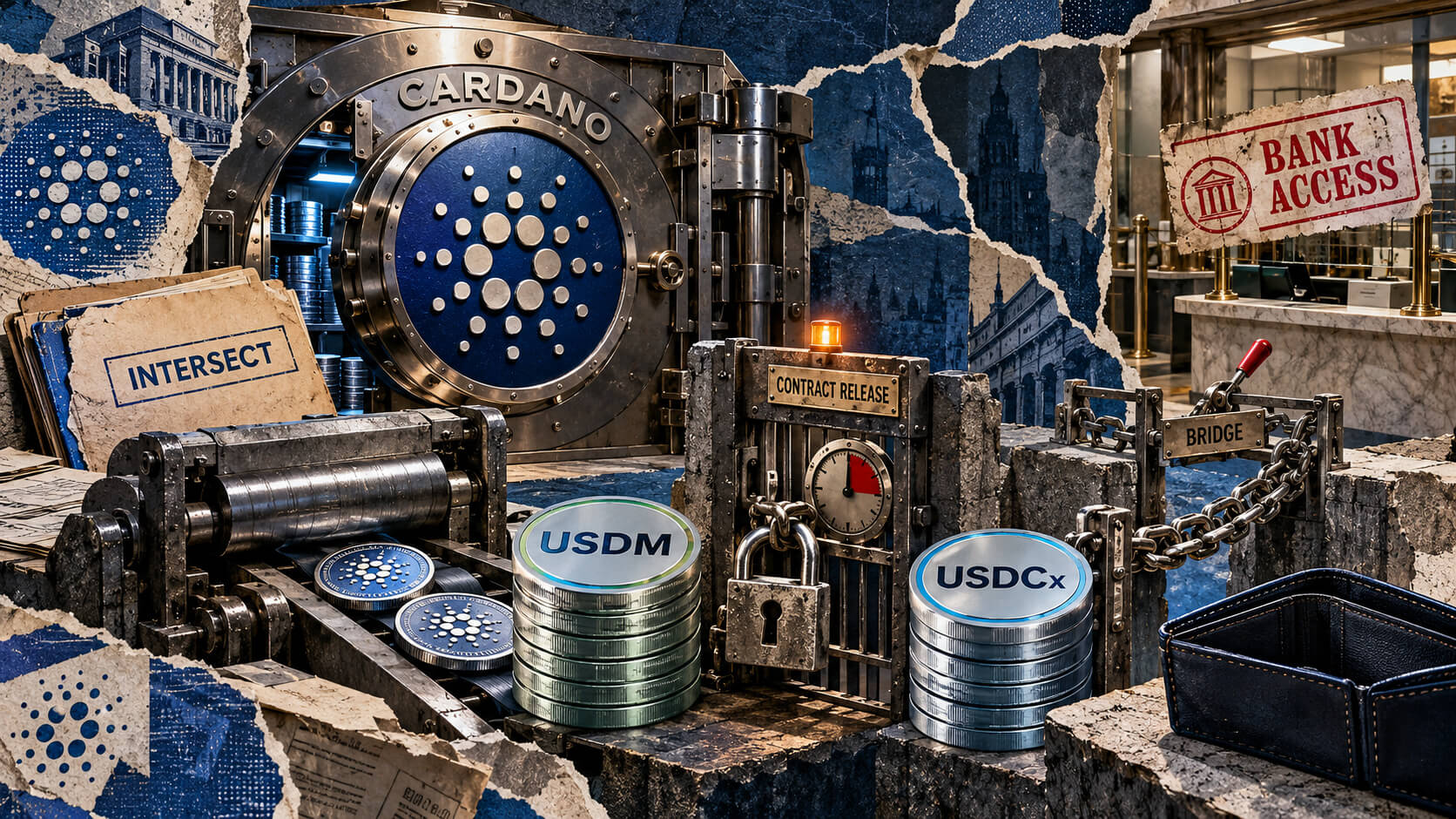
Some Cardano development funding is now held in dollar-denominated tokens rather than ADA, changing how the value and availability of approved project budgets should be assessed. According to CryptoSlate, treasury-administered programs include sizeable allocations in USDM and USDCx, although conversion into a stablecoin does not automatically mean recipients can withdraw conventional dollars.
Cardano’s development budgets use several currencies
The SundaeSwap treasury dashboard lists scheduled funding of 4,505,955 USDM for Intersect’s governance and technical stewardship work, alongside 316,253.88 USDM for Se7en Labs’ Daedalus wallet program. Intersect said on Oct. 2 that both withdrawals had been minted through Moneta Digital into USDM, a Cardano-based dollar stablecoin, and placed in live smart contracts.
The USDM amounts remain fixed in token terms as ADA moves. Their purchasing power, however, depends on USDM maintaining its dollar peg, payments being released and recipients having an eligible way to use or redeem the tokens. The two schedules extend into 2027: Intersect’s runs through July 29 and Se7en’s through Sept. 29.
Intersect said in an Oct. 9 update that its 2026 Treasury Reserve Smart Contract had administered 201.67 million ADA, 26.1 million USDCx and 4.8 million USDM. Those figures measure cumulative administration, not necessarily current reserve holdings, funds sitting in vendor contracts or money already spent.
ADA-denominated commitments remain part of the treasury portfolio. The dashboard lists a 525,000 ADA budget for TxPipe’s Pallas Rust libraries project and 4,947,757.56 ADA for Hydra. In those cases, the value of the budget remains directly exposed to movements in ADA.
The choice of stablecoin also involves conversion conditions. Intersect’s election terms place execution-rate, spread, slippage and related conversion risks on suppliers. Suppliers may convert in batches and bear the risk of the exchange rate and number of tokens received. Once a coin is selected for a statement of work, the amount actually converted determines the portion insulated from later ADA price changes.
Release, acceptance and withdrawal are different events
A scheduled budget should not be treated as immediately usable cash simply because it has been approved or denominated in dollars. Se7en’s first payment of 63,188.312 USDM was marked withdrawn on Oct. 12. Its initial acceptance requirement was a signed contract, and no evidence submission was required for that milestone.
Later maintenance payments have separate acceptance conditions. In an Intersect project snapshot retrieved Oct. 16, three payments dated Sept. 29 were marked unlocked while showing no milestone evidence submitted. That status alone does not prove that work was not completed: a withdrawal transaction, acceptance of deliverables and availability under a smart contract answer different questions.
Intersect’s published milestone policy generally calls for acceptance evidence and invoices, with payment dates usually set 30 days after milestone completion. At the same time, the smart-contract framework is described as “fail-open,” meaning unpaused payments may become available through time-based release even if administration or oversight does not take place.
The framework allows administrators to pause payments, subject to leadership review, while executive approval governs resumption after problems are addressed. Contractual evidence requirements and automated release rules therefore operate in parallel.
Se7en’s project page adds a specific control: withdrawals can only go to destinations included on an on-chain allowlist. The contract configuration for a particular stablecoin deployment also determines permissions, signer thresholds and the treatment of paused or expired funds. These controls can affect when and where an otherwise approved payment can move.
USDM and USDCx have separate routes to dollars
USDM holders still need an eligible route from the token to bank money. Under Moneta Digital’s terms, direct US-dollar redemption requires a Moneta account and identity, anti-money-laundering and sanctions checks. Moneta’s availability page lists direct access for residents of 20 licensed US states and directs users in most other countries to Norwegian Block Exchange, or NBX, subject to eligibility and operating policies.
NBX’s terms distinguish between NBX-issued USDM and Moneta-issued USDM. For Moneta-issued tokens, NBX’s facilitation of redemption is discretionary, and settlement must wait for Moneta to provide corresponding cleared US dollars before NBX funds it. A recipient’s account, location and the issuer-specific redemption route can therefore determine whether USDM becomes usable bank currency.
USDCx follows a different process. Circle described the Cardano token as separately issued and fully backed by USDC held in its xReserve. The conversion process involves depositing and burning USDCx, followed by the release of native USDC on Ethereum. IOG’s launch documentation also describes supported exchange routes involving USDC on Base.
The relevant portal terms estimate a normal burn conversion at roughly two to four hours, including 400-block finality and attestation processing. Circle, IOG and Midgard can each pause the bridge, while Circle may delay or deny reserve release for compliance, security or operational reasons. The terms say IOG and Midgard cannot freeze, reverse or redirect user funds through contract updates.
After USDC is received, dollar redemption or an exchange withdrawal remains a separate step. Circle’s USDC terms outside the European Economic Area require an eligible Circle Mint account in good standing for direct redemption.
Current market picture
Moneyiar market data recorded at 21:59 on Oct. 17, 2026, put ADA at $0.2163304343, down 3.85% over 24 hours and 14.47% over seven days. USDC was at $0.9997656066, down 0.01% over both periods, at 21:58.
The data also showed STABLE at $0.0254595271, down 2.8% in 24 hours and 6.56% over seven days, while MON was $0.0214908547, down 5.72% over 24 hours and 15.03% over seven days. These figures do not establish the value or redemption status of any particular treasury allocation.
For Cardano funding, the key distinction is now between ADA-denominated commitments and tokens whose value is intended to track the dollar. The latter reduce direct exposure to ADA after conversion, but payment releases, contract controls, acceptance status, account eligibility and the final redemption route still determine how much approved funding recipients can actually use.




