
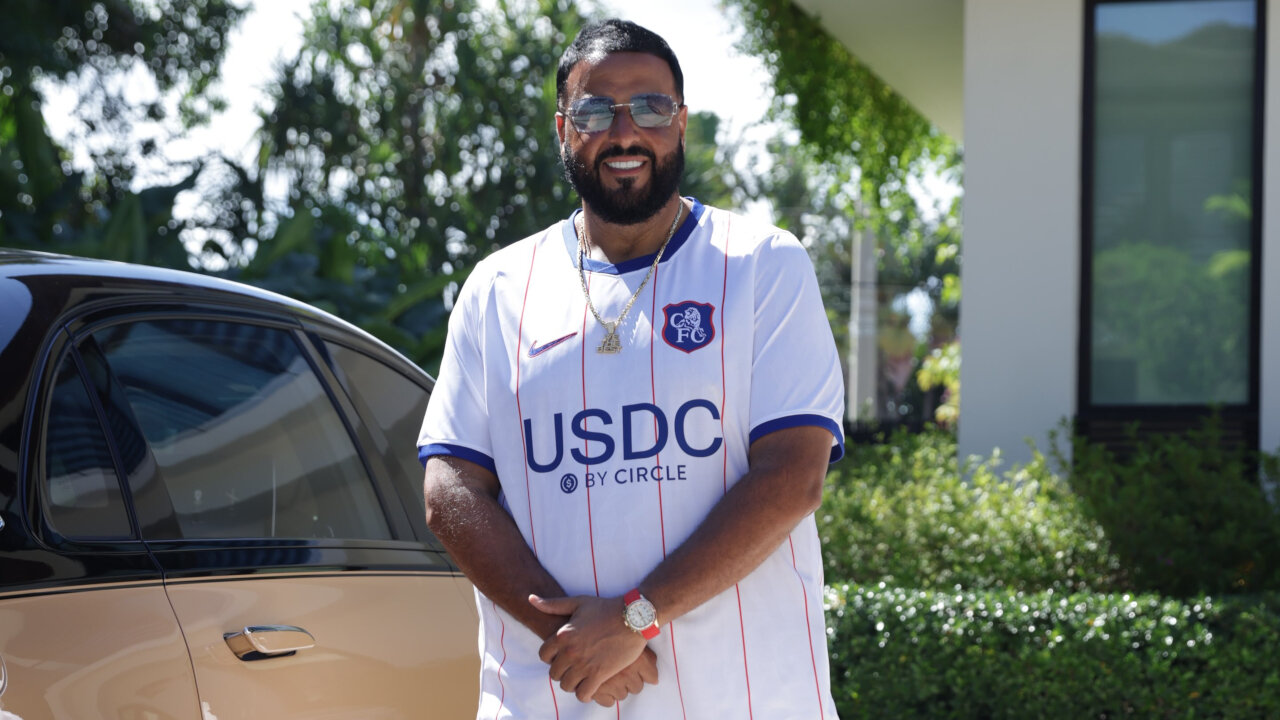
Circle’s USDC account has triggered a wave of criticism after welcoming DJ Khaled to “team USDC” in a post on X, reviving scrutiny of the rapper’s earlier involvement in a cryptocurrency promotion that led to action by the U.S. Securities and Exchange Commission.
The post showed Khaled wearing a Chelsea football shirt bearing the words “USDC by Circle” across the front. Its caption, “Another one,” referenced Khaled’s familiar catchphrase. Around four hours later, Circle chief executive Jeremy Allaire reposted the image and wrote: “DJ Khaled welcome to team USDC.”
Neither post said that Khaled had become a paid ambassador, announced a sponsorship agreement or disclosed any payment. According to Decrypt, the exchange appears to be connected to Chelsea Football Club rather than a newly announced direct promotional arrangement between Circle and the rapper.
Why the post caused an immediate reaction
Circle is Chelsea’s official front-of-shirt partner, meaning its USDC branding appears on the club’s main playing shirts. Khaled has also been associated with Chelsea through a separate relationship involving Roc Nation, which the club announced in May. The source material describes his appearance in that context as a promotional stunt.
That background suggests the photograph may have been a light-hearted reference to the club’s existing commercial links, rather than confirmation that Circle had hired Khaled to promote its stablecoin. Still, the wording of Allaire’s post was enough to prompt a strong response from crypto users familiar with Khaled’s history.
USDC is a stablecoin issued by Circle. Unlike cryptocurrencies whose prices can fluctuate widely, a stablecoin is designed to maintain a relatively stable value against a reference asset such as the U.S. dollar. Because of that positioning, associations with celebrity promotions can attract particular attention when they bring earlier crypto marketing controversies back into the conversation.
Several users criticized Circle on X. Joseph Schiarizzi asked why the company would work with someone who had paid more than $150,000 in fines to the SEC over the failure to disclose compensation received for promoting an initial coin offering, or ICO. Other posts used sarcasm to point to celebrities who have also faced regulatory scrutiny over crypto promotions.
The Centra promotion behind the criticism
The controversy dates to Khaled’s promotion of Centra Tech’s cryptocurrency project in 2017. At the time, Khaled had 12.4 million Instagram followers. He posted a photograph of himself with a Centra Tech debit card, described it as “the ultimate winner in Cryptocurrency debit cards” and urged followers to obtain the project’s CTR tokens.
According to the SEC’s order, Centra paid Khaled $50,000 for the post. He did not disclose that it was a paid promotion. The SEC later said that people promoting an investment in exchange for compensation must disclose that relationship so audiences can distinguish advertising from an independent opinion or recommendation.
CTR was sold through an ICO, a fundraising method in which a project offers its own digital tokens to the public. The SEC said Centra’s claimed Visa and Mastercard partnerships were fictitious and that the company’s supposed chief executive, “Michael Edwards,” did not exist. Centra raised more than $25 million.
The company’s founders faced criminal consequences. Robert Farkas pleaded guilty and received a sentence of one year and one day, while Sohrab Sharma received an eight-year sentence and was ordered to forfeit $36 million. The story was later featured in Netflix’s documentary “Bitconned.”
Khaled settled with the SEC and paid the fine. The source material emphasizes that he was not charged with fraud by either the SEC or the U.S. Department of Justice; his case concerned the undisclosed payment for the promotion. His two-year agreement not to accept payment for promoting securities expired on November 29, 2020.
What the posts do—and do not—show
The available posts do not establish that Circle has entered into a paid endorsement deal with Khaled. They also do not show that he is taking an ambassador role or receiving compensation for promoting USDC. The reaction therefore rests largely on the symbolism of the image and the wording used by Circle’s leadership, rather than on a disclosed commercial contract.
That distinction has not stopped crypto commentators from revisiting past cases involving celebrity marketing. One pseudonymous commentator sarcastically suggested that Circle should next sponsor Kim Kardashian, citing her own regulatory case. In 2022, the SEC ordered Kardashian to pay $1.26 million in penalties, disgorgement and interest after she promoted EthereumMax on Instagram without disclosing a $250,000 payment.
The episode illustrates how quickly old controversies can resurface in digital-asset markets, particularly when established financial companies use celebrity-facing social media. For now, Circle’s public interaction with Khaled appears to be a playful post connected to Chelsea’s commercial relationships, not a formally announced USDC sponsorship.
Moneyiar market picture
Moneyiar market data at 10:23–10:24 on October 7, 2026, showed USDC at $0.9998317773, up 0.01% over 24 hours and down 0.01% over seven days.
Other listed assets were weaker:
- Ailey (ALE): $0.2688154604, down 0.36% in 24 hours and 0.17% over seven days.
- Notcoin (NOT): $0.0004597468, down 7.19% in 24 hours and 7.63% over seven days.
- Prom (PROM): $5.7121982278, down 7.34% in 24 hours and 10.7% over seven days.
The market figures describe price movements at the stated time and do not establish any link between those moves and the social-media controversy.




