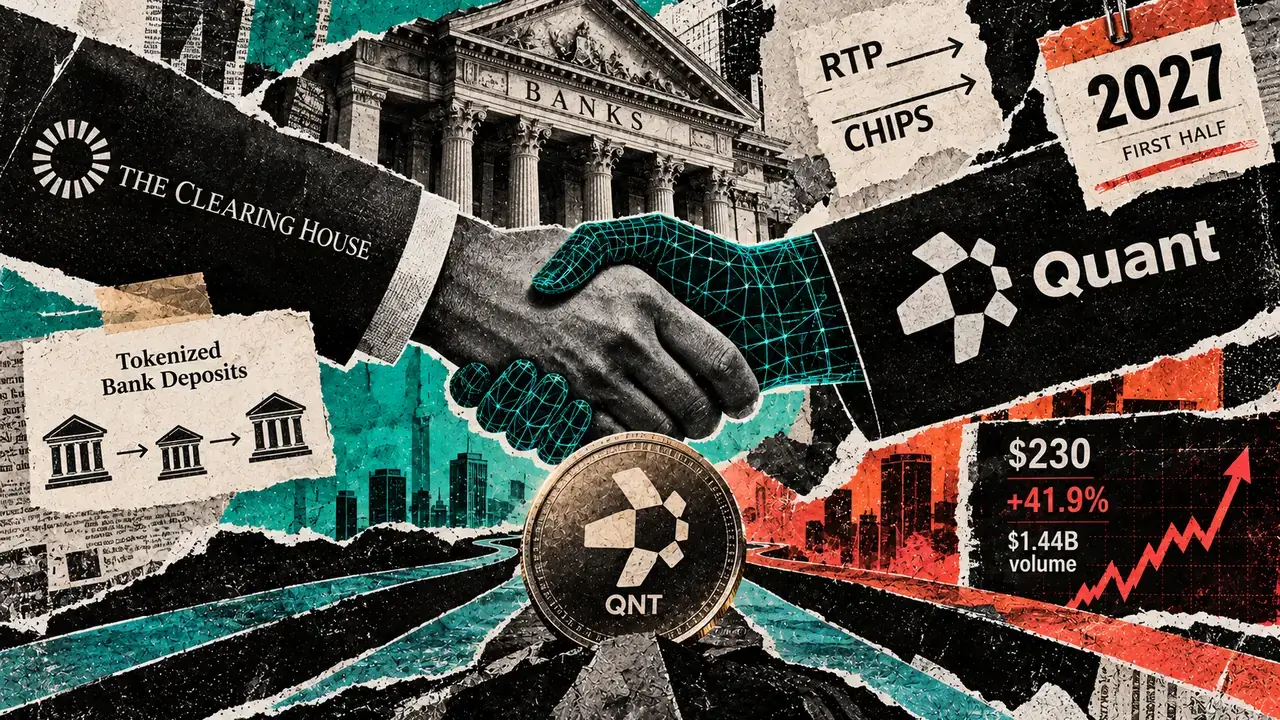
The Clearing House has selected Quant to provide interoperability and transaction software for a planned network that will allow participating US banks to clear and settle tokenized commercial-bank deposits. The arrangement gives Quant a role in the infrastructure, but the announcements do not establish that banks will need to buy, hold or use Quant’s QNT token.
The bank-owned payments operator announced the selection on September 24. The planned network is part of The Clearing House’s On-Chain Money Initiative, introduced in June to connect tokenized bank deposits with existing payment infrastructure. The service is expected to become available to participating institutions in the first half of 2027.
According to CryptoSlate, the deal leaves several commercially important details undisclosed, including which banks will participate, expected transaction volumes and the revenue Quant could generate from the service.
Quant’s role in the planned network
Quant is expected to supply the technology layer that connects systems, coordinates activity and manages transactions. Its software is also intended to link the tokenized-deposit network with The Clearing House’s existing RTP and CHIPS payment systems.
Quant described the offering as Tokenized Deposits-as-a-Service for US institutions using The Clearing House that do not have their own capability to issue or manage tokenized deposits. The announcements do not say that the network has begun operating, and they do not identify banks that have subscribed to Quant’s additional service.
The initiative is designed to support transfers between on-chain and conventional financial infrastructure. The Clearing House says it aims to enable immediate settlement and payments that are triggered when agreed conditions are met.
A tokenized bank deposit differs from a publicly issued stablecoin. It remains a claim on the commercial bank that issued it, rather than a separately issued digital asset. The planned network would therefore focus on representing and moving bank money across participating institutions while connecting that activity to established fiat payment systems.
The Clearing House said its existing wire, ACH, check-image and real-time-payment networks clear and settle more than $2 trillion each day. The September announcement did not specify how much activity would move through the new tokenized-deposit network.
Why the deal does not yet prove demand for QNT
Quant’s general terms describe QNT as a utility token that customers may use for Quant products and services. However, neither The Clearing House nor Quant has said that participating banks must acquire or hold QNT, pay network fees in the token, use it as a settlement asset or remove it from circulation through a token-burning mechanism.
The announcements also do not set out a rule requiring a bank to purchase or lock up QNT when it transfers a tokenized deposit. That distinction matters because Quant could earn software or service revenue from the project without creating a direct requirement for customers to buy the token.
Quant’s published payment information says fees can be agreed during the ordering process, displayed through a subscription dashboard or included in an order form. Fees may be paid monthly or annually in advance, with additional invoices possible when usage exceeds an agreed amount. The company also allows card payments and invoices where it agrees to those methods.
Quant’s frequently asked questions state that platform fees can be paid in US dollars or through subscriptions using QNT. This leaves fiat payment as a possible route and does not establish that the token is required for the bank network.
An older 2022 description of Quant’s Overledger platform provides additional context, saying transactions on that interoperability service are powered by QNT while corporate customers may pay in fiat currency. Overledger is Quant’s technology for connecting different ledgers, but that explanation predates the 2026 selection. The latest announcements do not say whether the same token mechanism will apply to the tokenized-deposit implementation.
Market picture
Moneyiar market data recorded QNT at $97.1850433619 as of September 25, 2026, at 22:04 +03:30. The token was up 8.56% over 24 hours and 53.02% over seven days at that time.
The source material separately reported that QNT reached an intraday high of $373 on September 27 before falling to an intraday low of $195.35 on September 28 and rebounding. Those figures are not the same timestamp as the Moneyiar data and should not be treated as a single market snapshot.
For the new network to support a defensible estimate of future QNT demand, more information would be needed: a project-specific rule for token use, the applicable fees or conversion process, expected or observed transaction volumes and clarity on which participants would obtain the tokens. Until those details are disclosed, Quant’s selection confirms a role in planned bank-payment infrastructure but does not establish how, or whether, activity on that network will translate into demand for QNT.