
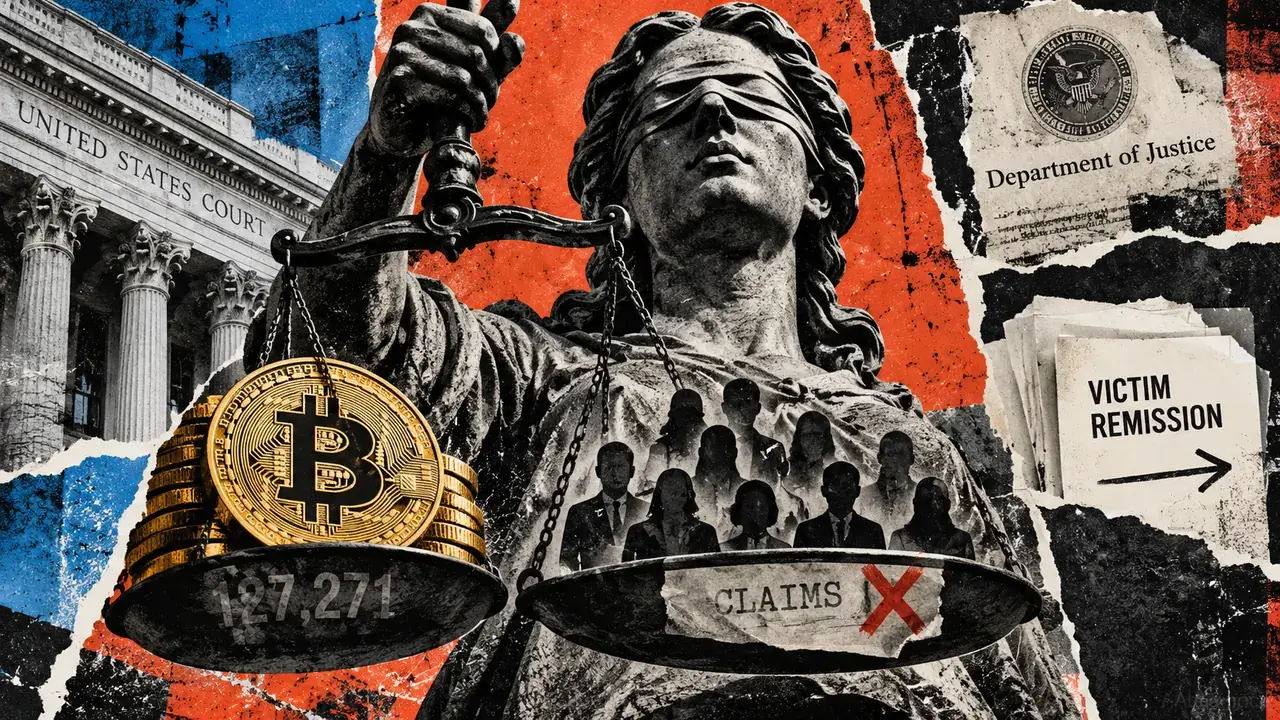
A US federal judge has blocked nine alleged fraud victims from contesting the forfeiture of approximately 127,271 Bitcoin held by the government, finding that they did not plausibly show their missing funds were among the coins seized. The Sept. 25 ruling leaves a possible, but separate, route through the Justice Department’s victim-remission process if the government ultimately wins the forfeiture case.
Why the claims failed
Judge Rachel P. Kovner of the Eastern District of New York struck the timely claims filed by Ath Leepinyo and Connie Wilson. She also refused seven other claimants permission to submit filings after the applicable deadline. The court concluded that all nine lacked Article III standing, the legal requirement for a person to demonstrate a sufficient interest to challenge a case in federal court.
The dispute concerns a civil forfeiture complaint filed on Oct. 14, 2025. The US Department of Justice said at the time that the Bitcoin was in government custody and alleged that it was connected to fraud and money laundering involving Prince Holding Group, a Cambodian conglomerate, and its chairman, Chen Zhi.
According to CryptoSlate, the claimants argued that they were victims of fraud and should therefore be allowed to challenge the government’s effort to take the cryptocurrency permanently. But the judge distinguished between suffering a financial loss and proving ownership of the particular property named in a forfeiture action.
In the court’s view, the allegations established no more than the position of general unsecured creditors: people who may have a claim for compensation but not a qualifying ownership interest in the specific Bitcoin wallets under seizure. A loss caused by an alleged fraud, without a plausible link to the coins held by the government, was not enough to establish standing.
The order noted that a constructive trust could, in some circumstances, give a claimant an equitable ownership interest in property derived from that person’s assets. Such an interest could support standing in a forfeiture case. However, none of the nine claimants plausibly described the necessary connection between their funds and the seized Bitcoin.
One claimant, Lawrence D. Van Dyn Hoven, relied on an investigator’s belief that his stolen cryptocurrency was included in the seizure. Judge Kovner found that the filings did not provide supporting facts explaining why that belief was justified.
Remission may provide another route
The ruling does not determine whether the claimants suffered losses or whether they can receive compensation. Instead, it resolves whether these nine people may contest the forfeiture based on an ownership interest in the specific assets.
The judge pointed to victim remission as a possible alternative if the government succeeds in forfeiting the Bitcoin. Remission is a Justice Department process through which eligible victims may petition for recovery from forfeited property, even when they do not currently hold an ownership interest in the assets themselves.
Eligibility is not automatic. Under 28 CFR 9.8, a petitioner must document a specific financial loss directly caused by the offense underlying the forfeiture, or by a related offense, and must meet additional conditions. The petitioner must not have knowingly participated in or benefited from the offense, or acted with willful blindness.
Applicants must also show that they have not already been compensated and that they lack reasonably available alternative assets from which to recover the loss. These requirements mean that documented harm alone does not guarantee a payment.
If the forfeited property is insufficient to satisfy approved petitions in full, recognized victims may receive proportionate shares. Recovery is also limited to a victim’s share of the associated net forfeiture proceeds. As a result, the quantity of Bitcoin involved in the case does not itself promise full repayment to every eligible claimant.
The Sept. 25 order therefore closes the standing issue for these nine claimants, while leaving any potential remission request dependent on two later steps: a successful government forfeiture action and a separate discretionary decision on a petition documenting an eligible loss.
Current crypto market picture
Moneyiar market data at 09:44 on Oct. 1, 2026, showed Bitcoin at $83826.598211553, up 0.39% over 24 hours and 0.83% over seven days. The figures provide a market snapshot but do not indicate the value or eventual recovery available in the forfeiture case.
Other assets in the Moneyiar data were mixed:
- Chainlink was $14.3157665038, down 0.5% over 24 hours and up 17.54% over seven days.
- Sei was $0.0730057603, down 1.93% over 24 hours and up 27.14% over seven days, according to data recorded at 09:43.
- Walrus was $0.0344375331, up 0.3% over 24 hours and 7.1% over seven days.
The market figures are separate from the court’s legal findings. The central issue in the ruling was not Bitcoin’s trading price, but whether the claimants could connect their alleged losses to the particular wallets seized by the US government.




