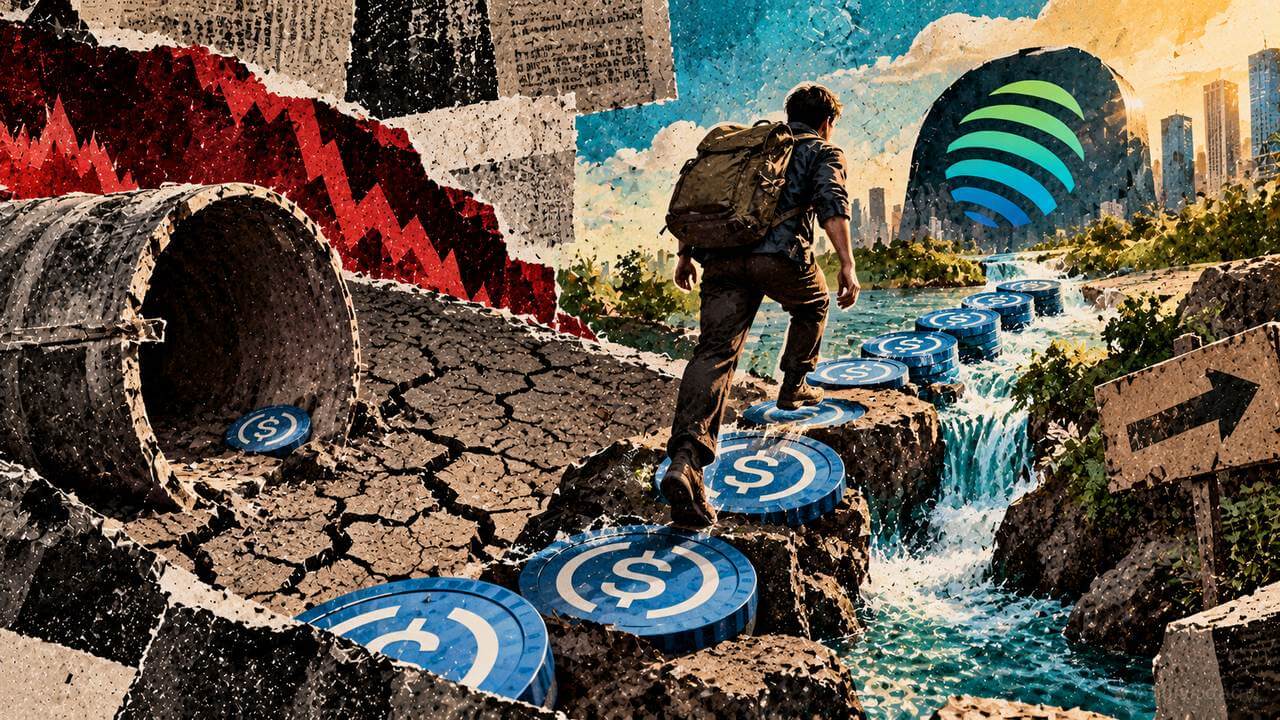
Crypto companies are entering a new phase: after years spent building blockchain infrastructure and financial products, they now need to persuade consumers and institutions to use those products regularly. According to CoinDesk, the industry’s central question is shifting from whether a product can be built to why customers would choose it, trust it and keep returning to it.
The issue is emerging as tokenized funds, crypto lending, payments and institutional blockchain services move closer to traditional finance. For firms developing these products, technical capability is no longer enough. They must connect with familiar financial needs, provide a straightforward user experience and create reasons for customers to keep assets on their platforms.
From blockchain technology to everyday finance
Coinbase is focusing on what customers want to do with money rather than on the blockchain technology operating behind a service, said Ben Shen, the company’s head of financial services and loyalty products. Those needs include growing wealth, holding funds, sending and spending money, or borrowing against assets.
Shen said the crypto sector has often been heavily focused on technology, with products that exposed users to specialist language and the systems beneath them. As crypto services begin to overlap with conventional financial products, he argued, the underlying blockchain may matter less to customers than the practical result.
Coinbase is looking for what Shen describes as “magic moments” — points at which a customer quickly understands the value of a product. But an initial trial does not necessarily translate into sustained use.
The company views adoption as a cycle. Money first comes onto its platform, customers then receive a reason to leave it there, and they are given ways to use it. Examples could include receiving a paycheck or making a deposit, earning rewards while holding assets, and eventually spending, trading or making payments.
Rewards can help begin that process. Some are built into a product, while others are temporary incentives intended to persuade customers to move money from an existing service. Shen said such offers can help “break inertia.”
The longer-term objective, however, is not simply to attract funds until a promotion expires. Coinbase’s expectation is that customers who arrive for a yield incentive may discover other uses for the same assets, including trading or spending. In that model, an incentive is an entry point, while continued activity depends on the product proving useful.
Institutions want evidence of adoption
The same concern applies to blockchain networks seeking institutional business. Kevin O’Leary, the Shark Tank investor and chairman of O’Leary Ventures, said at the Avalanche Summit in New York last month that networks must demonstrate that companies are using them.
“Show me adoption,” O’Leary said, describing the demand facing blockchain projects. He said the technical case for a network may already be clear to technologists and large companies building capacity, even when transaction volumes are not yet substantial. But institutional customers also want actual commercial deals and adoption rather than tests alone.
O’Leary added that one significant customer could make it easier for a network to win another. In his view, competitors’ recommendations are among the most powerful ways for technology to gain credibility.
Trust is also important on the consumer side. Shen said financial services involve people handing over money, and in some cases their paychecks and savings. As a result, hearing that another person has used a service successfully can influence whether a potential customer is willing to try it. This “social proof” can help determine whether experimentation develops into a lasting relationship.
Distribution becomes part of the product
Another route to adoption is to make products available through platforms customers already use. WisdomTree, the $150 billion asset manager, has created a group of tokenized funds. One of them, WTGXX, is a tokenized money market fund with about $1.2 billion in assets, according to Will Peck, WisdomTree’s head of digital assets.
WisdomTree is seeking broader distribution rather than requiring customers to access the funds only through its own channels. Peck said the company wants customers to be able to reach its products through different front ends while still accessing WisdomTree’s funds.
The firm recently announced a collaboration with MoonPay that will allow eligible U.S. retail customers to access WTGXX through MoonPay’s platform. Customers who have already supplied their information to MoonPay can buy the fund using stablecoins without completing a separate onboarding process with WisdomTree, Peck said. MoonPay is not intended to be the only distribution channel for the tokenized funds.
Coinbase is similarly considering routes beyond its own platform. Shen said companies are likely to maintain their own apps and websites while also distributing products through additional channels. Third-party artificial-intelligence tools could become one such route: Coinbase is working on ways for its services to connect with external AI tools, although those products and integrations are still being developed.
Moneyiar market picture
Moneyiar data at 9:33-9:34 a.m. on Oct. 5, 2026, showed mixed performance among the listed assets:
- Nexus (NEX) was priced at $0.0000008249, down 0.58% over 24 hours and up 1.49% over seven days.
- ECOMI (OMI) was priced at $0.0003250913, up 2.94% over 24 hours and 44.04% over seven days.
- RedStone (RED) was priced at $0.1722740707, down 2.62% over 24 hours and up 7.18% over seven days.
- ConstitutionDAO (PEOPLE) was priced at $0.0089550966, up 1.61% over 24 hours and 2.53% over seven days.
These market movements do not resolve the industry’s adoption challenge. The companies and networks described above are trying to show that blockchain-based services can become useful, accessible and trusted parts of financial activity rather than products used only for an initial test.