
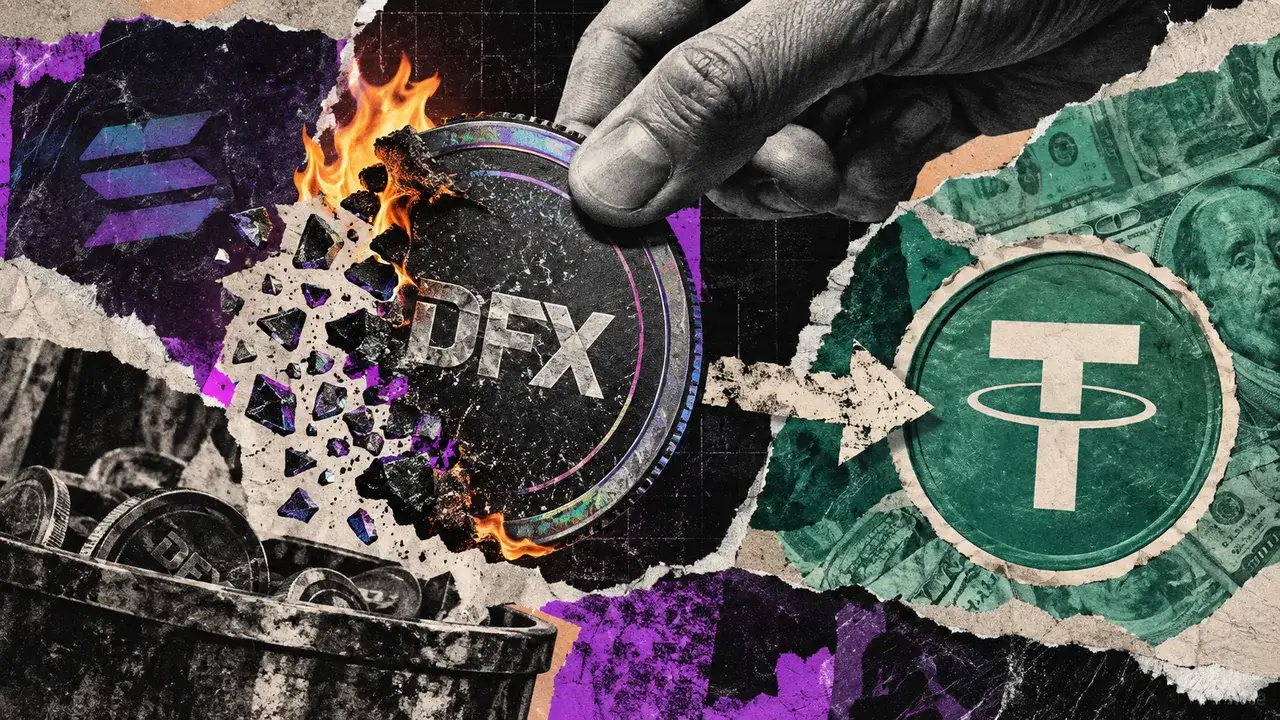
Drift Protocol has opened claims and redemptions for DFX, the recovery token created for users affected by the platform’s April exploit. The first redemption rate was about 0.0104 USDT per DFX, meaning victims could initially receive roughly 1.04 cents for each dollar of verified loss.
The claims process began on October 1 and pays eligible users from Drift’s Recovery Pool in USDT, a stablecoin designed to track the value of the US dollar. According to CryptoSlate, the pool held approximately 3.1 million USDT when the process opened.
DFX is issued on Solana and is separate from DRIFT, Drift Protocol’s governance token. The recovery token is allocated in proportion to verified losses: one DFX for each USDT of approved loss. Drift has set the total allocation at 299,500,810.998 DFX, corresponding to nearly 299.5 million USDT in verified losses.
The initial rate is not a fixed payment guaranteed for the entire claims period. Drift’s dashboard calculates the redemption price by dividing the pool’s balance by the amount of DFX still outstanding. As a result, the amount received can differ from the opening figure when a holder completes a transaction.
Redeeming DFX is permanent
A DFX holder must choose between redeeming tokens now and retaining them for possible future distributions. The redemption transaction sends USDT to the claimant and burns the submitted DFX in the same operation. Drift says the process is designed so that both actions either succeed together or fail together, and completed redemptions cannot be reversed.
Burned DFX no longer participates in future deposits to the Recovery Pool. A holder who redeems only part of their allocation loses future participation for those tokens, while the DFX that remains in the holder’s wallet continues to qualify for later deposits.
This mechanism means redemption fixes the amount payable at the rate displayed when the transaction is made. Keeping DFX preserves the holder’s potential share of future recovery funds, but the amount and timing of those funds are uncertain. Selling DFX through a secondary market, such as Raydium, is different: the tokens move to another holder rather than being exchanged for USDT and destroyed.
Under Drift’s stated design, removing USDT and burning DFX in matching proportions leaves the pool’s redemption ratio unchanged. New deposits, however, increase the amount that can be redeemed by each DFX still outstanding.
Recovery funding depends on future deposits
Drift restated an April support plan that includes up to 127.5 million USDT from Tether for relaunch and user recovery, as well as up to 20 million USDT from strategic partners for recovery. The stated ceilings should not be interpreted as proof that those amounts had already been deposited into the Recovery Pool or were immediately available to claimants.
Tether said in its April 16 announcement that its capital would be introduced progressively and linked to the platform’s performance. Drift’s April recovery framework described several forms of support, including a revenue-linked credit facility, an ecosystem grant and loans for market makers. Those arrangements may support the platform’s relaunch without making the full headline amounts available to DFX holders at once.
Drift said a portion of net protocol revenue from its Velocity trading platform is deposited into the Recovery Pool daily at 00:00 UTC. Recovered stolen funds may also be added. The eventual recovery available to users therefore depends on deposits that actually arrive; the support commitments do not promise that every victim will be made whole.
The DFX claim window closes on January 1, 2028, at 00:00 UTC. Any DFX that has not been claimed by then will be permanently burned. Drift describes this as the deadline for claiming the recovery tokens, while Insurance Fund claims operate under separate terms.
Current market picture
Moneyiar market data recorded at 09:53 on October 5, 2026, put Tether USDt at $0.9997090426, down 0.02% over 24 hours and up 0.01% over seven days.
Other assets in the same data snapshot showed mixed performance. NEAR Protocol traded at $5.0234918478, up 5.29% over 24 hours and 0.58% over seven days. Ethereum Name Service stood at $6.9161128377, with gains of 1.58% over 24 hours and 5.22% over seven days. Rootstock Infrastructure Framework was priced at $0.081516408, down 1.96% over 24 hours and 4.31% over seven days.
These figures are Moneyiar market data at the stated time and describe market prices and changes, not the value or future availability of Drift’s recovery payments.




