
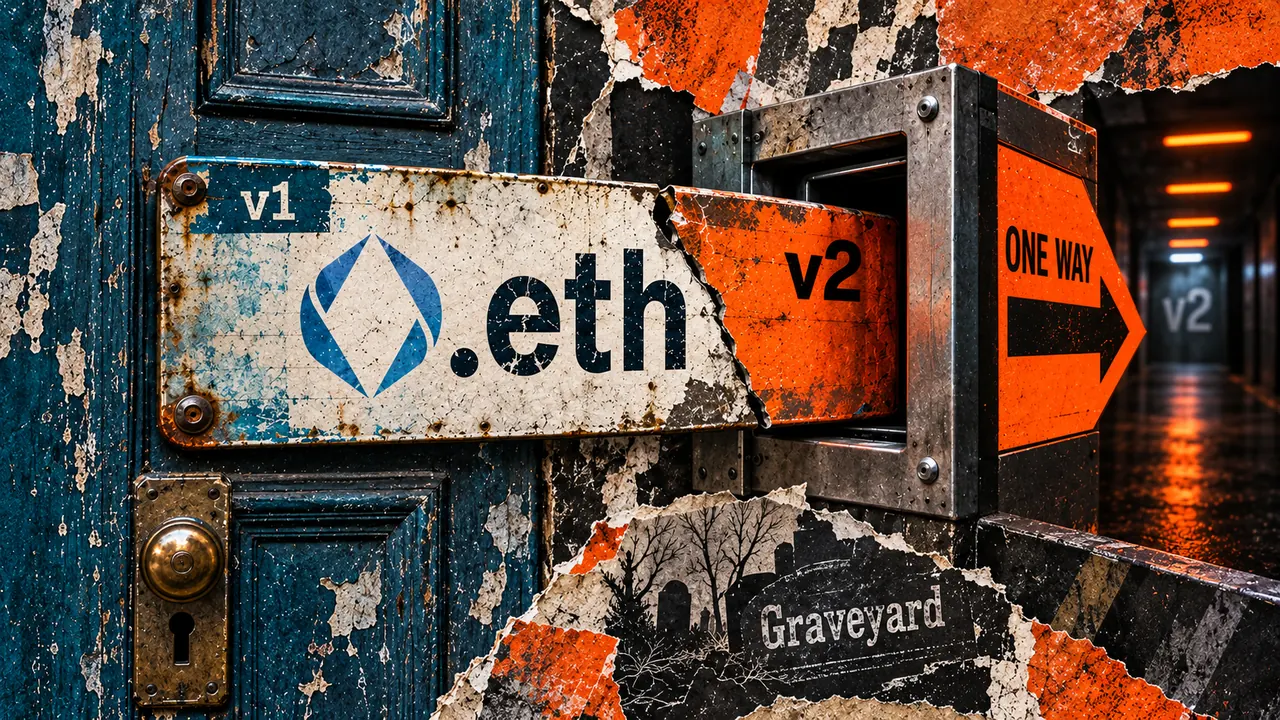
Ethereum Name Service has proposed activating ENSv2, a major redesign of the infrastructure supporting .eth domain names. The plan would allow current holders to keep using the existing system or permanently move their domains to the new one, but the transition would also bring higher fees for some names, stablecoin payments and revised expiry rules.
According to CryptoSlate, the proposal was submitted on Oct. 11 and remained subject to approval by the ENS decentralized autonomous organization, or DAO, as of an Oct. 12 governance bulletin. ENS has not announced a launch date. The DAO’s decision will determine whether the upgrade proceeds and how the transition is managed.
Two systems during the transition
ENSv2 would replace the registration infrastructure introduced in 2017 and would process all new .eth registrations after activation. Existing holders would not be forced to migrate. They could continue using their domains on ENSv1 indefinitely, provided they keep renewing them through a dedicated contract.
The alternative is a permanent transfer to ENSv2. A holder choosing that route would gain access to the new system’s features, but the move could not be reversed. During migration, the existing ENSv1 token would be transferred to a smart contract called the Graveyard. That contract cannot return or transfer the tokens it receives, meaning migrated domains would not be able to go back to the original system.
ENSv2’s proposed structure would allow individual domains to maintain separate registries for their subdomains. This is intended to provide more flexible permission management. For example, businesses and decentralized applications could delegate control over particular names or records without surrendering broader control of the main domain.
The distinction between the two systems matters because users who remain on ENSv1 would preserve access to their names and retain the existing 90-day grace period after expiration. Migrated names, by contrast, would be subject to the new expiry framework.
Fees, payments and expiry rules
The proposed pricing changes would affect some registrations but not others. Annual fees for names containing five or more characters would rise 60%, from $5 to $8. Prices for three- and four-character names would remain unchanged.
ENSv2 would also offer lower annual costs for longer commitments. Users registering names for six years or more would receive discounts that reduce the annual cost by approximately 44%, according to ENS’s official guidance.
Another significant change would be the payment method. Registration and renewal fees would be paid in stablecoins, including USDC and DAI, rather than in ETH. Stablecoins are crypto tokens designed to maintain a value linked to a reference asset; in this case, the proposal would keep ENS fees fixed in dollar terms instead of exposing them to changes in ETH’s price.
Expiry arrangements would also be revised for migrated domains. Their grace period would fall from 90 days to 28 days. At the same time, ENS would extend registration expiry dates by 62 days, preserving the original deadline at which a name can become available to another user.
Domains that stay on ENSv1 would continue to receive the 90-day grace period. Names that had already expired beyond that period would not receive reservations in the new registry.
Launch uncertainty and market picture
The activation process could temporarily interrupt new registrations. ENS expects to pause them while developers synchronize existing records and bring the new infrastructure online, a process expected to take several hours. The proposal contains conflicting provisions about whether current holders will be able to renew domains during that window, leaving an operational question unresolved.
Wallets and applications that integrate ENS would also need to update their resolution infrastructure to work with ENSv2. After DAO approval, ENS Labs would complete the final synchronization, activate registration and resolution under ENSv2, and transfer its remaining administrative permissions to the DAO. The timing of those steps remains undecided.
Moneyiar market data recorded at 20:44 on Oct. 13, 2026, showed Ethereum at $2,506.5724408986, down 0.56% over 24 hours and 7.08% over seven days. Other tracked tokens showed mixed performance: Shiba Inu was $0.0000052127, down 2.70% in 24 hours and 9.86% over seven days; Uniswap was $7.5834768638, up 2.67% on the day but down 12.15% over the week; and Pepe was $0.00000419, up 2.21% over 24 hours and down 1.69% over seven days.
ENSv2 therefore remains a proposal rather than an active system. Until the DAO votes and the transition details are clarified, users do not have a confirmed launch date or certainty about renewal access during the planned suspension.




