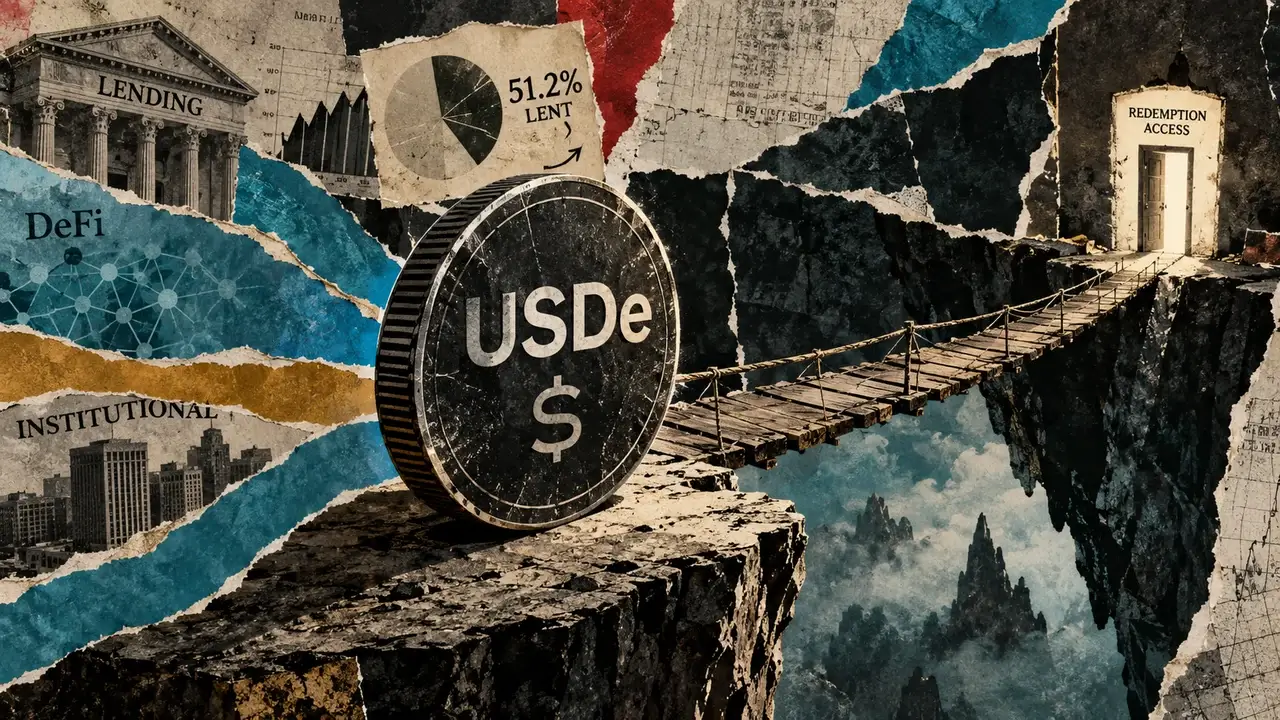
Ethena’s USDe has 51.2% of its reported backing allocated to DeFi and institutional lending, according to an October 12 assessment by risk assessor LlamaRisk. The finding highlights an important distinction for holders: the value of assets assigned to lending is not the same as the amount immediately available for redemption.
LlamaRisk’s snapshot placed 36.9% of USDe backing in DeFi lending and another 14.3% in institutional lending. Together, those categories represented more than half of the backing for the synthetic dollar, which is designed to target a value of $1.
The report put total backing at $4.76 billion against 4.76 billion USDe outstanding. Other allocations included 24.9% in liquid stablecoins, 17.6% in crypto basis positions and 6.0% in real-world assets.
Lending allocation is not the same as immediately available liquidity
The allocation figures describe where backing assets are deployed. They do not show how much borrowers have drawn, how much liquidity is currently available in lending pools or how quickly assets could be returned to the protocol.
For DeFi positions, withdrawal depends on unborrowed liquidity in the relevant market. Under Aave’s rules, a supplier can withdraw only the amount that has not been borrowed from the pool. Morpho markets also require sufficient liquidity before supplied assets can be withdrawn.
Ethena’s lending policy describes reviewed markets with excess collateral, conservative loan-to-value parameters and exposure limits subject to governance and Risk Committee oversight. These measures are intended to reduce losses, but they do not eliminate the timing difference between having collateral and receiving the supplied stablecoins back.
Institutional lending works under a different set of conditions. Ethena describes loans of stable assets backed by collateral worth more than the amount borrowed, including liquid bitcoin and ether. Custody and triparty arrangements, in which an independent agent holds and administers collateral, are intended to protect the protocol’s claim.
The agreements also include counterparty eligibility and aggregate exposure oversight. However, individual commercial terms remain confidential. LlamaRisk’s review framework considers factors such as collateral ratios, custody segregation, enforceable security interests, liquidation rights, recall notice and redelivery periods. Its March review of agreements involving Maple and Anchorage found no material contractual deficiencies, but the public information does not establish an exact timetable for recovering every lent asset.
Redemption access depends on eligibility and execution
USDe holders do not all have the same route to Ethena’s primary redemption facility. Direct redemption is reserved for eligible Mint Users who have completed know-your-customer and anti-money-laundering checks, other onboarding requirements and whitelisting. Holders who do not meet those conditions must generally use secondary markets to exit.
The published terms describe conditional redemption into supported digital assets representing a pro-rata share of reserves, capped at $1 in notional value per USDe and subject to fees and other conditions. This is not the same as receiving dollars in a bank account. Orders also require signed prices and operational acceptance, so a stated redemption mechanism does not guarantee that every requested transaction will be executed immediately.
LlamaRisk’s assessment of the Ethereum contract lists PYUSD, USDC, USDG, USDT, USDm and USDtb as enabled stablecoins, with DAI supported under smaller limits. The report gives an aggregate redemption ceiling of 20 million USDe per block, compared with 200 million for minting, and a 2 million limit in each direction for DAI. These are smart-contract ceilings, not measures of cash available for withdrawal. Ethena can suspend minting and redemption without the controller’s 24-hour wait.
The redemption route is relevant to USDe’s peg mechanism. An authorized participant may buy USDe below its target value in an external market and redeem it for backing assets. That process can help narrow a gap between the market price and the $1 target, but it depends on an eligible participant obtaining an acceptable quote and receiving the assets. Other sellers remain dependent on secondary-market liquidity.
sUSDe withdrawals add another step
Investors holding sUSDe, Ethena’s staking-vault share, face a separate withdrawal process. sUSDe is an ERC-4626 vault share representing a proportional claim on USDe held in the staking contract. Rewards increase the amount of USDe represented by each share, meaning sUSDe itself is not designed to maintain a fixed $1 price.
Ethena’s staking guidance describes a governance-set cooldown of between one and seven days. Technical documentation places pending unstaked USDe in USDeSilo before withdrawal. The published range does not identify the active setting on October 12. Completing unstaking delivers USDe, after which the holder must still consider the liquidity and eligibility conditions that apply to selling or redeeming USDe.
Ethena also maintains a reserve fund intended to absorb negative protocol revenue and backing shortfalls. LlamaRisk’s September assessment valued it at about $62.1 million. That buffer serves a different function from assets ready for immediate settlement. Ethena’s policy says 0% of ongoing protocol revenue is currently allocated to the fund, with revenue directed instead to incentives and promotional distributions; this does not describe the fund’s existing balance.
Moneyiar market picture
Moneyiar market data at 20:49 on October 13, 2026, showed USDe at $0.9996095432, up 0.02% over 24 hours and down 0.02% over seven days. Ethereum was trading at $2,508.7797448209, down 0.51% over 24 hours and 6.99% over seven days. ENA, Ethena’s token, stood at $0.2121174776, down 3.01% over 24 hours and 10.73% over seven days.
The figures underline the difference between USDe’s target price and the practical conditions behind an exit. For holders, the relevant questions are not only the value and quality of collateral, but also available pool liquidity, institutional recall terms, redemption eligibility, accepted orders and, for sUSDe, the active cooldown.