
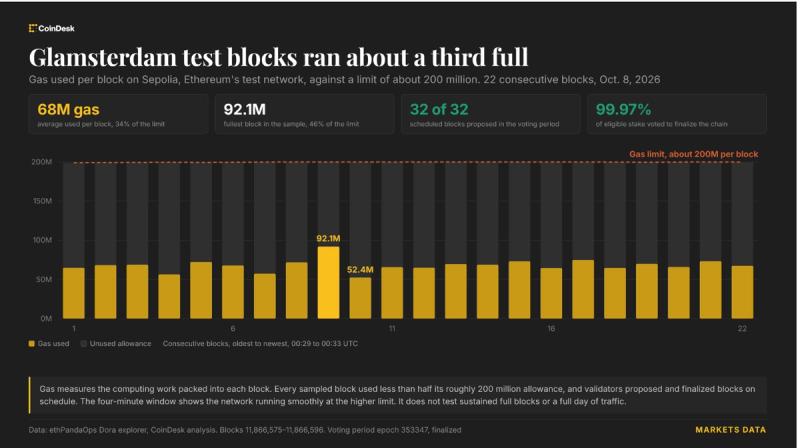
Ethereum developers have begun testing the Glamsterdam upgrade on Sepolia, a public network used to trial changes before they are considered for Ethereum’s mainnet. The rehearsal has increased Sepolia’s block processing limit to nearly 200 million gas, compared with roughly 60 million before the upgrade.
Gas is Ethereum’s measure of the computing work required to process transactions. A block’s gas limit determines how much work can be included in that block. Raising the limit can give the network room to handle more payments and trades before users compete for limited block space, a situation that can contribute to higher fees.
The test does not mean Ethereum can automatically process three times as many transactions. Glamsterdam also changes the gas charges assigned to particular operations, so the increase in the overall budget will not translate directly into a matching rise in transaction capacity.
Early Sepolia results show room below the new ceiling
The upgrade went live on Sepolia on Tuesday, and developers were still monitoring its performance by early Thursday. According to CoinDesk’s review of more than 25 consecutive test blocks, those blocks consumed between about 52 million and 92 million gas apiece. That represented approximately 26% to 46% of the available limit.
None of the sampled blocks came close to using the full allowance. That matters because blocks operating near the ceiling would place the greatest additional demands on the computers that run the Ethereum network. The early results therefore show that the test network has not yet approached the maximum workload created by the new limit, although the trial remains ongoing.
Sepolia uses tokens with no real-world value, allowing developers to test software and network behavior without deploying the changes directly on Ethereum’s live blockchain. A successful rehearsal would not itself activate Glamsterdam on mainnet, where users conduct actual transactions.
Upgrade changes how transaction work is handled
Glamsterdam is not limited to a larger block budget. It also changes the way Ethereum’s computers organize and price parts of transaction processing.
Under the new design, the handoff between specialists that assemble transactions and validators that publish blocks is built into the network’s rules. This is intended to give validators more time to verify the calculations associated with transactions.
Blocks will also include a record of the accounts and stored information touched by their transactions. Software can use that information to retrieve data in advance and check transactions that do not depend on one another at the same time, rather than processing every operation strictly in sequence.
The changes affect the costs of creating and accessing stored data as well. Developers have been told to retest applications that rely on particular gas prices, because assumptions built into those applications may no longer match the upgraded network.
Testnet participation and next steps
During a separate six-minute voting period early Thursday, all 32 scheduled blocks were proposed. Data from testing group ethPandaOps’ explorer showed that 99.97% of eligible Sepolia stake voted toward finality. Finality is the point at which the network treats its transaction history as settled.
The next public test network in the sequence is Hoodi. Its activation is tentatively planned for October 27, subject to the results from Sepolia. Ethereum’s mainnet activation date has not been set, so the current test does not establish when, or whether, the upgrade will be deployed for live users.
The testing is significant because increasing Ethereum’s processing allowance involves a trade-off: more capacity can help accommodate activity, but handling larger blocks also increases the work required from the computers maintaining the network. Glamsterdam’s changes to transaction organization, data access and gas pricing are being evaluated alongside the higher limit.
Current Ethereum market picture
Moneyiar market data at 08:59 on October 8, 2026, showed Ethereum at $2,557.2872618875, down 1.99% over 24 hours and 4.78% over seven days. Shiba Inu was priced at $0.0000053928, down 2.31% over 24 hours and 6.19% over seven days.
Uniswap stood at $7.7689513969, with a 24-hour decline of 4.27% and a seven-day decline of 13.86%. Moneyiar listed Polygon’s unit as دلار, without providing a price or percentage change.




