
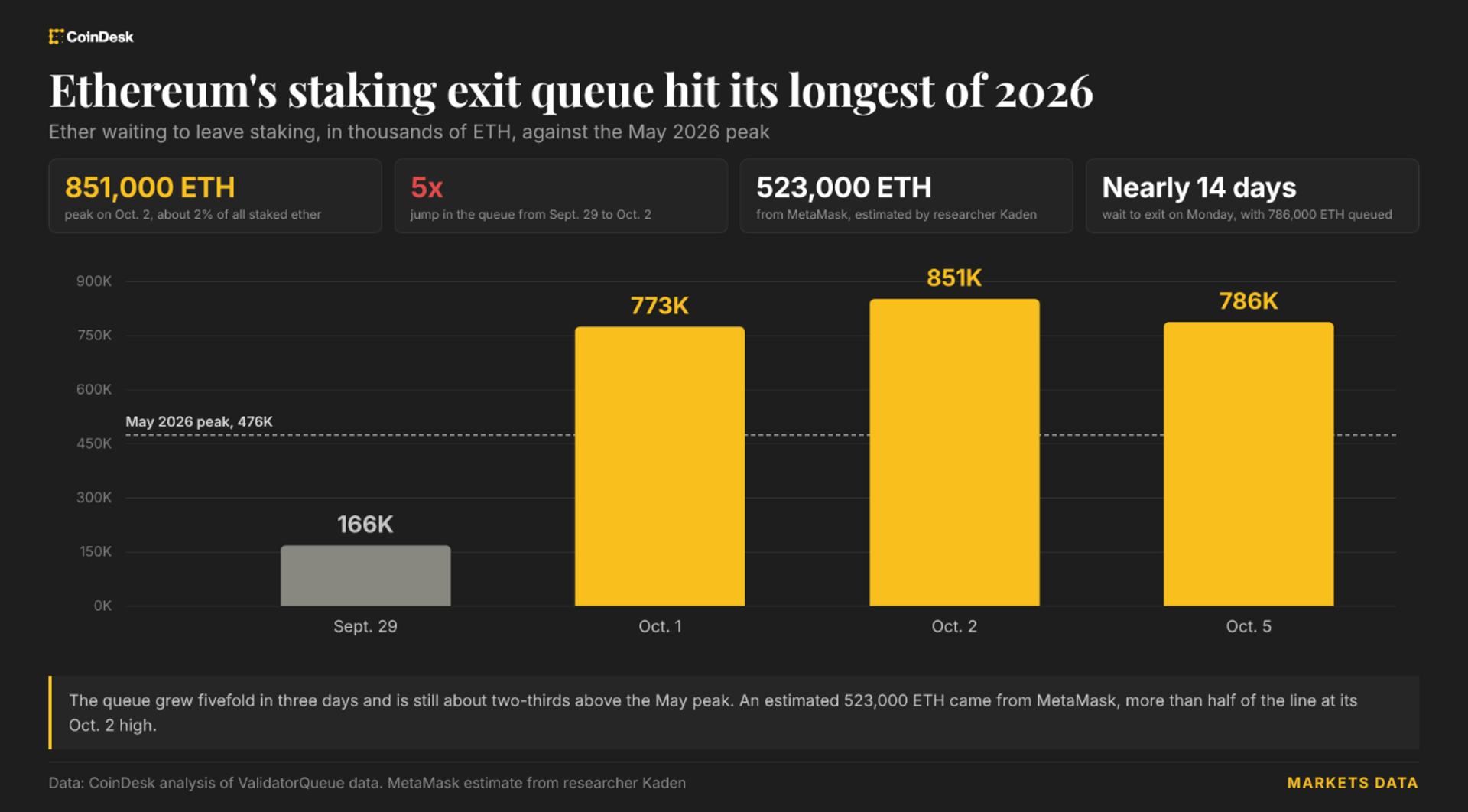
Ethereum’s staking exit queue has expanded to its longest wait of 2026 after MetaMask began withdrawing validators as a precaution linked to a security incident affecting part of its infrastructure.
About 786,000 ETH remained waiting to leave the network as of Monday morning in Asia, with an estimated processing time of nearly 14 days. The amount was worth slightly more than $2 billion based on the figures reported. The surge highlights how Ethereum’s rules for controlling validator flows can turn a large operational move by one staking provider into a lengthy queue.
According to CoinDesk, the amount of ether waiting to exit rose from roughly 166,000 ETH on Sept. 29 to about 851,000 ETH on Oct. 2. That was more than a fivefold increase in three days and represented about 2% of the approximately 43.6 million ETH then staked on Ethereum. The queue also exceeded the roughly 476,000 ETH recorded during a surge in May.
Why the exit queue grew
MetaMask, best known as a cryptocurrency wallet provider, also operates validators for Lido, a service that pools customers’ ether for staking. Staking involves committing ether to validators—computers that help check transactions on the Ethereum network—in exchange for rewards.
MetaMask disclosed a security incident on Sept. 30 and began taking affected validators out of service as a precaution. In an update on Oct. 1, the company said its investigation had found no evidence that wallets or customer funds were affected.
The majority of the increase in the exit queue appears to have come from MetaMask’s precautionary withdrawals. Ethereum security researcher Kaden estimated that the move involved about 17,000 validators holding approximately 523,000 ETH, although MetaMask has not confirmed those figures.
Ethereum does not allow unlimited numbers of validators to enter or leave at once. At the current limits, roughly 57,600 ETH can enter the staking system each day and a similar amount can exit. Those restrictions are designed to avoid abrupt changes in the network’s validator base and security. Once validators leave, the ether also passes through a separate withdrawal process before it can reach owners’ wallets.
Lido expects a gradual return to staking
Lido has characterized the movement as a temporary detour for the affected ether. The service expects the coins to return to staking gradually after the relevant validators stop operating, their balances are withdrawn and the ether is deposited into staking again.
Lido estimated that the full process could take up to about 45 days. During the period in which the affected validators are out of service, they will miss staking rewards. Lido also said that holders of stETH, its token representing users’ staked ether, do not need to take action.
The company expects the last affected MetaMask validators to stop staking by Oct. 7. Their ether would then join the queue for re-entry into the staking system, adding another stage to the process after the current exits are completed.
Demand to enter staking has eased
The exit surge is occurring alongside a separate change in demand from investors seeking to stake ether. About 1.5 million ETH, worth approximately $4 billion, was waiting to enter Ethereum staking on Monday, with an estimated wait of roughly 25 days.
That queue has declined from about 2 million ETH and an estimated 35-day wait in early September. The fall means the amount of ether waiting to begin staking has dropped by more than a quarter over that period, even as the withdrawal queue has reached its 2026 peak.
The two queues reflect different processes. Ether waiting to enter must be assigned to new validators, while ether leaving must pass through the network’s exit and withdrawal procedures. Because Ethereum limits both directions, unusually large flows can remain pending even when they relate to a single operator’s precautionary decision.
Moneyiar market picture
Moneyiar data recorded at 09:28 on Oct. 5, 2026, showed Ethereum at $2,718.8178546459, up 0.6% over 24 hours and 2.77% over seven days. The market data describes the asset’s price performance at that time and does not indicate how the staking queues will develop.
For context within the same Moneyiar snapshot, Shiba Inu traded at $0.0000059466, up 4.1% in 24 hours and 5.65% over seven days. Uniswap was at $9.043487855, down 0.15% over 24 hours and up 1.68% over seven days, while Pepe stood at $0.0000044951, up 4.75% over 24 hours and 7.72% over seven days.




