
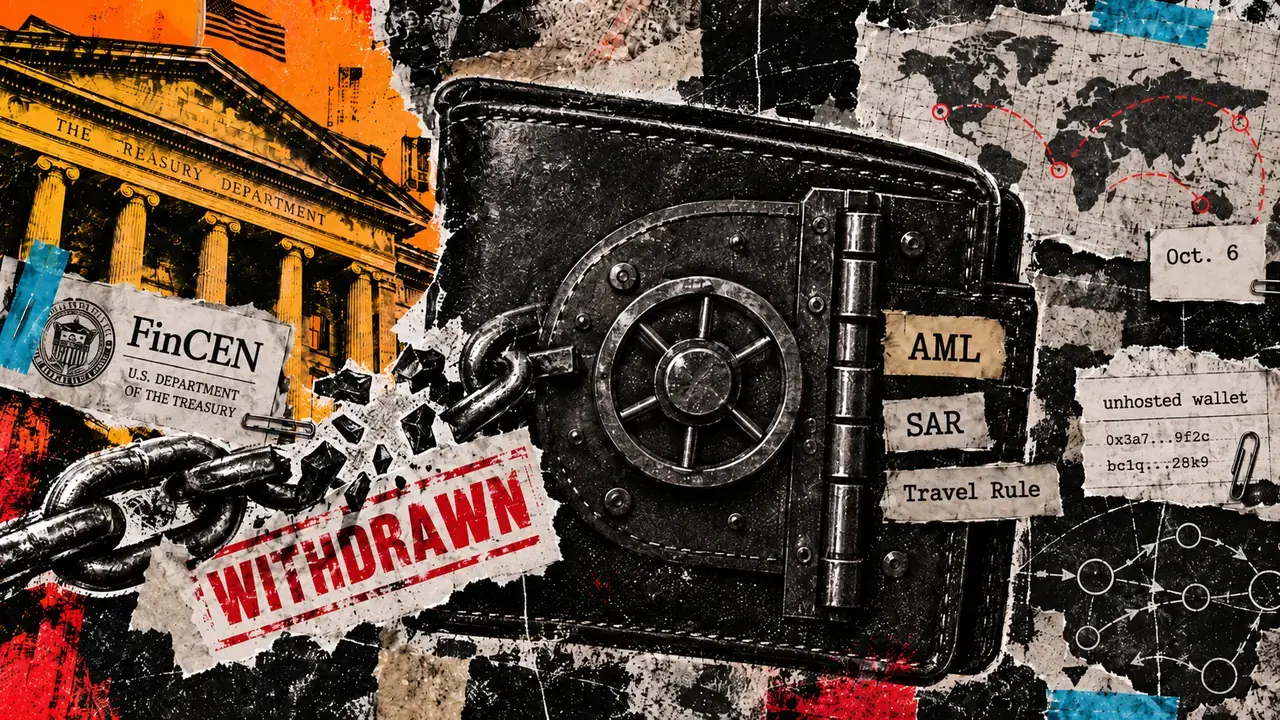
The US Treasury’s Financial Crimes Enforcement Network has withdrawn a proposed rule that would have expanded reporting requirements for transactions involving cryptocurrency mixing, ending a regulatory effort that never took effect. According to CryptoSlate, FinCEN announced the decision on October 5, with the withdrawal scheduled to become effective when published in the Federal Register on October 6.
What FinCEN withdrew
The action covers both FinCEN’s 2023 finding that international crypto mixing represented a class of transactions of primary money-laundering concern and a related proposal covering recordkeeping and reporting. The proposal was not an implemented requirement, so the withdrawal removes a pending framework rather than cancelling a rule already in force.
Crypto mixing refers to techniques intended to make it harder to identify a transaction’s source, destination or amount. FinCEN’s proposed definition was deliberately broad and was not limited to businesses marketed specifically as crypto mixers. It could have covered a range of activity, including pooling funds, coordinating transactions through code, dividing transfers, routing assets through multiple single-use wallets, exchanging one crypto asset for another and adding delays initiated by users.
The proposal would have applied when a covered US financial institution knew, suspected or had reason to suspect that a transaction involving it was connected to mixing within, or involving, a jurisdiction outside the United States. The institutions concerned would have reported information about covered transactions and customers in their possession, while also documenting how they complied with the requirement.
Privacy and compliance concerns
For wallet users, the proposed reporting system raised concerns because the information available to institutions could have included wallet addresses, transaction hashes, IP addresses and customer identity details. Commenters argued that the definition was too expansive, could discourage legitimate activity and would create a substantial reporting burden for financial institutions.
The proposal also included an exception for certain internal processes used by banks, broker-dealers and money-services businesses to execute transactions. That exception depended on the institutions retaining records identifying the source and destination of funds and providing those records when legally required.
The debate reflects a broader tension in digital-asset regulation. Authorities seek visibility into transactions that may involve money laundering, terrorist financing or other illicit activity, while users and industry participants have raised concerns about the treatment of privacy-preserving tools and ordinary transactions that may be swept into broad definitions.
Existing obligations remain
FinCEN’s decision does not remove the existing compliance duties that apply to covered crypto money transmitters. Under current guidance, those businesses remain subject to registration, risk-based anti-money-laundering programs, applicable customer checks, recordkeeping and suspicious activity reporting. Qualifying transfers also remain subject to the Funds Travel Rule.
FinCEN distinguishes between an anonymizing service that accepts and retransmits value and a provider that merely supplies anonymizing software. Providing a tool by itself does not make a person or entity a money transmitter, although operating a transmission business can do so. Similarly, someone using an unhosted wallet to pay for goods or services on their own behalf is not a money transmitter on that basis.
The agency’s notice also addresses a separate proposal concerning unhosted wallets, first published in December 2020. That proposal had already been listed as withdrawn in the Spring 2024 regulatory agenda, dated April 12, 2024. FinCEN’s latest notice says it will take no further action on it.
Although the crypto-mixing proposal is being withdrawn, FinCEN said it will continue monitoring mixing activity for money laundering, terrorist financing and other illicit conduct. The agency may take additional steps in the future, and financial institutions must continue considering their existing obligations when evaluating transactions involving privacy-related features.
Market picture
Moneyiar market data at 10:44 a.m. on October 7, 2026, showed declines across the four listed crypto assets:
- Monad (MON) traded at $0.0266543359, down 6.58% over 24 hours and 3.59% over seven days.
- Comedian (BAN) stood at $0.0634826858, down 6.22% in 24 hours and 0.95% over seven days.
- ONEchain (ONE) was priced at $0.1372978226, down 5.94% over 24 hours and 0.63% over seven days.
- Request (REQ) traded at $0.0534203472, down 5.49% over 24 hours and 6.65% over seven days.
These market movements are presented as Moneyiar data at the stated time and are separate from FinCEN’s regulatory announcement.




