
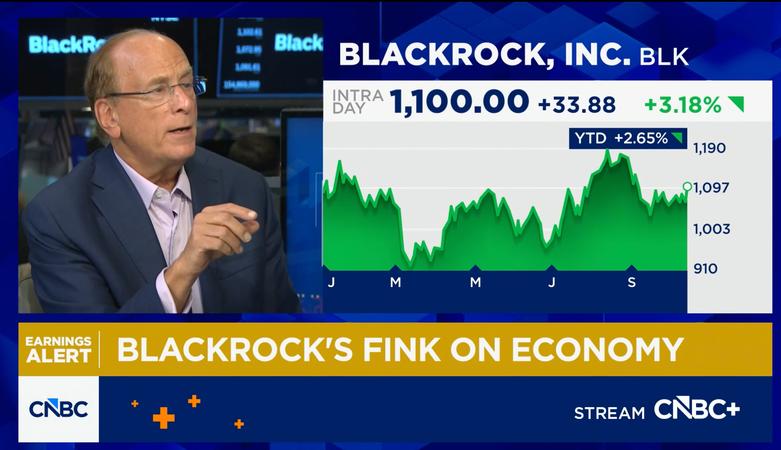
BlackRock chief executive Larry Fink has warned that a broad halt to data center construction in the United States could push the economy into recession, arguing that artificial-intelligence infrastructure has become too important to overall investment and growth.
Fink also raised concerns about the country’s rapidly increasing national debt, saying government borrowing is placing growing pressure on credit markets. His comments, reported by CoinDesk from a CNBC interview, linked two major economic debates: whether the U.S. should slow the expansion of energy-intensive data centers, and how the government can manage a debt burden that he said has reached $40 trillion.
Data center spending becomes an economic issue
Data centers are large facilities filled with computing equipment used to store and process information. They have become a central part of the infrastructure supporting artificial intelligence, creating demand not only for servers and other hardware, but also for construction, power generation and transmission networks.
Fink said a “moratorium of some sort” on data center construction in the U.S. would cause a recession. A recession is commonly defined as two consecutive quarters of shrinking economic output. His argument was that the potential damage would extend beyond technology companies and their share prices because a substantial part of current economic activity depends on the construction boom.
“So much of our economy is based on the buildout of this capex,” Fink said, referring to capital expenditure on data center infrastructure.
The scale of planned investment helps explain his concern. Moody’s estimates that U.S. data center capital spending will total $700 billion this year. The forecast rises to between $2.4 trillion and $2.48 trillion through 2030. Worldwide spending is expected to reach $7 trillion by the end of the decade.
At the same time, opposition to new facilities has grown. A Pew Research Center survey found that at least 49% of Americans view data centers as mostly negative for the environment, household energy costs and the quality of life of nearby communities. Concerns include their effect on electricity demand and local areas.
Fink rejected what he described as “misinformation” about the industry and said data centers themselves are not the problem. He highlighted employment connected with construction, energy infrastructure and the production of hardware needed for AI computing.
Debt and the pressure on credit markets
Fink’s second warning focused on government borrowing. He said U.S. national debt had increased from $8 trillion in 2000 to $40 trillion in 2026. In his view, the country added $32 trillion over 26 years, creating a significant effect on demand for credit.
“The government is demanding more and more credit, and bond auctions are getting larger and larger,” Fink said. Larger government financing needs can make the availability and cost of credit an increasingly important issue for the wider economy.
He argued that the answer should include unlocking private capital to help expand the U.S. economy by 3%. The comments came as the economy faces other pressures, including persistent inflation and rising bond yields, according to the report.
A downturn would also be relevant to cryptocurrency markets because recessions often reduce investors’ willingness to hold riskier assets. Although bitcoin supporters describe it as a potential haven, the cryptocurrency has historically experienced selling pressure when investors broadly move away from risk. Bitcoin was trading near $81,200 at the time of the report, down 0.8% since midnight UTC.
BlackRock is closely connected to the digital-asset market through its iShares Bitcoin Trust, known by the ticker IBIT. SoSoValue data cited in the report showed cumulative net inflows of $65.62 billion into the fund since its launch in January 2024.
BlackRock’s results and Moneyiar market picture
Fink’s remarks followed a strong third quarter for BlackRock. The asset manager reported $205 billion in net inflows, while revenue increased 19% from a year earlier. Adjusted earnings per share rose 38%, and the operating margin reached 47.8%, even as organic asset growth slowed modestly over the previous 12 months.
Moneyiar market data at 21:03-21:04 on October 15, 2026, showed mixed performance among the listed digital assets:
- Lido DAO (LDO): $0.4038139116, up 0.54% over 24 hours and down 1.1% over seven days, as of 21:03 +03:30.
- WOULD: $0.0351412837, up 0.33% over 24 hours and up 10.6% over seven days, as of 21:04 +03:30.
- Data Network (DATA): $0.1905955646, down 3.44% over 24 hours and down 2.7% over seven days, as of 21:04 +03:30.
- Loaded Lions (LION): $0.0012706756, up 2.48% over 24 hours and down 7.47% over seven days, as of 21:03 +03:30.
The data illustrates differing short-term moves across individual tokens, while Fink’s broader warning centers on how infrastructure investment, government borrowing and risk appetite could shape financial markets beyond the technology sector.





