
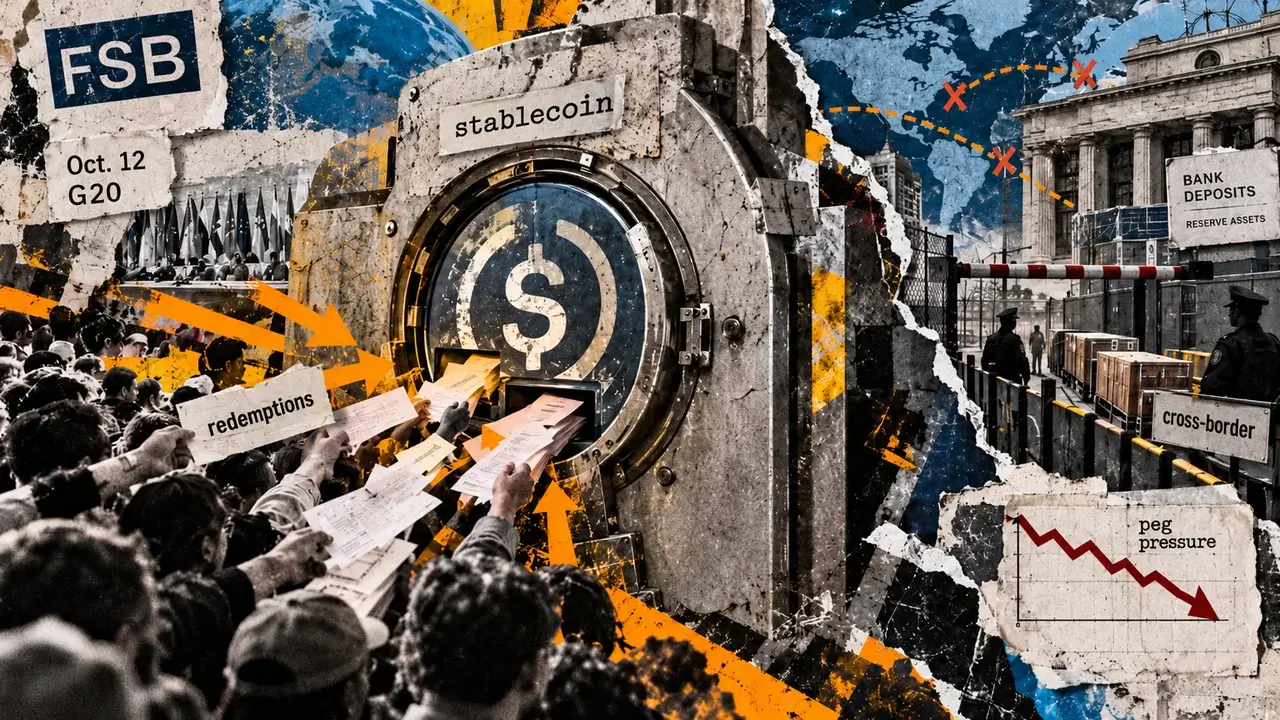
The Financial Stability Board has warned that stablecoins could face severe redemption pressure even when their reserves are sufficient in total, if those assets are held across different countries and cannot be moved quickly during a market crisis.
The warning, reported by CryptoSlate, comes ahead of an Oct. 15 meeting of G20 finance ministers and central bank governors. It concerns a stablecoin market valued at approximately $300 billion in mid-2026, of which about 99% was pegged to the US dollar.
A stablecoin is a digital token designed to maintain a relatively stable value against an asset such as the US dollar. Issuers generally support the tokens with reserves, including Treasury securities, bank deposits and other traditional assets. The FSB’s concern is that having enough reserves on paper may not guarantee that they are available where and when holders demand them.
Why reserves may not be available when needed
The FSB highlighted stablecoins issued by several affiliated companies that share responsibility for one token while keeping their reserves in separate jurisdictions. In some structures, a holder may be able to redeem through any participating issuer, regardless of the entity that originally issued the token.
That flexibility can become a problem if withdrawals are concentrated in one country while most of the backing assets are located elsewhere. Under normal conditions, affiliated entities could transfer reserves to address the imbalance. During a market panic, however, banking restrictions, settlement delays and differences between national rules could slow or prevent those transfers.
The mismatch is also linked to the different operating speeds of crypto markets and traditional finance. Stablecoins can circulate across borders and trade around the clock, while the assets backing them remain subject to local market hours, banking systems and settlement procedures.
If an issuer cannot process redemptions quickly, holders may attempt to sell their tokens on secondary markets at a discount. That could put pressure on the token’s dollar peg. A sufficiently large run could also affect traditional financial markets if issuers rapidly sell reserve assets or withdraw significant bank deposits to meet redemption requests.
Cross-border rules leave unresolved questions
FSB Chair Andrew Bailey said international coordination is still underdeveloped, leaving authorities without mature arrangements for handling a stablecoin failure that crosses national borders.
The watchdog also pointed to difficulties in determining which entity is responsible for a particular redemption. Blockchain transactions can be pseudonymous, making it harder to establish where tokens are held and which issuer or affiliate must meet a claim. Different insolvency laws could further complicate decisions about which regulator can intervene and how remaining reserves should be distributed.
The report also noted that countries have implemented the FSB’s global stablecoin recommendations unevenly. The watchdog’s 2025 assessment found substantial gaps, potentially allowing issuers to structure their operations across jurisdictions with differing supervisory requirements.
The FSB is seeking stronger information-sharing arrangements and closer monitoring of where stablecoins circulate, where redemptions take place and where reserve assets are held. It also wants regulators to assess the depth of secondary-market liquidity and develop more coordinated responses to stablecoin distress or insolvency.
However, important information gaps remain. Blockchain analytics firms may use different methods to estimate stablecoin activity, while identifying holders’ locations and tracking cross-border transactions reliably can be difficult.
The FSB’s recommendations build on measures issued in 2023, but they are non-binding. National authorities will decide how to implement any changes. Officials are expected to discuss the findings at the G20 meeting on Oct. 15, although the watchdog has not set a timetable for common procedures covering the failure of a stablecoin issuer operating in multiple jurisdictions.
A real-world example of contingency planning
The report referred to Circle’s European stablecoin arrangements as an example of how cross-border reserve management can affect redemption procedures. Under a policy updated in September, Circle co-issues USDC through a French entity for the European Economic Area and through its US entity for markets outside that region.
That policy allows Circle France, during a defined stress event, to adjust or defer certain redemption requests if the two entities cannot complete the required reserve rebalancing. Possible measures include temporary redemption limits for European crypto-asset service providers, while preserving holders’ right to redeem at par.
The provisions describe contingency arrangements, not an existing liquidity failure. They also apply to Circle’s specific jurisdictional structure and differ from the unrestricted cross-issuer redemption model examined by the FSB. Still, they illustrate the operational and legal questions regulators are seeking to address before a crisis occurs.
Moneyiar market picture
Moneyiar data at 10:03-10:04 on Oct. 13, 2026, showed the following prices and performance:
- Filecoin (FIL): $1.1722313473, down 5.83% over 24 hours and up 0.22% over seven days.
- Cronos (CRO): $0.0593389455, down 3.96% over 24 hours and 12.71% over seven days.
- Stable (STABLE): $0.0262241592, down 2.15% over 24 hours and 6.12% over seven days.
- Comedian (BAN): $0.0583503854, down 5.85% over 24 hours and 13.87% over seven days.




