
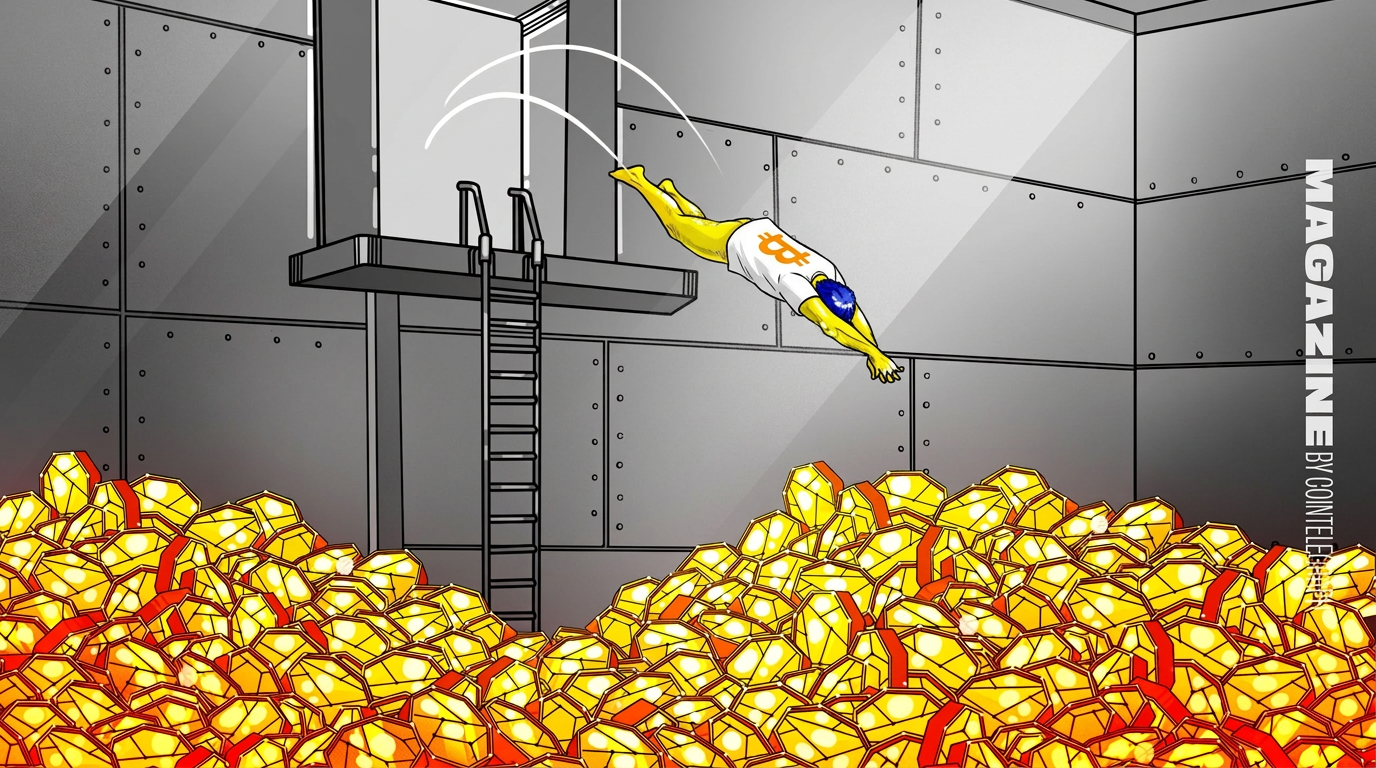
A US fusion startup says it has produced gold from mercury using a nuclear process, raising an unusual question for investors and cryptocurrency advocates: if technology eventually makes gold easier to create, could Bitcoin’s fixed supply become more valuable by comparison?
According to Cointelegraph, Marathon Fusion’s research describes a process in which high-energy neutrons from a deuterium-tritium fusion reaction irradiate mercury-198. That creates a radioactive isotope which later decays into stable gold-197, the naturally occurring form of gold.
The claim is based on nuclear transmutation rather than a chemical method. In other words, the company says it is changing one element into another through a nuclear reaction. The idea has prompted comparisons with an “infinite mint bug” for gold, whose scarcity has helped support its role as a store of value for centuries.
The experiment is far from commercial gold production
Marathon says it produced stable gold at a rate 10 times higher than a record associated with CERN, Europe’s particle physics laboratory. However, the quantities involved remain extremely small. The company has not publicly disclosed the exact amount produced in its own experiment, while research engineer Jake Harter described the output as “still microscopic.”
Marathon hopes to reach milligram quantities in 2027. Its larger production figures are not current output: they are projections based on a future fusion power plant. The company’s research paper models annual production of approximately two tonnes of gold for every gigawatt of thermal fusion power.
That projected volume would still be modest compared with the existing global gold industry. The World Gold Council reported that mines produced 3,672 tonnes of gold worldwide in 2025. Reaching even Marathon’s projected level would require the company to develop a fusion reactor and expand the supply of enriched mercury needed for the process.
The technology also involves several unresolved engineering questions. Marathon says it will study the compatibility of construction materials with the process, how mercury could be pumped through a future system and how the gold could be extracted.
Nikos Kavalis, managing director at precious-metals research firm Metals Focus, said the achievement was nowhere near production significance. He added that gold miners were likely to retain their jobs for the foreseeable future.
Radioactivity and cost remain major obstacles
The prospect of manufactured gold has drawn comparisons with lab-grown diamonds. Lab-grown diamonds are chemically identical to mined diamonds, and their wholesale prices have fallen by more than 90% since 2018 as production expanded. Marathon co-founder and CEO Kyle Schiller said the company had already received substantial interest from jewelers, while suggesting that manufactured gold would primarily be used as a store of value, much like conventional gold.
But analysts say the comparison has limits. Nagham Hassan, a market analyst at eToro, said the economics of the two industries were fundamentally different. Diamond manufacturing benefited from factory scaling, whereas fusion-based gold would require complex infrastructure that does not yet exist commercially.
The material produced by Marathon would also initially be radioactive. Harter said it would need to be stored for slightly more than a decade before its radioactivity fell to “banana-levels,” a reference to the very low radioactivity associated with bananas. He argued that storage could be less problematic for gold held as an investment, but the requirement would still affect how the material could be handled and sold.
The larger unanswered question is cost. Kavalis said there was no demonstration that the process was commercially viable, noting that theoretical revenue projections do not establish how much it would cost to operate the reactors.
What could it mean for Bitcoin?
Bitcoin is often called digital gold because both assets are viewed by some investors as stores of value outside traditional currencies and financial systems. The comparison is not exact, but Bitcoin has one feature that gold does not: its maximum supply is set by its protocol at 21 million coins.
Coinbase CEO Brian Armstrong argued that the development could ultimately support Bitcoin’s appeal. He compared the possibility of creating new gold through nuclear technology with the emergence of lab-grown diamonds, while saying that nothing could be invented to increase Bitcoin’s supply beyond 21 million.
The economic logic depends entirely on whether manufactured gold becomes affordable and scalable. Fabian Schär, a professor of distributed ledger technology and fintech at the University of Basel, said a substantial increase in the available supply of any asset would, all else being equal, put downward pressure on its price. Under the hypothetical assumption of inexpensive production at scale, he said gold would be no exception.
That scenario remains distant. The first fusion reactors are estimated to be at least a decade away, and the cost, engineering requirements and radioactive storage period have yet to be resolved. For now, Marathon’s work is better understood as an early scientific experiment with possible applications than as an immediate threat to mined gold or a near-term catalyst for Bitcoin.
Current crypto market picture
Moneyiar market data at 12:38-12:39 on November 1, 2026, showed Bitcoin at $77,759.60, up 0.27% over 24 hours but down 3.20% over seven days. Celestia was at $0.4777, down 0.51% in 24 hours and 8.98% over seven days. Four traded at $0.2089, up 3.47% over 24 hours and down 4.83% over seven days. AKEDO stood at $0.00916, down 21.55% over 24 hours and 68.48% over seven days.




