
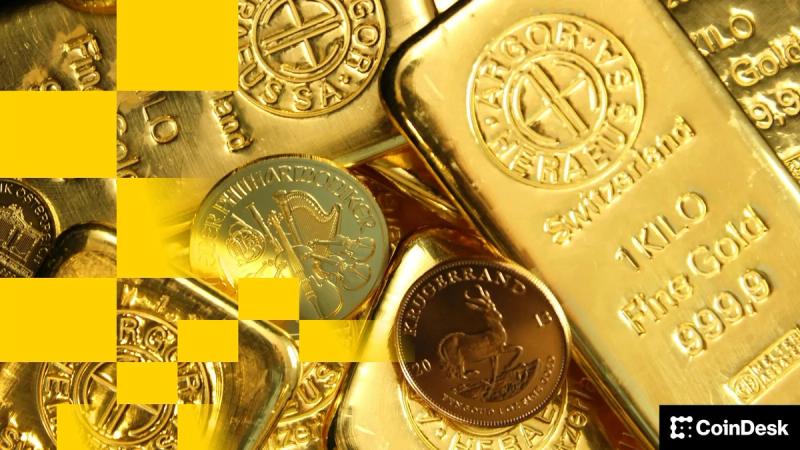
Gold and bitcoin are increasingly being discussed as complementary assets rather than competing versions of the same trade, as investors focus on the risk that currencies lose purchasing power over time.
That argument was central to this week’s Crypto Long & Short newsletter, according to CoinDesk. Steve Neamtz, chief executive of Yorkville America, argued that both assets benefit from constrained supply, while acknowledging that gold has a far longer record and a much more established institutional framework.
Gold was trading near $4,200 an ounce in the discussion, while bitcoin was described as holding around $84,000. The comparison highlights an important difference between the two: gold has been used as a reserve asset for roughly 5,000 years, whereas bitcoin has existed for about 17 years.
Two scarce assets, different levels of maturity
Neither gold nor bitcoin can have its supply expanded directly by central banks or fiscal policymakers. That characteristic has become more relevant as public debt increases. The newsletter said U.S. federal debt has passed $39 trillion and that the country spends about $1 trillion annually servicing existing debt. It also said the U.S. dollar has lost approximately 40% of its purchasing power over the past two decades.
The case presented for holding the two assets is therefore not necessarily that they will reliably protect a portfolio during every market crash. Instead, it is based on the possibility that scarce assets can preserve value relative to currencies that gradually lose purchasing power. This is sometimes described as a debasement trade.
A 2025 study published in Resources Policy examined relationships across six asset classes: developed-market equities, emerging-market equities, bonds, commodities, energy and crypto. Its conclusion, as cited in the newsletter, was that neither gold nor bitcoin could be classified as a hedge or safe haven under rigorous tests.
That conclusion concerns how assets behave during financial-market drawdowns. It does not directly answer whether they can retain value against a depreciating currency. The distinction matters because an asset that does not consistently rise when stocks and bonds fall may still be used by investors seeking exposure to limited supply and reduced dependence on government liabilities.
Gold has the infrastructure bitcoin is still building
Gold’s advantage is not presented as proof that its investment rationale is stronger. Rather, it reflects the infrastructure developed around it over many decades. Central banks already have established systems for custody, legal ownership and reserve eligibility, allowing them to use gold when diversifying reserves or expressing concern about currency debasement.
The newsletter said central banks bought a record 289 metric tons of gold in the second quarter of 2026, following purchases of 244 metric tons in the first quarter. It described that activity as a clear indication of where reserve managers are allocating funds, while noting that the pace of purchases has also been independently corroborated.
Bitcoin is being accessed by institutions through a newer structure: spot exchange-traded funds. These products address some of the custody challenges associated with directly holding bitcoin, but they do not give the cryptocurrency the sovereign-reserve status that central banks require.
This leaves gold and bitcoin at different stages of development. Gold is already embedded in the systems used by central banks, while bitcoin’s institutional infrastructure is still expanding. The newsletter also suggested that bitcoin may appeal particularly to younger investors, but characterized it as being on an earlier point of a similar long-term curve rather than representing an entirely separate investment idea.
Institutional crypto expands across markets
The newsletter’s other headlines pointed to continued development in regulated crypto markets and financial infrastructure:
- The European Securities and Markets Authority told authorized platforms to stop new trading and purchases of stablecoins that do not comply with the Markets in Crypto-Assets regulation. National regulators are expected to address existing customer holdings within three months.
- Russia’s largest bank, Sberbank, joined the country’s crypto exchange register and plans to make trading available to all clients on Dec. 1. Bitcoin, ether and tether were already being tested in its application.
- Ledger said a covert chip placed in resold signing devices was used to read wallet recovery phrases from screens and transmit them over a mobile network. Onchain researchers estimated losses of up to $93.2 million across more than 300 wallets.
- Thailand’s stock exchange rules, taking effect Oct. 16, will permit domestic asset managers to launch single-asset bitcoin and ether funds, provided at least 80% of net assets track the relevant cryptocurrency and regulated custodians hold the tokens.
- Standard Chartered launched institutional custody for Ripple’s RLUSD stablecoin in Dubai for eligible clients. It plans to connect those holdings to LMAX so they can be used as trading collateral without leaving the bank, subject to approvals and testing.
The newsletter also reported that USD.AI’s active loans fell about 22% to roughly $311 million on Oct. 2 and then remained flat. Its associated CHIP token had recovered about 35% since Oct. 1 to approximately 5.8 cents, although it was still around 48% below its April high. The proposed GLX model would originate loans, sell performing loans to institutions and recycle capital into new lending.
Moneyiar market picture
Moneyiar data at 21:08-21:09 on Oct. 15, 2026, showed bitcoin at $82,032.19, up 0.47% over 24 hours and 0.49% over seven days. Ontology Gas was $0.08240, down 0.58% in 24 hours and 4.74% over seven days.
Dogelon Mars stood at $0.0000000324, rising 3.44% over 24 hours but falling 1.24% over seven days. Tokenlon Network Token was $0.19247, up 0.92% over 24 hours and down 3.11% over seven days. These figures are Moneyiar market data captured at the stated times and are separate from the levels cited in the newsletter’s discussion.




