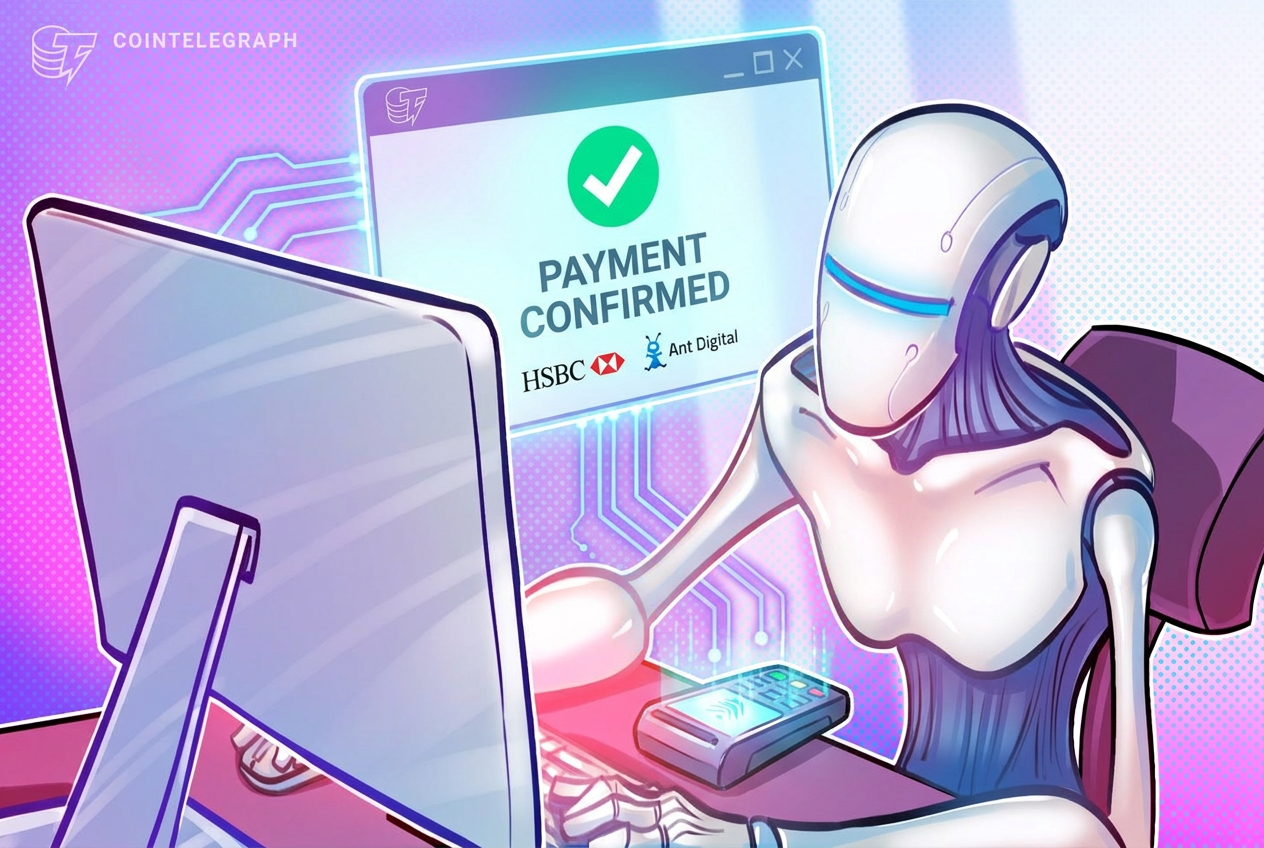
HSBC and Ant Digital Technologies have completed a technical trial in which an artificial-intelligence agent discovered a digital service and paid for it using HSBC tokenized bank deposits. The transaction was settled in real time on a blockchain testnet, offering a demonstration of how automated software could access services and handle very small payments without a person manually initiating each step.
According to Cointelegraph, the test combined three separate components: HSBC’s Tokenised Deposit Service, Ant Digital’s Anvita Flow network and Jovay Testnet, a layer-2 blockchain testing environment. HSBC supplied the payment settlement function and real-time risk checks. Ant Digital’s network coordinated the agent’s search for a service, its access to that service and the associated payment.
The companies said the demonstration involved an AI agent selecting a digital service and completing a micropayment. Micropayments are generally understood as payments of less than $2, making them relevant to automated software that may need to carry out frequent, low-value transactions across different applications.
The trial was not a commercial product launch. HSBC and Ant Digital said it was conducted for technical verification and did not constitute a live offering for customers.
How the payment test worked
The demonstration brought together an AI-agent service layer, bank-issued digital representations of deposits and a blockchain environment for testing. An AI agent is software capable of carrying out tasks based on programmed instructions or objectives. In this case, the agent could identify an available digital service, use it and complete the payment required for access.
Tokenized deposits are digital representations of money held as bank deposits. In the test, HSBC’s Tokenised Deposit Service provided the settlement capability, while the blockchain testnet supplied the environment in which the transaction could be processed. The companies also included real-time risk checks, meaning the payment process incorporated checks as the transaction took place.
The result was a controlled technical demonstration rather than evidence of a customer-facing payment network. The announcement did not provide a commercial launch date, customer numbers or transaction volumes.
Banks are testing automated payments
HSBC’s experiment is part of a wider series of trials involving banks and AI-initiated payments. Spanish bank Santander completed an AI-agent-initiated payment in March using Mastercard’s Agent Pay infrastructure. That test was controlled but involved the bank’s live payment systems.
Swiss digital asset bank Sygnum conducted a test in May in which an AI agent initiated transactions on a blockchain mainnet. Customers still had to approve and sign each transaction. Spanish banking group CaixaBank also completed an AI-agent-initiated card transaction using Visa Intelligent Commerce and existing merchant payment systems.
These projects are examining different ways software might act on a user’s behalf while financial institutions retain controls around authorization, settlement and risk. They also highlight a central question for banks: whether systems designed mainly around human-initiated payments can support software that may operate continuously and across multiple applications.
Ferdinand Dabitz, CEO of Augustus Bank, argued in a May interview with Cointelegraph that traditional clearing banks depend on older systems designed for human operations rather than automated, around-the-clock activity. Augustus is developing a US bank built around stablecoins and AI-driven operations, with the aim of using purpose-built infrastructure in parts of banking.
Why blockchain infrastructure is part of the discussion
The HSBC-Ant Digital test reflects a broader argument that AI agents could increase demand for programmable financial infrastructure. In an Oct. 8 report titled “Breaking The Wall,” investment research firm Citrini Research said autonomous AI agents could expand the need for systems that allow money and financial assets to move programmatically.
Traditional financial systems were largely designed for people to initiate and approve transactions. AI agents, by contrast, can be built to operate across applications and handle tasks automatically. Supporters of blockchain-based infrastructure argue that its ability to remain available continuously and record transactions in a shared system could suit this type of activity.
Citrini Research wrote that AI agents operate programmatically around the clock across applications, and that money and financial assets could eventually follow the same model. The HSBC and Ant Digital trial does not establish that such a model is ready for broad use, but it provides a technical example of how bank deposits, automated service discovery and blockchain settlement might be connected.
Moneyiar market picture
Moneyiar data at 11:39 a.m. on Oct. 11, 2026, showed Cronos (CRO) at $0.0593280733, down 2.55% over 24 hours and 13.52% over seven days. AKEDO (AKE) was priced at $0.0262127958, falling 3.89% in 24 hours and 25.9% over seven days.
RealLink (REAL) was listed at $0.0100747766 in Moneyiar data recorded at 7:04 a.m. on Sept. 15, 2026, down 86.56% over 24 hours and 86.35% over seven days. REAL (ASSET) stood at $0.1927052765 in data recorded at 6:54 p.m. on Oct. 8, 2026, up 3.26% over 24 hours but down 2.28% over seven days.