
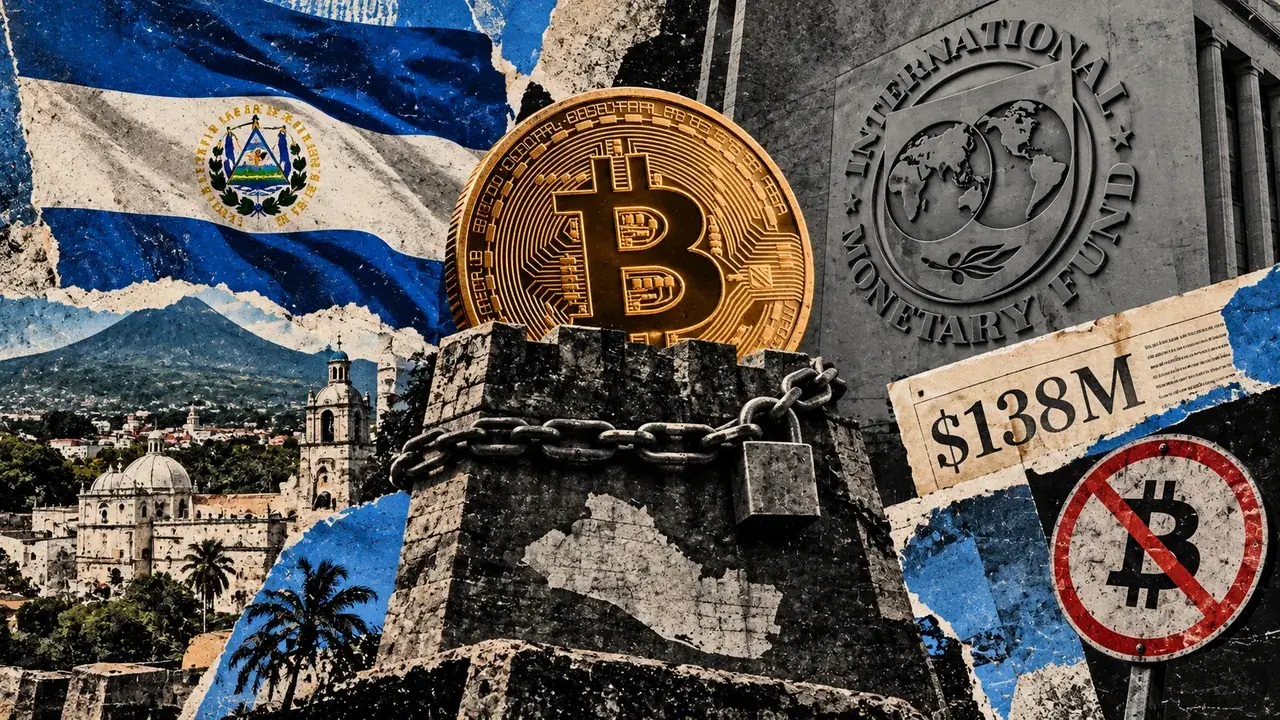
El Salvador has secured access to about $138 million in IMF financing after the Fund waived missed performance criteria linked partly to the country’s accumulation of Bitcoin, according to CryptoSlate. The decision keeps the loan program on track, but it does not give the government a free hand to expand its cryptocurrency reserve with public money.
The International Monetary Fund completed the second and third reviews of El Salvador’s $1.4 billion lending program on October 1. The review unlocked an immediate disbursement equivalent to 101.96 million special drawing rights, or SDRs, valued at approximately $138 million.
The IMF granted waivers for unmet criteria related to Bitcoin accumulation after Salvadoran authorities took corrective steps and renewed their commitments under the program. A waiver allows financing to continue even though certain agreed targets were not fully met. In this case, however, the concession did not remove the restrictions governing Bitcoin purchases.
El Salvador’s government remains committed to making no further state-funded Bitcoin acquisitions under the IMF program. The Fund said additional accumulation is not envisaged beyond documented donations. That distinction is important because Bitcoin held by public-sector wallets can increase without necessarily meaning that the government has used taxpayer funds to buy more coins.
Bitcoin reserve remains under scrutiny
El Salvador currently holds approximately 7,794.37 Bitcoin, with the reserve valued at about $666.1 million in the source material. The size and changing value of that reserve have drawn continued attention because additions to government-linked wallets have appeared difficult to reconcile with the terms of the IMF agreement.
The IMF has separated Bitcoin acquired with public funds from coins received through documented donations. Under the latest review, that distinction remains central to the program. Donations may allow reserve balances to rise, but they must be properly recorded if the government is to demonstrate compliance with the agreement.
The source material also says El Salvador added 1,540 Bitcoin, while the IMF maintains that President Nayib Bukele’s government did not pay for those coins. No additional details about the timing or specific form of those additions were provided. The issue nevertheless illustrates why the documentation of public-sector crypto holdings is likely to remain a focus of future reviews.
Chivo and crypto reforms remain part of the deal
The Bitcoin waiver was included in a broader assessment of El Salvador’s economic program. The IMF said fiscal consolidation was advancing broadly in line with its objectives, while reserve and liquidity targets had been comfortably met.
The 40-month Extended Fund Facility was approved in February 2025. Its stated goals include supporting fiscal adjustment, strengthening international reserves and advancing financial-sector reforms. The latest disbursement therefore reflects progress across the wider program as well as the decision to waive the Bitcoin-related criteria.
The IMF also pointed to progress in reducing the state’s direct involvement in cryptocurrency. El Salvador has transferred majority ownership and control of the government-backed Chivo wallet to a private operator. The Fund said, however, that the remaining public-sector exposure should be fully unwound.
Chivo is relevant because it represents a direct channel through which the state has been involved in digital assets. Completing its unwind, alongside stronger disclosure, would give the IMF greater visibility into how public-sector crypto activity is being managed.
What future reviews will examine
The IMF expects El Salvador to improve disclosure of public-sector cryptocurrency holdings, strengthen regulation and governance for digital-asset service providers, and amend the country’s Digital Asset Issuance Law where necessary. These commitments sit alongside the continued prohibition on additional government-funded Bitcoin accumulation.
That framework leaves the government with limited room to use its balance sheet to enlarge the reserve while remaining within the IMF program. At the same time, changes in Bitcoin’s market price can increase or reduce the dollar value of coins already held by the state without any new purchase taking place.
Future reviews are expected to depend in part on whether El Salvador can fully document changes in its Bitcoin balance, complete the Chivo-related unwind and deliver the promised transparency reforms. If new accumulation cannot be explained under the donation or other permitted categories, the government could again need a waiver before receiving further financing.
Current market picture
Moneyiar market data recorded at 9:49 a.m. local time on October 5, 2026, showed Bitcoin at $85,941.068904725, up 0.75% over 24 hours and 3.91% over seven days. Compound was priced at $24.8520017547, down 0.66% over 24 hours and up 7.42% over seven days. RedStone stood at $0.1720966834, down 2.43% in 24 hours and up 7.57% over seven days, while Loaded Lions was $0.0015599324, up 0.63% over 24 hours and 6.36% over seven days.




