
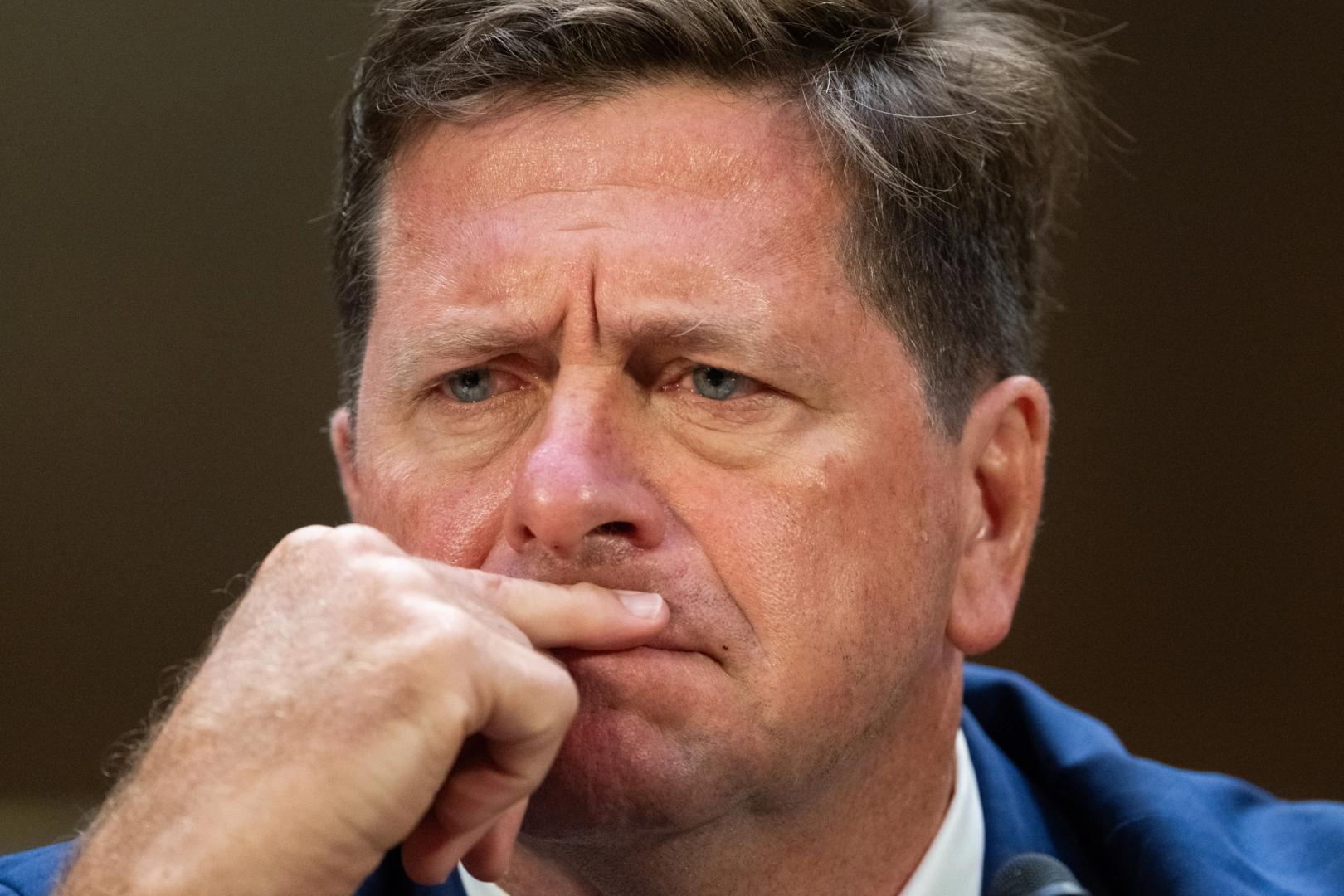
Jay Clayton, the former chairman of the U.S. Securities and Exchange Commission, is reportedly close to being appointed the Trump administration’s artificial intelligence czar, a role that would place a former digital-asset regulator at the center of U.S. AI policy.
According to CoinDesk, Clayton is expected to oversee the administration’s AI Force and the rapidly expanding domestic artificial-intelligence industry. The position appears narrower than the role previously held by David Sacks, who served as the administration’s combined crypto and AI czar. Clayton’s potential appointment therefore matters not only for the direction of U.S. AI policy, but also because of his history with one of the crypto industry’s most consequential regulatory periods.
A new focus for the administration’s AI role
The prospective position does not appear to include responsibility for cryptocurrency. Sacks left his crypto czar role in March, and White House crypto initiatives have since been led by adviser Patrick Witt. The division between the two policy areas is notable because crypto and artificial intelligence can overlap through areas such as digital infrastructure and emerging technology, even though they raise different regulatory and policy questions.
President Donald Trump announced the creation of the AI Force on Truth Social in September, comparing it with the Space Force established during his first administration. He said an AI czar would be named in the “near future” and described the person as having a “high IQ.”
The precise duties of the new AI position remain unclear. The administration is weighing how to support a fast-growing technology while responding to concerns about the safety of increasingly capable machine intelligence. In a recent CNBC interview, Clayton described AI as a national-security issue but rejected calls to pause its development.
“I don’t think any American should think that that’s a good strategy,” he said.
Clayton has held several senior public- and private-sector positions. Before joining the public sector as U.S. attorney for the Southern District of New York, he served for several years on the board of private-equity firm Apollo Global Management, which invested billions of dollars in artificial-intelligence and digital-infrastructure projects. Trump appointed him director of national intelligence this year, adding to a series of roles in the administration.
Why crypto observers are watching
Clayton’s record at the SEC could shape how technology companies and digital-asset participants view his possible move into AI policy. Trump appointed him to lead the agency during his first administration, and his tenure included the early development of the SEC’s regulation-by-enforcement approach to cryptocurrencies and blockchain businesses.
In 2017, Clayton created the SEC’s Cyber Unit to address activity in the emerging digital-asset sector. The unit focused on initial coin offerings, digital-asset securities and other conduct involving the industry. By the time Clayton departed in 2020, the SEC reported that it had brought 57 cases involving digital assets, blockchain businesses and ICOs.
The agency said those actions targeted alleged efforts to defraud investors through digital-asset securities, as well as alleged violations of federal registration rules governing the offer and sale of those securities. That enforcement language later became familiar throughout the industry during the chairmanship of Gary Gensler, a Democratic appointee of former President Joe Biden.
Clayton’s tenure also produced the SEC’s major legal action against Ripple Labs. As he was preparing to leave the agency in 2020, the SEC accused Ripple of failing to register approximately $1.3 billion worth of XRP tokens as securities. The case became one of the agency’s most prominent actions against a major crypto company. It was later halted under current SEC Chairman Paul Atkins, another Trump appointee, after the agency dismissed further pursuit of the court action last year.
A changed political backdrop
Clayton’s SEC record was established when Trump was publicly skeptical of cryptocurrency. In a 2021 interview, Trump referred to the “bitcoins of the world” and said he believed they should be regulated “very, very high.”
Trump later adopted a markedly different position. His involvement expanded from launching non-fungible tokens to introducing a self-referential memecoin and holding a stake in World Liberty Financial. During the 2024 campaign, he presented himself as a supporter of digital assets. After returning to the White House, he selected Sacks to oversee both crypto and AI policy.
The apparent separation of the roles now places Clayton’s regulatory history in a new context. If appointed, he would be responsible for positioning a strategic technology rather than directly supervising crypto markets, while crypto policy remains with other White House advisers. Clayton did not respond to a message from CoinDesk seeking comment.
Moneyiar market picture
Moneyiar data at 08:58-08:59 on October 3, 2026, showed declines across the listed assets:
- OFFICIAL TRUMP (TRUMP): $2.0558141031, down 2.31% over 24 hours and 3.21% over seven days.
- Celestia (TIA): $0.4450215522, down 3.74% over 24 hours and 8.93% over seven days.
- Four (FORM): $0.2804395083, down 5.09% over 24 hours and 11.27% over seven days.
- Dog (Bitcoin) (DOG): $0.0009498919, down 1.06% over 24 hours and 8.30% over seven days.
These market figures describe prices and recent performance at the stated times; they do not establish a connection between those movements and Clayton’s potential appointment.




