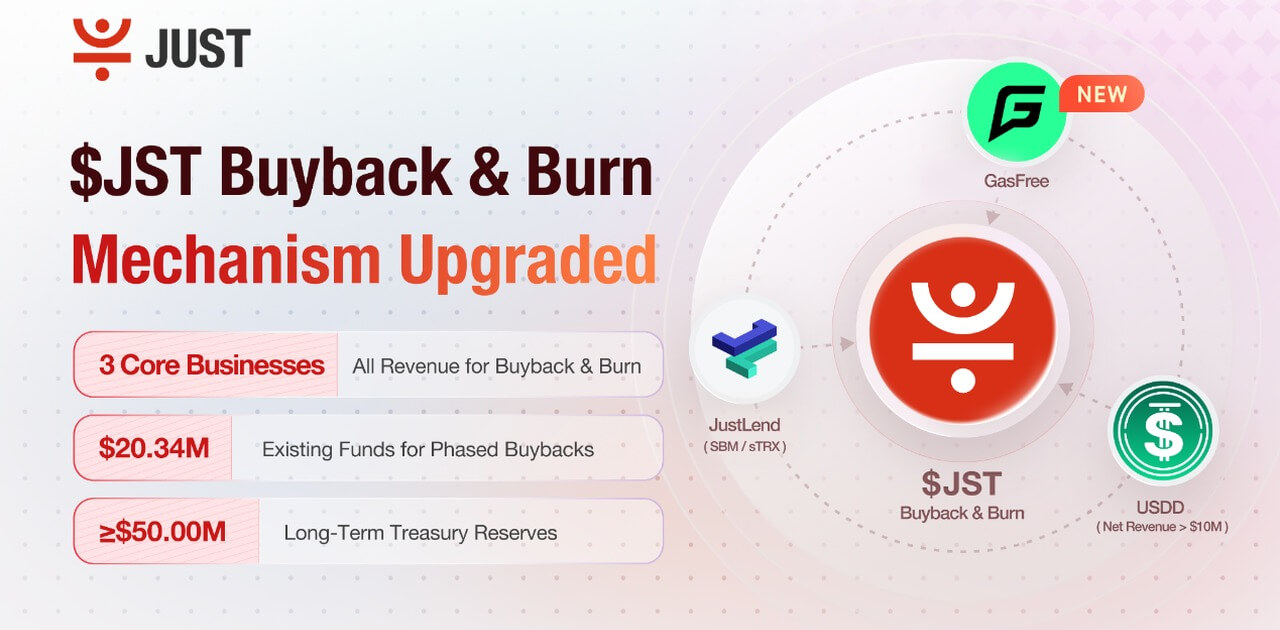
JUST has announced an upgraded buyback-and-burn framework for its JST governance token, adding GasFree revenue to existing funding from JustLend and USDD. The plan also sets a $50 million treasury reserve floor and allocates about $20.34 million in surplus capital to four buyback rounds beginning in the fourth quarter of 2026.
The changes follow the completion of the fifth JST buyback and burn on October 16 and JUST’s brand refresh on October 23. According to CryptoSlate, the revised structure is intended to connect revenue from the ecosystem’s three core businesses more directly with JST’s value-accrual system while establishing clearer limits on how treasury funds can be used.
A three-part funding model for JST
The upgraded program broadens the mechanism from two main revenue sources to three: JustLend, USDD and GasFree. Eligible funding includes revenue from JustLend’s sTRX staking and supply-borrow market, GasFree income, and USDD protocol revenue above a $10 million threshold.
A central feature is the permanent $50 million treasury safety floor. Funds below that level are not designated for buybacks. The reserve is intended to provide a liquidity and solvency buffer for the protocol, including during severe market conditions, while defining the amount of capital that can be deployed for JST purchases.
Capital held above the floor will be directed entirely to buybacks. The first release under the new structure totals approximately $20.34 million, drawn from accumulated GasFree earnings and surplus treasury reserves. The funds are scheduled to be deployed in four rounds starting in the fourth quarter of 2026.
The operating model will use continuous open-market buybacks, with the timing and size of purchases adjusted to market depth and liquidity. Tokens accumulated through those purchases will be burned periodically rather than immediately after every transaction. In general terms, a token burn removes tokens from circulation, while a buyback uses available funds to purchase tokens in the market.
GasFree becomes a new source of buyback funding
GasFree is a TRON-based service that allows users to pay transaction fees with the tokens they are transferring. This gasless design means users do not need to hold TRX solely to move supported assets. The service currently supports gasless transfers for USDT and USDD.
The platform began operating in March 2025 and generated approximately $12.03 million in cumulative revenue through the third quarter of 2026, according to the source material. As of October 23, it had processed more than $157.1 billion in cumulative stablecoin transfer volume across over 9.14 million transactions and served more than 500,000 unique addresses.
GasFree is expected to begin contributing capital to JST buybacks in the fourth quarter of 2026. Its revenue will be added to the existing streams from JustLend and USDD, making the buyback program less dependent on a single product line.
In late September, GasFree also partnered with Binance Web3 Wallet to support TRC-20 USDT gas-fee delegation. Under that arrangement, users can pay network fees in USDT without holding TRX. The source describes the integration as expanding GasFree’s potential user base and fee-generation capacity.
JUST consolidates governance across its ecosystem
The revised program places execution under JUST DAO, which the source identifies as the consolidated governance body formerly known as JustLend DAO. Buybacks and burns will be conducted on-chain, with key financial information disclosed to the community regularly and transactions remaining publicly verifiable.
The governance change accompanies JUST’s broader effort to bring JustLend, USDD and GasFree under one brand and user gateway. JST is the native governance token for the combined ecosystem, whose businesses cover lending and resource markets, decentralized stablecoin infrastructure, and gasless transaction settlement.
JustLend remains the foundation of the system and funded the initial phase of JST buybacks and burns. As of October 23, its total value locked exceeded $7.13 billion. Its supply-borrow market accounted for approximately $3.71 billion, while total TRX staked through the platform surpassed 9.83 billion.
Across the wider JUST ecosystem, total value locked was described as roughly $12.2 billion, representing nearly half of TRON’s total liquidity. These figures provide context for the scale of the businesses now being connected to JST’s token-economics framework, but they do not guarantee future revenue, buybacks or token performance.
Current market picture
Moneyiar market data recorded at the stated times shows JST at $0.1409533488, up 0.63% over 24 hours and 4.46% over seven days, as of 08:18 on October 24, 2026, Tehran time. USDD was at $0.99866766, down 0.03% over 24 hours and unchanged over seven days, as of 08:19.
For comparison, Solana was priced at $101.9920762986, down 2.49% in 24 hours and 2.78% over seven days, while Gram (previously Toncoin) stood at $1.2446841948, down 5.67% and 7.5% over the same periods, respectively. These are Moneyiar market data points and reflect prices at the stated times, not an assessment of the upgraded buyback program’s future effect.