
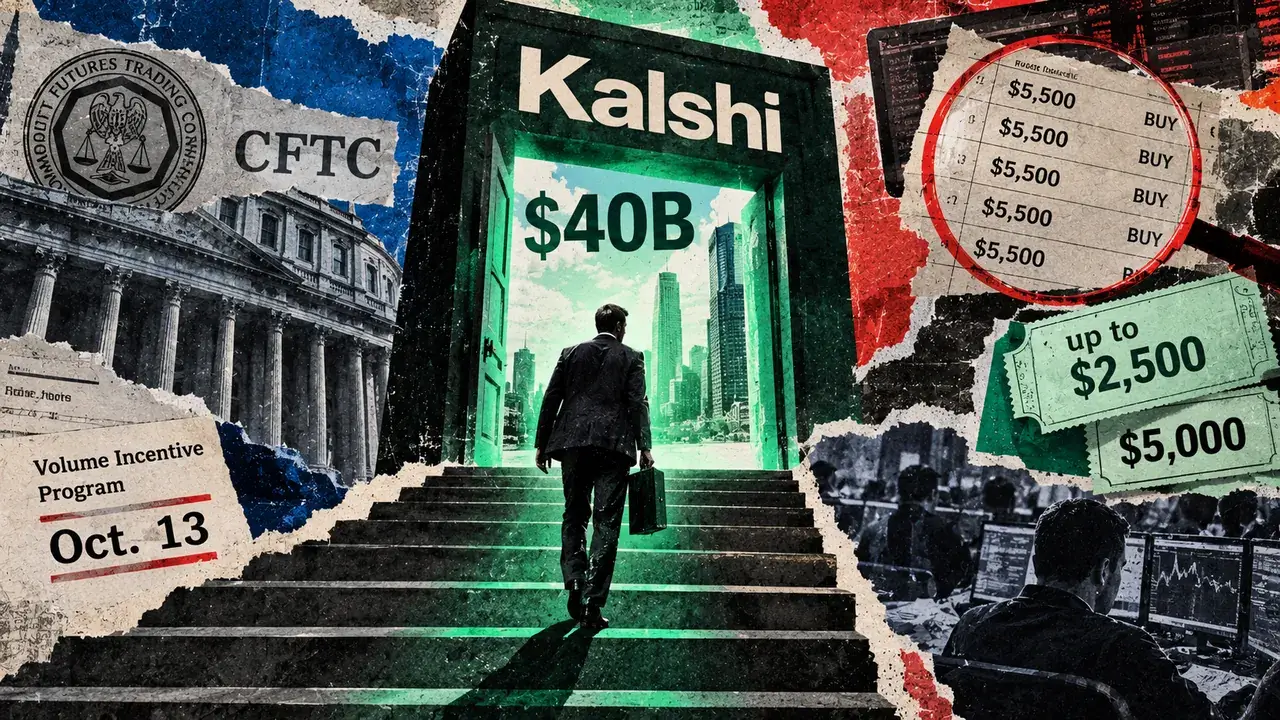
Kalshi is ending a program that rewarded trading volume almost a year ahead of schedule, while introducing a more targeted system tied to deposits and trading activity. The move comes as the prediction-market operator faces questions about the quality of some trading in its crypto markets and seeks a reported valuation of about $40 billion.
According to CryptoSlate, Kalshi notified the Commodity Futures Trading Commission (CFTC) that its Volume Incentive Program would terminate no earlier than Oct. 13. The scheme had been scheduled to continue until Oct. 1, 2027. Kalshi’s filing did not give a reason for bringing the program to an earlier close, and its terms allowed the company to end it at its discretion.
From broad volume rewards to targeted promotions
The outgoing program was designed to increase activity on Kalshi’s central limit order book, where buy and sell orders are matched. Kalshi could select eligible markets and set reward pools, with participants receiving a share based on their portion of qualifying trading volume.
Rewards for event contracts were capped at half a cent per contract for each participant. Perpetual futures were also eligible, and unlike other contracts, they were not subject to the program’s qualifying price range of 3 cents to 97 cents.
Kalshi has now filed a separate Deposit and Trading Reward Incentive Program. A modified version was recorded by the CFTC on Sept. 25, with the filing identifying Sept. 28 as the earliest effective date. The two programs are not formally described as replacements and may overlap before the volume scheme ends, but the new framework gives Kalshi substantially more discretion over how incentives are distributed.
Under the new system, promotions can last between three and 90 days and can be linked to deposits, trading, or both. Kalshi can target users according to factors such as account age, whether an account is funded, previous activity, inactivity, location and past participation in specific contract categories.
Promotions may cover crypto, sports, economics, financial markets, politics, weather and entertainment. A single promotion can provide as much as $2,500 to an individual, while the total reward available to one person is capped at $5,000 over the program’s planned two-year duration. Kalshi can use either percentage-based matches or fixed-value payments.
The change matters because it shifts Kalshi from paying primarily according to overall market volume toward selecting particular groups of users and behaviors. That could give the company more control over customer acquisition, reactivation and retention as platform activity expands.
Questions over crypto-market trading patterns
The program reset follows increased attention to trading patterns in Kalshi’s perpetual futures markets. Researchers identified repetitive transactions around fixed dollar amounts, including trades of roughly $5,500 in Ethereum perpetuals. The CFTC has reportedly examined the activity.
Kalshi has said it is not under investigation and has rejected allegations of wash trading. Wash trading generally refers to transactions in which the same party effectively buys and sells to create the appearance of market activity without genuine economic exposure. Kalshi has attributed the repeated trades to market makers placing quotes of fixed size that were repeatedly taken by other traders.
The filing ending the volume program does not connect the decision to the concerns over trading patterns. The new incentive rules do, however, contain more explicit provisions addressing potentially abusive activity. Trades being reviewed for possible self-matching, wash trading, prearranged trading or other prohibited practices will not qualify for promotional rewards.
Kalshi said its surveillance personnel would apply heightened monitoring to users receiving incentives. The company can remove a participant from a promotion or take disciplinary action if necessary. These provisions give the operator a clearer mechanism for limiting rewards linked to activity that is being questioned.
Record volume and the reported $40 billion valuation
The changes are being introduced even as Kalshi reports strong headline growth. Data compiled by DeFiRate showed record daily volume of $3.24 billion on Sept. 27. Trading for the seven days ending that day reached $15.66 billion, while Kalshi accounted for about 80% of tracked prediction-market volume.
That expansion is also shaping investor expectations. Reuters has reported that Kalshi is in advanced discussions to raise approximately $1 billion at a valuation of around $40 billion. Sequoia Capital and Wellington Management are considering leading the round, while Tiger Global and Dragoneer Investment Group are also evaluating investments.
A transaction at that valuation would nearly double the $22 billion value assigned to Kalshi in a $1 billion funding round in May. Reuters also reported that Kalshi is examining expansion into additional asset classes and has held preliminary discussions about a possible initial public offering.
The valuation discussions raise a central question about the company’s growth: how much of the rising activity represents lasting demand from traders, and how much is supported by incentives designed to encourage deposits and transactions. Kalshi’s new framework does not eliminate rewards; instead, it gives the company more flexibility to direct them while applying additional monitoring to participants.
Moneyiar market picture
Moneyiar data at 09:43-09:44 on Oct. 1, 2026, showed mixed moves among selected digital assets:
- Filecoin (FIL): $1.0259100445, down 4.89% over 24 hours and up 6.67% over seven days.
- Gram (prev. Toncoin) (GRAM): $1.5003801089, up 0.44% over 24 hours and 6.87% over seven days.
- NEAR Protocol (NEAR): $5.2138133791, up 2.34% over 24 hours and 23.72% over seven days.
- Ethereum Name Service (ENS): $6.927437581, down 1.43% over 24 hours and up 4.73% over seven days.
These figures describe the selected assets’ market performance and are separate from Kalshi’s reported trading-volume figures.





