
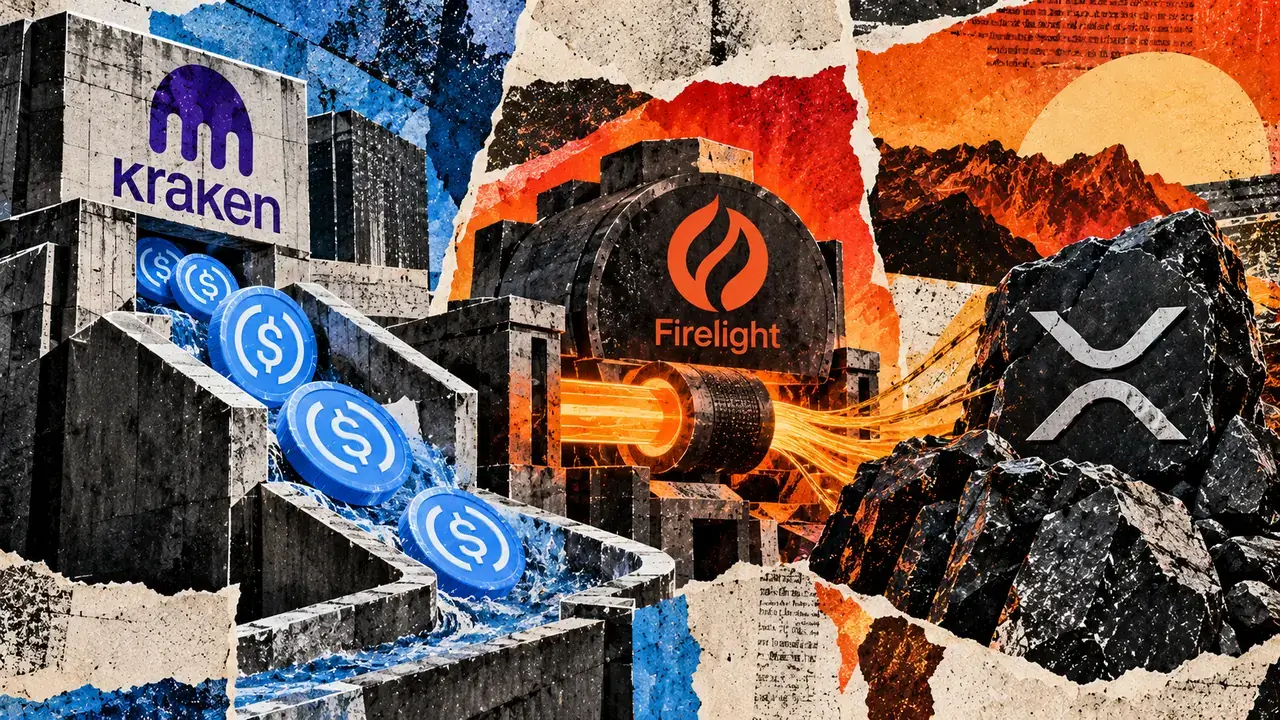
A new integration between Kraken’s DeFi offering and Firelight’s coverage protocol is creating a possible income stream for investors who provide XRP-linked collateral. The arrangement connects Kraken’s Protected Strategies USDC vault with Firelight’s pool on Flare, but the returns remain untested and providers can absorb losses from covered incidents across the wider portfolio.
Kraken vault connects to Firelight coverage pool
Firelight announced on Oct. 15 that Kraken’s Protected Strategies USDC vault had joined its coverage system. The product is available through Kraken’s DeFi Earn service, while Sentora, the vault’s independent curator, arranged the enrollment.
The mechanism is designed to protect eligible deposits against specified DeFi failures. In return, investors in the Kraken vault accept a lower yield because the published annual percentage yield already includes fees charged for coverage by Firelight and Sentora. Those charges can change each month.
Kraken said it does not receive the fees and does not arrange or guarantee any resulting claim payments. Instead, the premiums are directed to Firelight, where collateral providers receive a share of the income for supplying capital that can be used to cover eligible losses.
According to CryptoSlate, the integration gives Firelight access to another distribution channel for its protection product. It also gives XRP-linked capital a way to earn from premiums paid by users of a USDC-based investment product, even though those Kraken customers do not need to hold XRP themselves.
How XRP-linked returns are generated
Firelight operates on Flare and uses FXRP, a representation of XRP created through the network’s FAssets system. Participants who stake collateral receive stXRP, which represents their claim on the assets supporting Firelight’s coverage commitments.
When a participating vault pays a protection premium, Firelight converts the fee from USDC into FXRP and adds it to the shared collateral pool. The benefit to stakers is reflected in the redemption value of stXRP rather than being paid as additional tokens directly into their wallets.
This means potential returns depend on the amount of protection that customers purchase and renew. Firelight initially launched the system with Sentora’s USD Protected and Protected RWA vaults on Oct. 6. The Kraken-distributed product now adds another source of premiums to the same pool.
The arrangement could create demand for FXRP when USDC premiums are converted, but it does not automatically represent new purchases of native XRP. Investors providing collateral may use XRP they already own to obtain FXRP, while Kraken’s vault users can participate without acquiring XRP.
Firelight also offers separate participation rewards and points. Those incentives are distinct from the core staking return, which comes from coverage fees. The protocol has not disclosed how much premium the Kraken vault has generated or how much FXRP has been purchased through those conversions, leaving the size of the opportunity unconfirmed.
Coverage risk and withdrawal limits
The income comes with exposure to losses throughout Firelight’s active coverage portfolio. Capital supplied by a staker for premiums associated with Kraken can be affected by a qualifying incident involving another covered vault.
Firelight first uses a stablecoin reserve known as the First-Loss Buffer to pay validated claims. If that reserve is depleted, the protocol proportionally reduces the assets backing stakers’ positions, a process called slashing. As a result, the amount of FXRP redeemable against a position can fall. Premiums that have already compounded into the pool remain exposed along with the original collateral.
Eligible Kraken depositors can receive up to $100,000 per address for each coverage period. However, payments are also restricted by the vault’s aggregate coverage limit and the capital available at the time, so approval of a claim does not guarantee full reimbursement.
Covered events include specified smart-contract exploits, oracle failures, governance attacks and failures in a protocol’s economic mechanisms. Ordinary declines in asset prices, changes in advertised yield and routine liquidity shortages are excluded.
Firelight’s independent Risk Consortium decides whether an event qualifies. Sentora is responsible for distributing any approved USDC payments to eligible wallets, while Kraken does not finance the claims.
Collateral providers also face a delayed exit. A withdrawal currently takes 30 to 60 days after an unstaking request, and exposure to eligible losses can continue for part of that period. Premium accrual stops when the request is submitted.
Monthly resets will determine demand
Firelight resets coverage terms, prices and capacity every 30 days. At each renewal, vault operators can reassess whether the protection is worth its cost, while the reset determines how much premium income remains available to collateral providers.
The system’s capacity is tied to the dollar value of FXRP collateral and the stablecoin reserve. A decline in XRP’s price could reduce the backing available for new coverage even without a claim event.
The key measures to watch are premium payments, their conversion into FXRP and whether capital providers remain committed after the risks become clearer. More recurring demand could expand the pool and support additional covered products, while claims or withdrawals could constrain growth.
Moneyiar market picture
Moneyiar data at 22:34 on Oct. 19, 2026, showed XRP at $1.3048583726, up 0.66% over 24 hours but down 3.55% over seven days. The same data listed Stable at $0.024947893, up 4% in 24 hours and down 8.19% over seven days; Sentient at $0.0224143722, up 0.65% and 8.8%, respectively; and Nexus at $0.0000006715, down 6.01% over 24 hours and 17.01% over seven days.





