
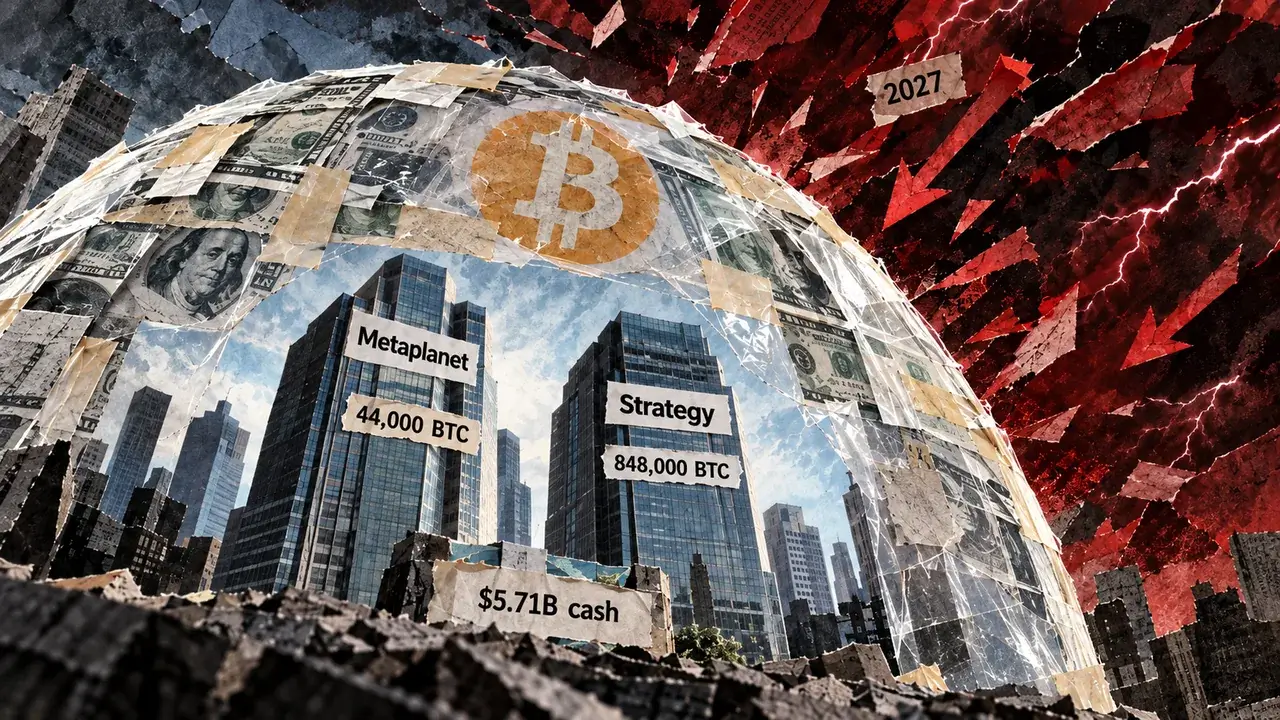
Metaplanet sold 10,000 Bitcoin and later bought 11,000 back at a materially higher average price, turning a financing demonstration into an expensive balance-sheet exercise. The Japanese Bitcoin treasury company said the sale was intended to show potential creditors that it could convert part of its holdings into cash when needed, supporting its pursuit of a credit rating and improved access to financing. According to CryptoSlate, the transactions reveal the tension between long-term Bitcoin accumulation and the shorter deadlines imposed by lenders and other securities investors.
A costly demonstration of liquidity
Metaplanet received ¥124.7 billion from the Bitcoin sale and subsequently spent ¥149.9 billion to purchase 11,000 BTC. Based on the average prices disclosed, replacing the 10,000 Bitcoin that had been sold created an estimated price difference of approximately ¥11.57 billion, before transaction costs and possible tax effects.
The company did not use the sale proceeds to repay borrowings or bonds. Instead, the transaction formed part of an effort to strengthen the financing structure supporting continued Bitcoin accumulation. Metaplanet ended September with 44,000 BTC.
The logic behind the sale was that owning Bitcoin is not identical to having cash available for a payment. Bitcoin can be pledged as collateral, while management may also be reluctant to sell during an unfavorable market. Creditors, however, assess whether a company can meet obligations when they fall due, regardless of its long-term view of the asset.
Metaplanet’s June financial statement listed ¥67.49 billion in short-term borrowings and ¥8 billion in bonds payable within one year. Against those obligations, it reported ¥1.09 billion in cash and deposits and ¥250 million in USDC. Those figures exclude the company’s larger Bitcoin reserve and any financing it might access, but they help explain why lenders may seek evidence of liquidity beyond a headline BTC balance.
Bitcoin holdings still face fixed payment dates
The same issue affects other corporate Bitcoin holders, including Strategy. Its notes technically mature in September 2028, but holders have a right to demand repayment that could create a cash obligation one year earlier. Strategy’s June filing also identified approximately $4.9 billion of notes with similar holder repurchase rights during 2028. Together, the principal connected with the relevant 2027 and 2028 dates was about $5.91 billion.
These amounts may be reduced before those dates through conversions or repurchases, and holders must exercise their rights. Even so, the terms establish points at which access to cash can matter more immediately than confidence in Bitcoin’s eventual price.
Companies can respond by raising new debt, issuing securities, drawing on cash or selling Bitcoin. Each option carries its own cost. A company may continue to believe in Bitcoin while slowing purchases or selling some holdings to meet obligations. That is different from a forced liquidation, and the disclosures described here do not establish that either Metaplanet or Strategy faces an imminent forced sale.
Cash is part of the Bitcoin strategy
Strategy has built a substantial dollar cushion alongside its Bitcoin reserve. Its October 5 filing reported a dedicated reserve of $4.88 billion and a separate dollar-denominated cash balance of $833.4 million, for approximately $5.71 billion as of October 4.
The dedicated reserve supports preferred-stock dividends and debt interest, and its policy requires board approval for other uses. The separate cash balance provides additional flexibility. However, the two figures should not be treated as one entirely unrestricted pool available for any future repayment.
Between September 28 and October 4, Strategy used $142.5 million from its reserve for dividends and interest, spent $154.1 million repurchasing preferred shares and bought $13 million of Bitcoin. It still held 848,000 BTC, acquired for approximately $63.97 billion. The figures show why maintaining cash can help a company avoid selling Bitcoin simply because a payment arrives during an unfavorable market period.
Share issuance creates another constraint. When a treasury company’s shares trade above the value of its underlying assets, selling stock can raise funds while increasing Bitcoin exposure per existing share. If that premium disappears, issuing shares may require greater dilution for the same amount of capital.
Metaplanet’s June results said its market-value-to-net-asset-value measure, or mNAV, was below 1.0 for much of the period. Its policy generally avoids discretionary common-share issuance below that level, limiting one potential source of funding. The company continued buying through other sources, but the episode shows that accumulation can become harder before a company is forced to sell its core asset.
Metaplanet looks beyond simply holding Bitcoin
Metaplanet’s revised allocation policy targets approximately 85% to 90% of assets in Bitcoin and 10% to 15% in strategic investments, including income-producing securities. Its Net Interest Income Strategy aims to earn more from those investments than it pays to finance them.
The potential investments include preferred securities issued by other Bitcoin treasury companies. That could create recurring income for financing expenses or additional purchases, but it also creates linked exposure: a decline in Bitcoin could weaken Metaplanet’s core holdings while securities issued by similar companies could also lose value or become less reliable sources of income.
The broader message is that corporate Bitcoin ownership depends on the money surrounding the asset. The coins do not expire, but loans, bond terms, preferred dividends and shareholder expectations impose deadlines. A willingness to sell some Bitcoin on reasonable terms may therefore be more useful than a strict promise never to sell if the alternative is expensive borrowing or excessive dilution.
Current market picture
Moneyiar market data at 11:54 a.m. on October 11, 2026, showed Bitcoin at $83,063.436843442, up 0.3% over 24 hours but down 2.61% over seven days. Solana was $109.5130351242, down 0.24% over 24 hours and 9.69% over seven days. Sui stood at $1.095073571, down 2.32% and 7.26% over those periods, respectively. Plasma was $0.0870976927, up 0.27% over 24 hours and down 8.31% over seven days.




