
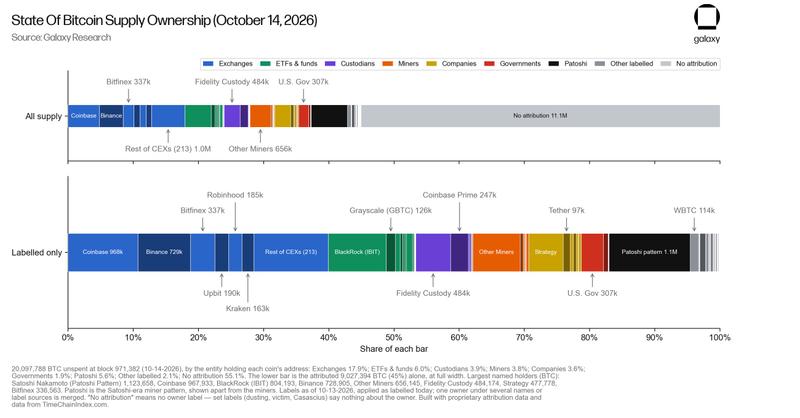
Bitcoin’s growing presence in mainstream finance has not made most of its supply easy to attribute. About 11.1 million BTC—roughly 55% of the approximately 20.1 million coins mined—sits in addresses that Galaxy Research cannot connect to an exchange, fund, government or another identified entity, according to CoinDesk.
The finding highlights how much of the cryptocurrency may still be held through self-custody, where individuals control their own private keys instead of leaving coins with an exchange, fund or professional custodian. But the blockchain data does not reveal who controls every unattributed wallet, so the figure should not be read as a precise count of bitcoin owned by individual investors.
What the unidentified supply shows
Galaxy’s October snapshot separates bitcoin addresses with no known attribution from wallets and holdings that researchers have been able to associate with recognizable entities. The unattributed category accounts for approximately 11.1 million BTC, or 55% of the roughly 20.1 million BTC mined so far.
Alex Thorn, Galaxy’s head of research, said the scale of the unidentified holdings indicates that self-custody remains widespread despite the expansion of exchanges, investment funds and institutional custody services. In self-custody, the holder—not an intermediary—maintains control of the keys needed to access the bitcoin.
That interpretation supports a broader view of Bitcoin’s development: individual users entered the market before larger financial institutions became involved. Xapo Bank, a bitcoin-focused bank, responded to Thorn by describing the large pool of unnamed wallets as evidence that retail participants have been involved for more than a decade, while institutions arrived later.
A bitcoin address can be compared with an account number on a public ledger. The balance and transaction history are visible, but the real-world identity behind the address is not automatically disclosed. Research firms therefore analyze known wallet patterns and blockchain activity to connect addresses with exchanges, funds, governments and other organizations.
This means “no known owner” refers to a lack of public attribution, not necessarily a lack of control. Someone may own the bitcoin while remaining unidentified to outside researchers.
Why the 55% figure needs caution
The unattributed total includes several possibilities beyond bitcoin held by individual investors for the long term. Some coins may be lost because their owners forgot or lost their keys, or because the owners died without passing on access. Those coins remain visible on the blockchain but may no longer be spendable in practice.
The category may also contain coins mined during Bitcoin’s early years, including early holdings that researchers have not linked to a known person or organization. Other unattributed balances could belong to institutions that Galaxy has not identified, such as companies, funds or over-the-counter trading desks. OTC desks arrange large transactions privately rather than through publicly visible exchange order books.
Complex custody arrangements create another source of uncertainty. A single owner or organization may distribute holdings across many addresses, making the associated balances more difficult to identify as belonging to one entity.
For that reason, the data indicates the scale of Bitcoin that cannot currently be linked to a named category. It does not establish that 55% of the supply is actively controlled by retail investors, nor does it show how much of the amount is permanently inaccessible.
The portion that has been attributed
The remaining 45% of bitcoin supply has been linked to known categories or entities in Galaxy’s analysis. Those attributed holdings include cryptocurrency exchanges, exchange-traded funds led by BlackRock, the U.S. government and the wallet grouping associated with the “Satoshi Nakamoto (Patoshi Pattern)” label.
Galaxy lists that Satoshi-era miner pattern as the largest single identified holder, with 1,123,658 BTC. The label refers to a set of early mined blocks that researchers associate with one miner, rather than providing a confirmed real-world identity for Bitcoin’s pseudonymous creator.
The comparison underscores the difference between institutional visibility and overall ownership. ETFs and other professional holders have attracted significant attention as Bitcoin has gained acceptance in mainstream financial markets. Yet, based on Galaxy’s classification, the largest portion of the supply remains in addresses that researchers cannot name.
Current Bitcoin market picture
Moneyiar market data recorded Bitcoin at $80,430.51 at 22:39 on October 25, 2026, Tehran time. The cryptocurrency was down 0.08% over 24 hours and 1.32% over seven days.
The source report cited a Bitcoin price of $84,459.46 when discussing the asset’s growing acceptance on Wall Street. The difference reflects the separate market-data timestamp and source. Bitcoin is the native asset of the Bitcoin blockchain, where miners verify transactions and add them to the public ledger in return for newly issued BTC.
The ownership research therefore offers a view of Bitcoin’s distribution rather than a direct measure of market performance. It shows that institutional participation can grow while a large share of the supply remains difficult to attribute, with individual self-custody, lost coins and unidentified professional holdings all potentially contributing to the total.




