
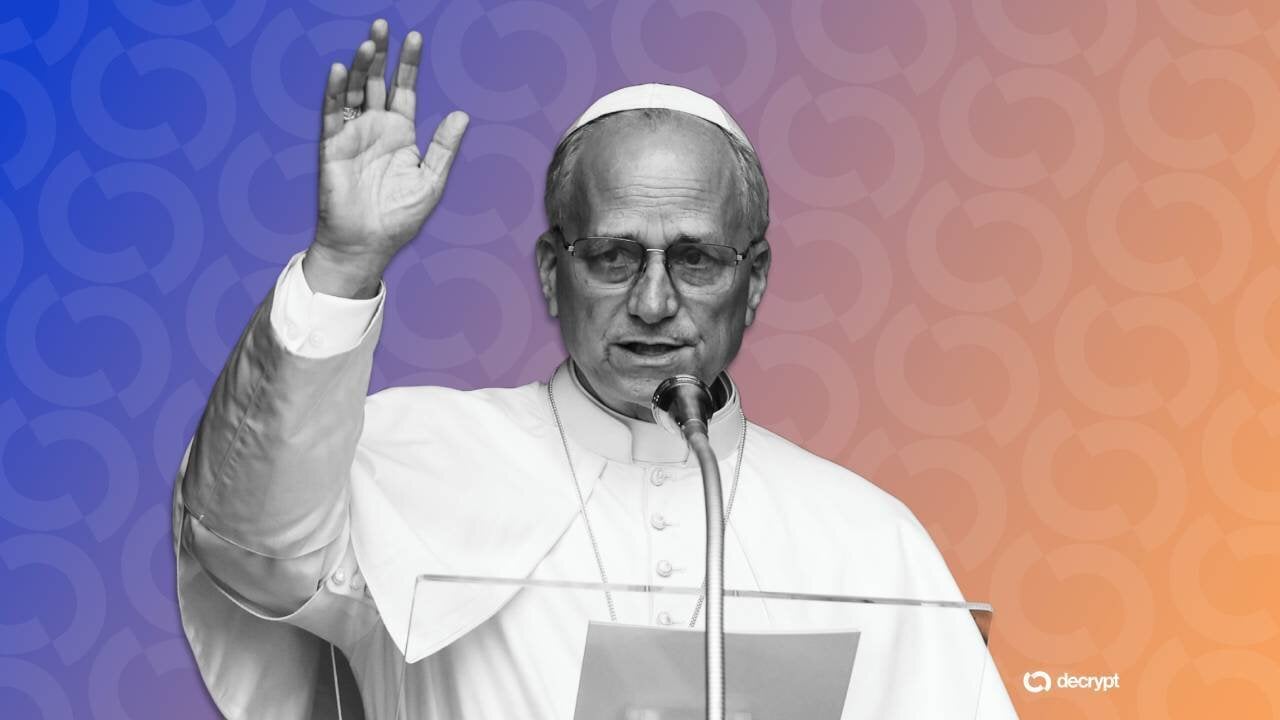
Pope Leo XIV has drawn a clear line between art made by people and images produced by artificial-intelligence systems, arguing that the difference is fundamental rather than merely a matter of artistic quality.
In an Oct. 2 post on X, the pope said there is an “ontological difference” between human art and material generated by machines. He also said the Catholic Church wants to renew its relationship with artists and cultural institutions in order to “safeguard our humanity.”
The comments, reported by Decrypt, place the pope’s latest warning within a broader Vatican discussion about how artificial intelligence should be developed and used. They also add a cultural dimension to debates that increasingly involve copyright, authorship and the economic value of creative work.
What the pope said about machine-made images
The word “ontological” refers to the fundamental nature of something. In this context, Pope Leo’s argument is that a painting created by a person and an image generated by an AI model may appear similar, but they are not the same kind of creation.
The pope said machine-generated material is produced through “statistical calculation based on millions of images created by others.” He added that algorithms lack the “spark of humanity.”
AI image generators are trained using large collections of existing pictures. They identify patterns and relationships in that material and use those patterns to predict the appearance of a new image. The pope’s criticism focuses not only on whether the resulting picture is attractive or technically impressive, but also on the absence of a human creator’s direct experience and intention behind the output.
That distinction reflects a wider argument over the growth of cheaply produced, low-quality AI content, often described as “AI slop.” The issue is therefore not limited to artistic standards. It also concerns what an AI-generated work is, who can claim responsibility for it and whether it should receive the same recognition as work made by a person.
The Vatican’s wider AI position
The Oct. 2 post follows several recent steps and statements from Pope Leo on artificial intelligence.
In May, he issued his first encyclical, a formal teaching document for the Catholic Church, titled “Magnifica Humanitas.” The document addressed the protection of people in an age of AI and argued that technology is not neutral. It also said data should be regarded as a common good.
The Vatican established an AI commission during the same month. The group brings together seven Vatican bodies and is intended to coordinate the Holy See’s approach to AI, including policies governing its use within Vatican offices.
On Sept. 25, during a speech to French authorities at the Élysée Palace in Paris, Pope Leo said it was essential for AI to be the subject of his first encyclical. He also warned that science and technology without the direction of conscience could lead people away from what is good.
His latest comments suggest that this concern extends beyond government policy and workplace use. The pope is also questioning how AI affects culture, creativity and the way society values human expression.
Authorship, detection and copyright
The debate has practical consequences as well as philosophical ones. In March, the U.S. Supreme Court declined to hear Thaler v. Perlmutter. That decision left in place an appeals-court ruling that copyright protection requires a human author, in a dispute involving artwork made entirely by an AI system.
Questions about whether content was created by a person have also become difficult to answer reliably. In April, an AI-detection extension developed by Pangram Labs reportedly flagged several posts from Pope Leo’s own X account as likely AI-generated. The Vatican did not respond to requests for comment at the time.
Detection tools can produce questionable results. The source report noted that ZeroGPT identified the U.S. Declaration of Independence as 97.93% AI-generated in 2024. In July, however, Proudly Human said a collection of Pope Leo’s speeches and writings about education and AI received its human-authored mark.
Artists and creative platforms have responded in their own ways. Cara, a portfolio network designed to exclude AI-generated images, reached nearly 900,000 users by June 2024. Its growth illustrates the demand among some creators for spaces that distinguish human-made work from machine-generated material.
Moneyiar market picture
Moneyiar market data at 09:49 on Oct. 5, 2026, showed Algorand at $0.1302571904, down 0.77% over 24 hours but up 4.97% over seven days. Humanity was priced at $0.0696022756, with a 24-hour decline of 0.34% and a seven-day gain of 2.27%.
At 09:48, Moneyiar data showed Huma Finance at $0.0355625144, up 1.38% in 24 hours and 32.85% over seven days. Spark stood at $0.024613948, down 1.04% over 24 hours and up 9.12% over seven days.
These market figures are separate from the pope’s remarks and do not indicate a direct connection between the assets and the Vatican’s discussion of AI or human creativity.




