
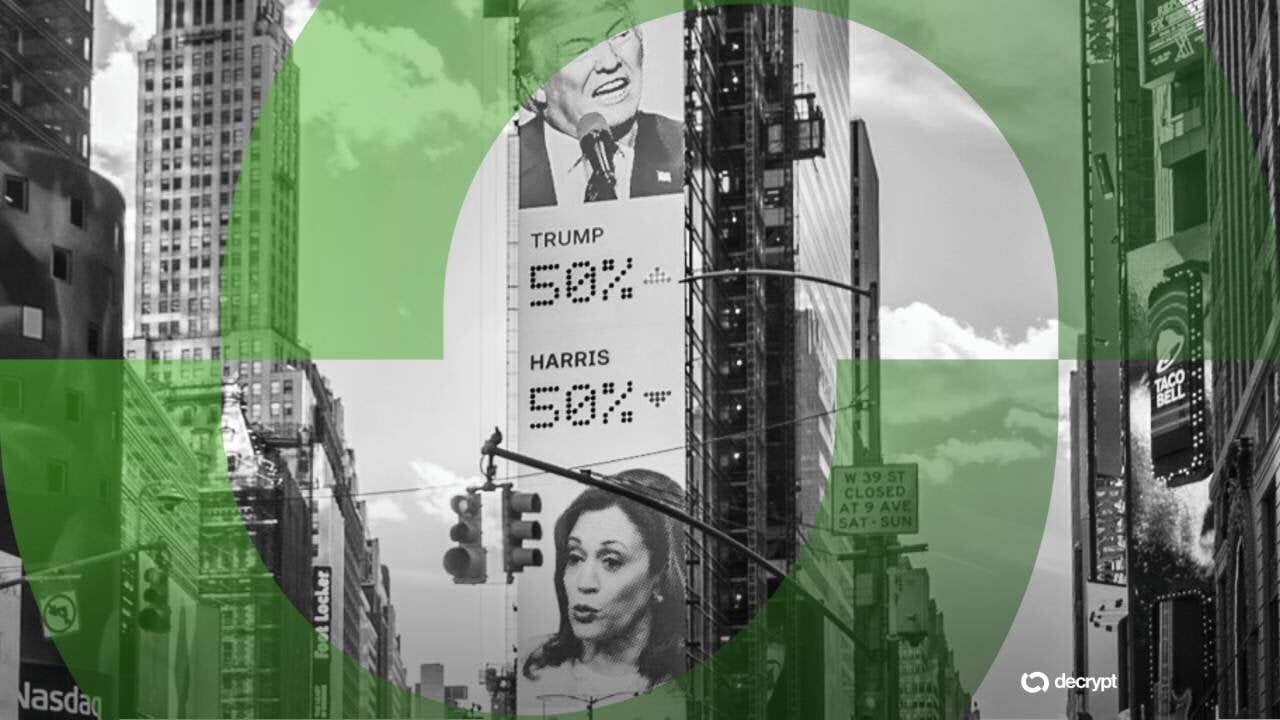
Prediction markets are entering the November 3 U.S. congressional elections with substantially more scale than they had before the 2024 presidential vote, setting up a high-profile test of whether market-based forecasts can compete with polls and election models.
Kalshi and Polymarket, the two most prominent U.S. prediction-market platforms, recorded combined monthly trading volume of $53 billion in July, according to a Pew Research Center analysis cited by Decrypt. That was more than double the $26 billion recorded in May. Most of the activity was tied to sports, however, rather than politics.
The political portion remains comparatively small. Pew found that political trading averaged about $2 billion a month on Polymarket this year and less than $300 million on Kalshi. CNBC reported that more than $30 million had been traded by July on contracts covering which party will control the House of Representatives and the Senate.
The increased activity gives the platforms a longer period to establish prices before the midterms. In 2024, election contracts became legal in the United States only about a month before the presidential election. This year, Kalshi has had much more time to develop its political offering. Benjamin Freeman, the company’s head of politics growth, told CNBC that there was now “a much longer runway to plan.”
A new contest with traditional forecasts
The central question is whether prediction markets can provide a useful signal alongside, or potentially in competition with, polling and statistical election models. In a prediction market, participants buy and sell contracts linked to an outcome. Prices are commonly read as an implied probability, although those prices can also reflect limited trading, hedging or other motives.
Kalshi launched its Midterms Hub in June, placing market-implied odds for individual races next to polling averages. The move came as the legal position of election contracts continued to develop.
The Commodity Futures Trading Commission had previously blocked Kalshi from listing contracts on which party would control Congress, ruling that the contracts involved “gaming.” In 2024, the agency proposed a rule that would have classified election contracts as gaming, but withdrew that proposal in February. On June 10, it published a proposed framework for event contracts. A Congressional Research Service analysis said the framework would not treat elections as gaming and noted the regulator’s argument that markets could “harness the wisdom of the crowds” to produce information more reliable than other forecasting methods.
That claim is now heading toward a practical test. The November vote will provide a broad set of outcomes against which market prices, polls and models can be compared, although the political markets are not equally active across all races.
Thin trading raises questions
The depth of trading is a major issue for congressional contracts. Research from the Anti-Corruption Data Collective, shared with CNBC, found that a $3,500 wager—the maximum personal federal campaign contribution—could move 97% of midterm-related markets by at least five cents. Michael Hornsby, the group’s co-director, said the thinness of many congressional markets showed that the trading needed to correct inaccurate prices often was not present.
Kalshi spokesperson Dani Lever offered a different view, arguing that mispricing in a liquid market creates an opportunity for traders to correct it. The disagreement highlights an important distinction: a market price may look precise, but its usefulness depends partly on how many participants are trading and how easily new information can change the price.
There is also evidence supporting the broader market approach. Morgan Stanley’s Counterpoint Global studied more than 72 million Kalshi trades and found that prices tracked outcomes closely. Still, the research does not remove the question of whether relatively small and thinly traded political contracts can perform as well as larger markets.
NEXTPredict puts the debate on stage
The relationship between polls and prediction markets will be a central topic at the NEXTPredict summit in New York on October 22 and 23, two weeks before the election. Former NBC News political director and Meet the Press moderator Chuck Todd is hosting the event, which is expected to draw about 2,500 attendees. CNBC correspondent Contessa Brewer and CNN senior reporter Marshall Cohen are also scheduled to participate.
Todd said he wants to examine how much pollsters and prediction markets need one another, how the two systems influence each other, and whether trading election outcomes is healthy for politics. He has also questioned whether activity reflects genuine hedging or analysis, or whether some of it is simply entertainment.
One race has already changed his view. Discussing the Texas Senate contest between Democrat James Talarico and Republican Ken Paxton, Todd said he would be more surprised by a Talarico loss than a win, aligning himself with the prediction markets. He also warned that the timing of voter engagement could matter, saying Trump voters may tune in later than Democratic voters and that September optimism can give way to October realism.
Todd will moderate a summit panel titled “Who Calls the Midterms: Polls, Models or the Markets?” Participants will include Columbia University professor Rajiv Sethi, Decision Desk HQ chief elections analyst Geoffrey Skelley and PredictIt CEO John Phillips. The discussion will focus on where each method can fail and which signal deserves the most weight as results begin arriving on November 3.
Moneyiar market picture
Moneyiar data at 11:09 a.m. on October 21, 2026, show Ethereum at $2,460.6253, up 3.14% over 24 hours but down 1.59% over seven days. At 11:08 a.m., Polygon’s POL token was $0.0960037588, up 4.16% in 24 hours and down 2.54% over seven days. Lighter’s LIT token was $3.3768951501, up 6.4% over 24 hours and 1.39% over seven days.




