
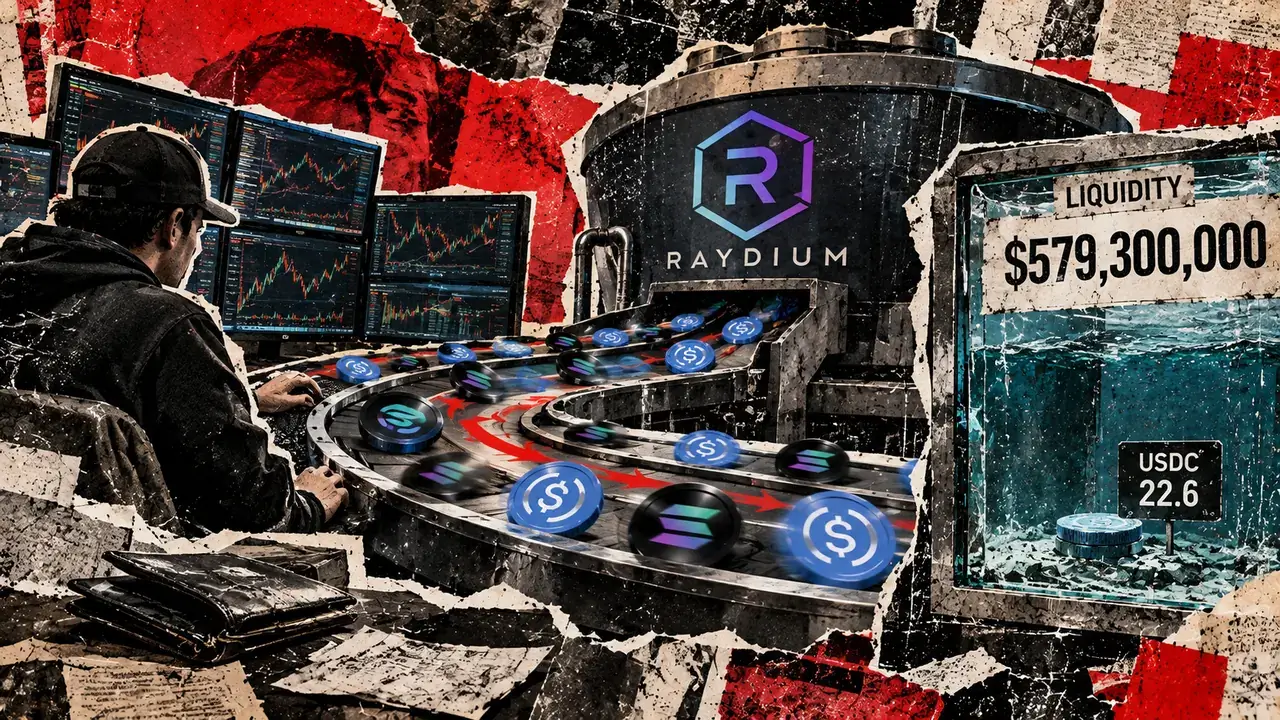
A Solana wallet used about $12,000 in working capital to generate roughly $1.4 billion in suspected wash-trading volume across Raydium’s concentrated-liquidity pools, according to blockchain analytics firm Bitquery, as reported by CryptoSlate. The activity represented 22.7% of the $6.17 billion traded in that segment between Sept. 21 and Oct. 20.
The findings raise questions about how reliably decentralized-exchange statistics reflect genuine market demand. Trading volume and displayed liquidity are commonly used by market participants to judge whether an asset is actively traded and whether sizeable orders can be executed without sharply moving its price. In this case, Bitquery’s analysis suggests that repeated transactions by a small group of wallets may have inflated both measures.
How the suspected trading operation worked
Bitquery identified 108,871 swaps across 438 pools linked to the activity. Many of the pools contained tokens using tickers associated with established cryptocurrencies, including XRP, Litecoin, Monero and Lisk. The investigation described the activity as suspected wash trading, in which assets are repeatedly bought and sold among related participants to create the appearance of market activity without corresponding independent demand.
The principal wallet appears to have repeatedly purchased tokens and then sold them back into the same pools. That allowed a relatively small amount of capital to produce a much larger turnover figure.
One transaction on Oct. 20 illustrates the pattern. The wallet exchanged 11,102 USDC for tokens in a pool using Lisk’s LSK ticker, then sold the tokens back 22 seconds later for 11,100.87 USDC. The round trip recorded approximately $22,200 in trading volume while costing about $1.13, excluding network fees.
Across the period examined, Bitquery counted 22,685 completed round trips. The analysis also identified 12 suspected helper wallets, which together carried out approximately 1.25 million swaps across thousands of pools.
The operator behind the wallets remains unknown. Bitquery linked the wallets through shared pools, funding sources and direct transfers, but did not establish that investors lost money. The findings also do not allege involvement by Raydium or by the platforms that displayed the pools.
Displayed liquidity differed sharply from reserves
The investigation found a significant gap between liquidity figures shown on DEXScreener and the USDC reserves held in the associated pools. Ten pools connected to the wallet displayed combined liquidity of about $5.93 billion, while holding only $10,238 in USDC, according to Bitquery.
One pool using the Lisk ticker showed approximately $579 million in liquidity despite holding about $19 in USDC when it was examined. The displayed valuation was based on nearly one billion tokens priced at about $0.58 each—close to the market price of the legitimate Lisk cryptocurrency.
A high displayed value does not necessarily mean that investors can sell a large position at that price. In concentrated-liquidity pools, the outcome of a trade depends on the amount of usable liquidity available across the relevant price range. If reserves are limited, a large transaction can cause severe price disruption even when a platform reports a very large headline liquidity figure.
Bitquery found similar pools using tickers associated with Monero, XRP, Ethereum and other established assets. The pools also appeared prominently in token searches. In one example, seven of the ten highest DEXScreener search results for XMR were linked to the suspected cluster, potentially putting users searching for the legitimate asset in front of similarly named tokens.
The investigation found limited evidence of independent participation. During the previous week, only four wallets outside the suspected cluster traded the pools, producing roughly $27 in combined transactions.
Market picture and wider implications
The latest findings follow CryptoSlate’s September report on Bitquery’s identification of $117.7 billion in circular or bot-like activity across its broader sample of Solana decentralized exchanges. The new analysis describes a more concentrated operation that affected a substantial share of Raydium’s concentrated-liquidity market while creating statistics that could mislead outside observers.
The central unresolved issue is whether decentralized trading platforms, token-search systems and data aggregators can distinguish genuinely funded markets from coordinated activity before users commit capital. Volume rankings may look strong even when most transactions are linked to a small group of wallets, while liquidity figures can appear large when token valuations are based on limited reserves.
Moneyiar market data at 23:34 on Oct. 22 showed Solana’s SOL at $103.2286, down 3.5% over 24 hours and 1.95% over seven days. Raydium’s RAY was $1.8269, down 6.76% over 24 hours but up 0.35% over seven days. USDC was priced at $0.9998646, with no reported change over either period. JUST’s JST token stood at $0.1391, down 0.71% over 24 hours and up 5.41% over seven days.





