
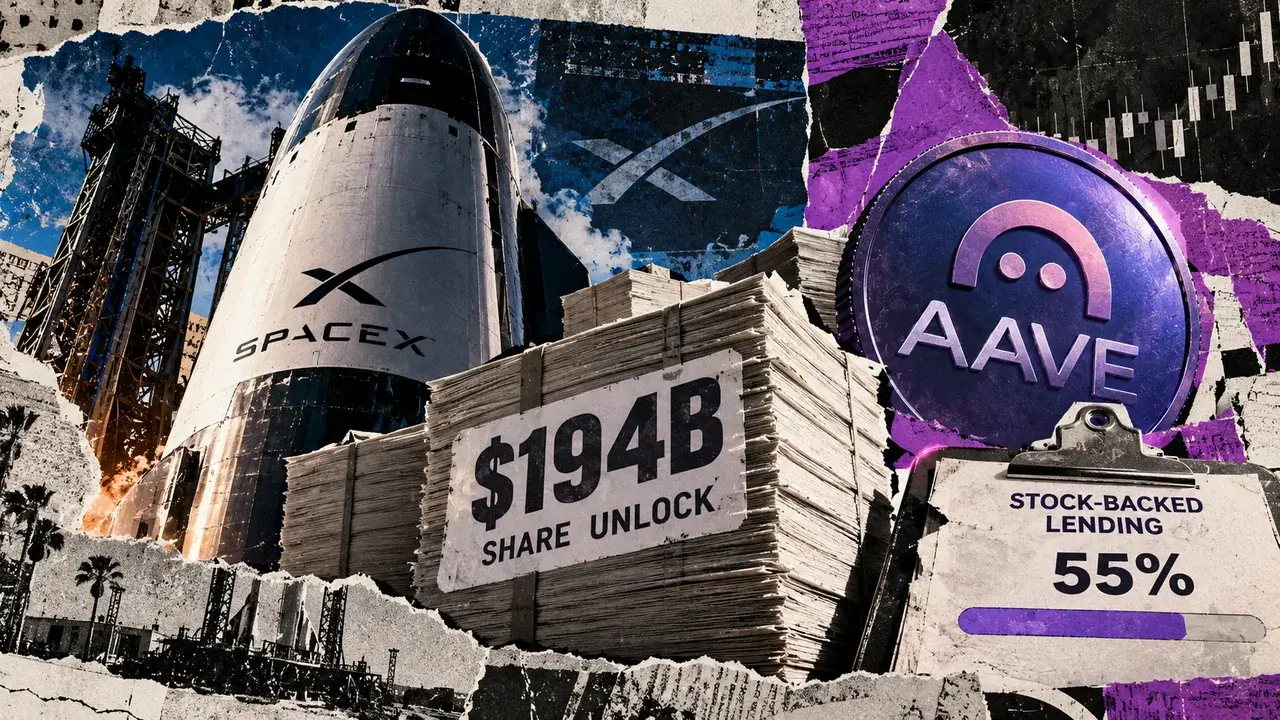
About 1.3 billion SpaceX shares are due to become eligible for sale on Oct. 22, creating a major test for Aave’s proposal to accept tokenized SpaceX equity as collateral. At SpaceX’s Oct. 20 closing price of $147.89, the newly eligible shares are worth approximately $194.3 billion. Eligibility does not mean that holders will sell, but even a limited flow of shares could affect trading conditions for a stock whose onchain representation has relatively shallow liquidity.
A large increase in potentially tradable supply
The Oct. 22 tranche represents about 28% of a roughly 4.691 billion-share lockup pool. It would increase the number of shares already tradable—about 2.9043 billion—by approximately 45%. A second release of around 328.4 million shares, valued at about $48.6 billion at the same closing price, is scheduled for Oct. 26.
The timing changed after SpaceX confirmed on Oct. 16 that it would publish earnings on Oct. 20. The company reported approximately $14.6 billion in revenue and $4.4 billion in net income. That earnings date brought forward the larger share release by roughly two weeks compared with the timetable in a risk assessment prepared for Aave.
According to CryptoSlate, Aave Labs had proposed adding tokenized SpaceX shares, known as SPCXc, to its V4 Equities Hub on Base. Aave’s risk adviser, LlamaRisk, published its assessment on Oct. 15. The public assessment reviewed as of Oct. 20 still showed the earlier November window as its latest entry, leaving the event calendar in need of updating.
The amount of selling remains unknown. LlamaRisk put average daily trading volume at roughly 91 million shares over the latest 30 sessions. If 1% of the 1.31 billion shares were sold, that would equal 13.1 million shares, or about $1.94 billion at $147.89—roughly 14% of average daily volume. Selling 5% would equal about 72% of average daily volume, while 10% would represent approximately 144%.
SpaceX shares rose 6.1% on the Aug. 6 unlock day and declined by around 4% around the Aug. 20 and Sept. 9 events. The stock closed Oct. 20 down 5.5% from Oct. 13 and approximately 14% below its Oct. 6 close of $171.92. Elon Musk’s holdings are subject to a separate lockup running through June 2027.
Why Aave’s proposed borrowing limit is 55%
LlamaRisk recommended a 55% collateral factor for SPCXc, meaning users could borrow up to roughly 55% of the collateral value under the proposal. That is below the 65% factor used for Tesla and Meta, described as the most conservative equity parameters currently supported by Aave.
The recommendation also included a maximum liquidation bonus of 6.5%, a 1,000-basis-point collateral risk premium, USDC as the borrowing asset and a supply cap of 37,000 SPCXc tokens. A liquidation bonus is an incentive for participants to repay a distressed loan and take control of the collateral.
The risk analysis modeled a severe 41% decline outside regular market hours. Combined with the proposed liquidation bonus and approximately 0.279% in accrued interest over the longest market closure, the calculation produced a collateral factor of about 55.2%, rounded to 55%.
SpaceX’s annualized realized volatility since its initial trading period was approximately 81.4%, compared with about 52% for Tesla. LlamaRisk noted that the SpaceX history is short and that the tail estimate was built using data from other stocks. Volatility over the most recent 30 sessions was 51.8%, while the longer-period figure included the stock’s initial price discovery.
For illustration, a borrower depositing $1,000 of SPCXc and borrowing $400 of USDC would begin with a 40% loan-to-value ratio. A 27.3% fall in the share price would bring that position to the proposed 55% threshold. At the maximum borrowing level, the position would already be at the liquidation threshold.
Thin onchain liquidity is the central risk
On Oct. 13, LlamaRisk counted 13,214 SPCXc tokens outstanding, worth about $2 million at the relevant share price. The Aerodrome SPCXc/USDC pool held $1.04 million, including around $452,000 of USDC, while its estimated depth for a 2% price move was approximately $370,000. More than 99% of trading was conducted through that single pool.
At $147.89, the proposed 37,000-token cap would represent about $5.47 million of collateral and support roughly $3 million of borrowing if fully used. That is approximately 0.0028% of the $194.3 billion value of the shares becoming eligible for sale. The comparison highlights the difference between the size of the traditional-market unlock and Aave’s potential direct exposure.
LlamaRisk expects larger liquidations to depend on issuer redemptions or hedges through perpetual futures. However, a liquidator using redemption would face eligibility restrictions. Aave’s Chainlink pricing operates around the clock on weekdays, while Nasdaq trading takes place during set sessions. That mismatch could expose USDC lenders to a price gap when the stock market is closed but onchain activity continues.
The Aave proposal remained subject to governance steps in the reviewed records, so SPCXc-backed borrowing on Aave was still prospective. Citi Research’s Oct. 19 note described Aave as a potential collateral-mobility layer for tokenized markets. A separate public Citi paper argued that programmable collateral could improve settlement speed and mobility, while warning that putting an asset onchain does not automatically change its underlying liquidity or fundamentals.
Moneyiar market picture
Moneyiar data at 11:13–11:14 on Oct. 21, 2026, showed AAVE at $156.0560, up 5.41% over 24 hours but down 2.28% over seven days. Nexus (NEX) was $0.0000006829, up 2.69% in 24 hours and down 10.79% over seven days. Ailey (ALE) stood at $0.26796, up 0.31% over 24 hours and down 0.06% over seven days, while BAS traded at $0.0185528, up 1.94% daily and down 11.20% weekly.
The proposed SpaceX listing therefore presents a focused test of tokenized lending infrastructure. The underlying stock’s volatility, scheduled equity-market closures and limited onchain exit liquidity could all matter as much as the size of the share unlock itself.





