
Stablecoin-linked payment cards are expanding rapidly, but the companies behind them still depend on familiar card fees, currency conversion and financing income to make the business work. For customers, the central question is whether convenience and rewards outweigh the costs of spending digital dollars in everyday transactions.
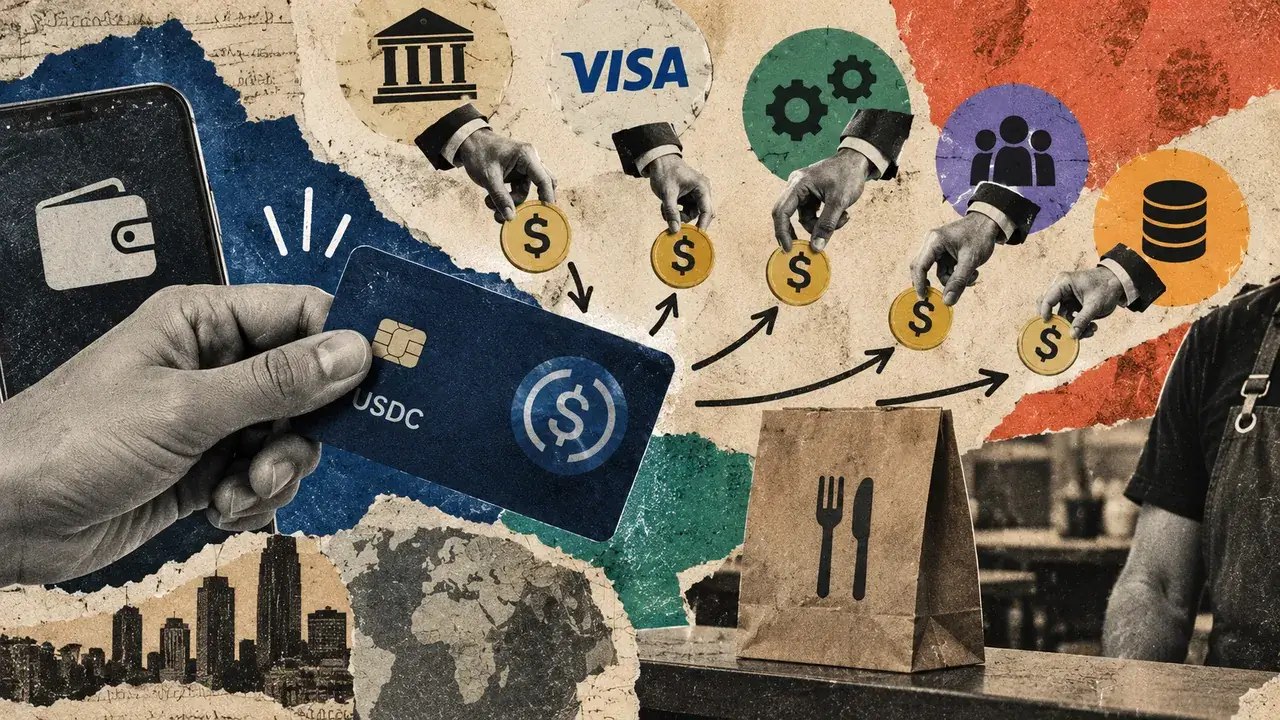
A stablecoin card allows a person to spend a dollar-linked token such as USDC at an ordinary card terminal. The customer’s digital-dollar balance funds the purchase, while the merchant receives local currency through its existing payment provider. In many cases, the restaurant or shop does not need to accept cryptocurrency or change its payment systems.
According to CryptoSlate, Visa said on October 1 that more than 160 stablecoin-linked card programs were operating, with payment volume almost 200% higher than a year earlier. Companies including Bridge, Wirex and Rain provide infrastructure for some of these products.
The growth creates potential revenue for several participants in the payment chain. These can include the consumer-facing wallet or financial app, a regulated card issuer, Visa as the payment network, the merchant’s acquiring provider and a company responsible for converting or settling the funds. The exact roles may overlap, and the revenue-sharing arrangements differ between programs.
Familiar card economics remain in place
Using USDC to fund a purchase does not remove the traditional costs of card payments. Interchange is one important source of income: the merchant’s bank or payment provider pays a fee to the card issuer as part of the broader cost of accepting cards. The issuer may share part of that income with the company operating the customer-facing product, while Visa earns revenue from its network and related services.
Bridge, which Stripe acquired in 2025, advertises a card product that allows program operators to keep all interchange revenue and charge additional transaction fees. That model gives wallets and financial applications a way to earn when users spend their balances. However, the amount left after processing, fraud prevention, compliance and support costs depends on each program’s contracts.
Those expenses can continue well after a payment is approved. A disputed transaction may lead to a chargeback weeks later, fraudulent activity requires investigation, and customer-service costs do not disappear simply because an individual purchase generated a fee.
Wirex co-founder and chief executive Pavel Matveev told CryptoSlate that programs using Wirex infrastructure process more than $200 million in monthly spending, including activity from partners. Wirex has not provided a breakdown of transaction fees or revenue sharing, so the reported volume does not show how much the company retains.
Settlement can require short-term financing
A card authorization confirms that a merchant can accept a payment, but the institutions involved still need to settle their obligations afterward. Stablecoins can move at any time of day, yet card programs must have funds available when settlement payments become due.
Rain, a stablecoin-card infrastructure provider, uses a revolving credit facility from Credit Coop for its Visa settlement obligations. Rain draws on the facility to fund payments and directs incoming cardholder proceeds through smart contracts that help repay the borrowing and interest.
This arrangement allows the same capital to support successive groups of transactions as earlier advances are repaid. It can also reduce the amount of cash Rain needs to hold idle, although borrowing introduces an interest expense and credit exposure.
For illustration, borrowing $1 million at an annual interest rate of 10% would cost approximately $274 for one day, or about $68 for six hours. Those figures are not Rain’s disclosed borrowing terms; they demonstrate how the length of the settlement period can affect financing costs. Visa has said the arrangement reduced borrowing costs by as much as 30% for some participants, but the underlying terms and allocation of credit risk have not been disclosed.
Visa also supports USDC settlement between participating financial institutions. As a result, the asset a customer spends, the currency used between institutions and the money deposited into a merchant’s account can all be different.
Rewards must be paid for
Cashback is another major part of the customer proposition, but advertised rewards may exceed the interchange income available from a purchase. The UK Payment Systems Regulator caps interchange at 0.2% for covered domestic consumer debit transactions and 0.3% for covered consumer credit transactions. On a qualifying £100 debit purchase, that would produce no more than 20 pence in interchange before operating costs or revenue sharing.
A 2% cashback offer on the same purchase would cost £2, leaving a £1.80 shortfall that would need to be funded elsewhere. The UK limits do not apply to every stablecoin card or international transaction, but they illustrate why rewards may depend on subscriptions, currency-conversion charges, other services or promotional budgets.
Wirex links higher cryptoback rates to subscription tiers and token lockups, with rewards varying by market and customer plan. A customer’s effective benefit therefore depends on the complete fee structure, including monthly charges, conversion spreads and foreign-transaction fees.
Market picture from Moneyiar
Moneyiar market data at 21:58-21:59 on October 17, 2026, showed USDC at $0.9997656066, down 0.01% over 24 hours and 0.01% over seven days. STABLE traded at $0.0254595271, down 2.8% over 24 hours and 6.56% over seven days. Terra Classic was $0.0000469264, down 1.64% and 8.81%, while Monad stood at $0.0214908547, down 5.72% and 15.03% over the same periods.
Convenience does not guarantee savings
Stablecoin cards may be most useful to people who already receive or hold digital dollars. A freelancer paid in stablecoins, for example, may spend those funds without first moving them through an exchange and a local bank.
The calculation is different for someone who earns and spends euros, pounds or another local currency. Converting into dollar-linked tokens and then back into local currency at checkout can introduce exchange costs that a conventional domestic card may avoid. Even users paid directly in stablecoins must consider spreads, card fees and the exchange rate applied to the purchase.
A dollar stablecoin can maintain its intended dollar value while still changing in purchasing power against euros, pesos or pounds. That means spending totals alone cannot establish how much customers save, or whether they continue using a card once introductory rewards end.
For providers, the business depends on repeat usage and whether payment income, conversion revenue and other charges cover rewards, financing, fraud controls, compliance and support. For customers, the result depends on what remains after all those costs are counted.




