
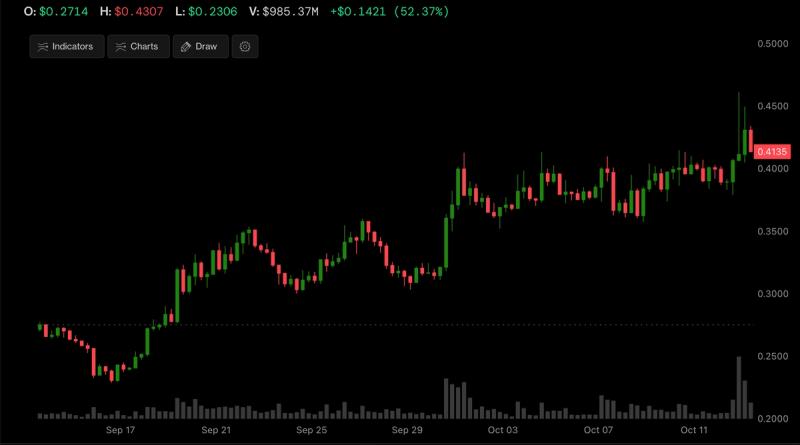
Stacks’ STX token has sharply outperformed major cryptocurrencies over the past month, with the Bitcoin layer-2 project’s native asset gaining more than 50% in four weeks, according to CoinDesk. The move has drawn attention to Stacks’ approach to Bitcoin staking, while the wider crypto market remains sensitive to upcoming U.S. inflation data.
STX outpaces major cryptocurrencies
STX rose nearly 10% over a 24-hour period and 14% over seven days in the market snapshot reported by CoinDesk on Oct. 13, 2026. Its four-week advance exceeded 50%, putting it ahead of bitcoin, ether, XRP and other large cryptocurrencies during the same period.
Stacks is a Bitcoin layer-2 project. In broad terms, a layer-2 network is built to operate alongside a main blockchain and expand the range of activity that can take place within that ecosystem. STX is the network’s native token and is used within Stacks’ network mechanisms.
The rally came as major cryptocurrencies continued to trade unevenly. Other notable gainers included BDX, REDNER and PYTH, each of which added about 6% over 24 hours in the CoinDesk report. That pattern suggested that some market liquidity was moving toward assets outside the largest cryptocurrencies, although the report did not present this as a broad-based recovery.
Why Stacks’ staking model is attracting attention
The reported interest in STX is linked to Stacks’ non-custodial Bitcoin staking architecture. The system is designed to allow Bitcoin holders to stake and earn yield directly on the Bitcoin blockchain while maintaining control of their private keys.
That structure differs from approaches in which holders first convert Bitcoin into a synthetic or wrapped version, such as wBTC, or transfer funds through a cross-chain bridge before seeking additional yield. A wrapped token represents an asset on another blockchain, while a bridge is used to move assets or their representations between blockchain networks. Stacks’ model instead emphasizes keeping control of the original Bitcoin while connecting it to activity on the Stacks ecosystem.
The framework uses a process called “bonding.” Participants lock assets to help secure the network, meaning those assets are not freely available for ordinary trading during the relevant period. The mechanism therefore links participation in the Stacks system with demand for STX.
Bonding Period 3 is due in November
The next stage, called “Bonding Period 3,” is scheduled for November. Under this phase, participants holding native STX must lock a specified amount of STX alongside their Bitcoin. The required STX is equivalent to roughly 5% of the total value of the participant’s Bitcoin.
The earlier Bonding Periods 1 and 2 were preparatory stages. They were used to transition signers safely and establish initial liquidity, according to the report.
The planned structure has an important supply implication for STX. If more Bitcoin enters the Stacks ecosystem, participants may need to lock a larger amount of STX to meet the bonding requirement. Tokens committed to the mechanism are removed from the actively traded supply for the period in which they are locked.
This creates a connection between Bitcoin liquidity and the availability of STX in the market. The CoinDesk analysis described that relationship as a potential positive feedback loop: greater Bitcoin participation can increase the amount of STX locked, while reduced active supply can strengthen the token’s scarcity dynamics. That mechanism explains why investors have focused on the upcoming bonding phase, but it does not guarantee a particular price outcome.
Moneyiar market picture
Moneyiar market data recorded at 20:29 on Oct. 13, 2026, showed Bitcoin at $83,125.527636265, up 0.17% over 24 hours but down 2.9% over seven days. The same data showed STX at $0.4233462134, down 6.29% over 24 hours while still up 11.34% over seven days.
The later Moneyiar snapshot differs from CoinDesk’s earlier intraday account of STX’s performance. This highlights how rapidly cryptocurrency prices can change and why the time attached to a market move matters.
Moneyiar’s data also put FORM at $0.2703681563, down 4.6% in 24 hours and 1.26% over seven days, while LAYER stood at $0.0705917998, down 3.62% over 24 hours and 8.71% over seven days.
Macro data remains a market focus
Despite the token-specific interest around Stacks, the broader crypto market remains tied to macroeconomic developments. Market participants were preparing for the U.S. Consumer Price Index report due Wednesday, according to the source material. CPI measures changes in consumer prices and is closely watched because it can influence expectations for future Federal Reserve interest-rate decisions.
That means the direction of STX and other cryptocurrencies may continue to reflect both developments within individual blockchain projects and changing expectations for the wider economy. The immediate Stacks catalyst is the design of its Bitcoin staking and bonding system, while the next major market-wide reference point is the upcoming U.S. inflation release.




