
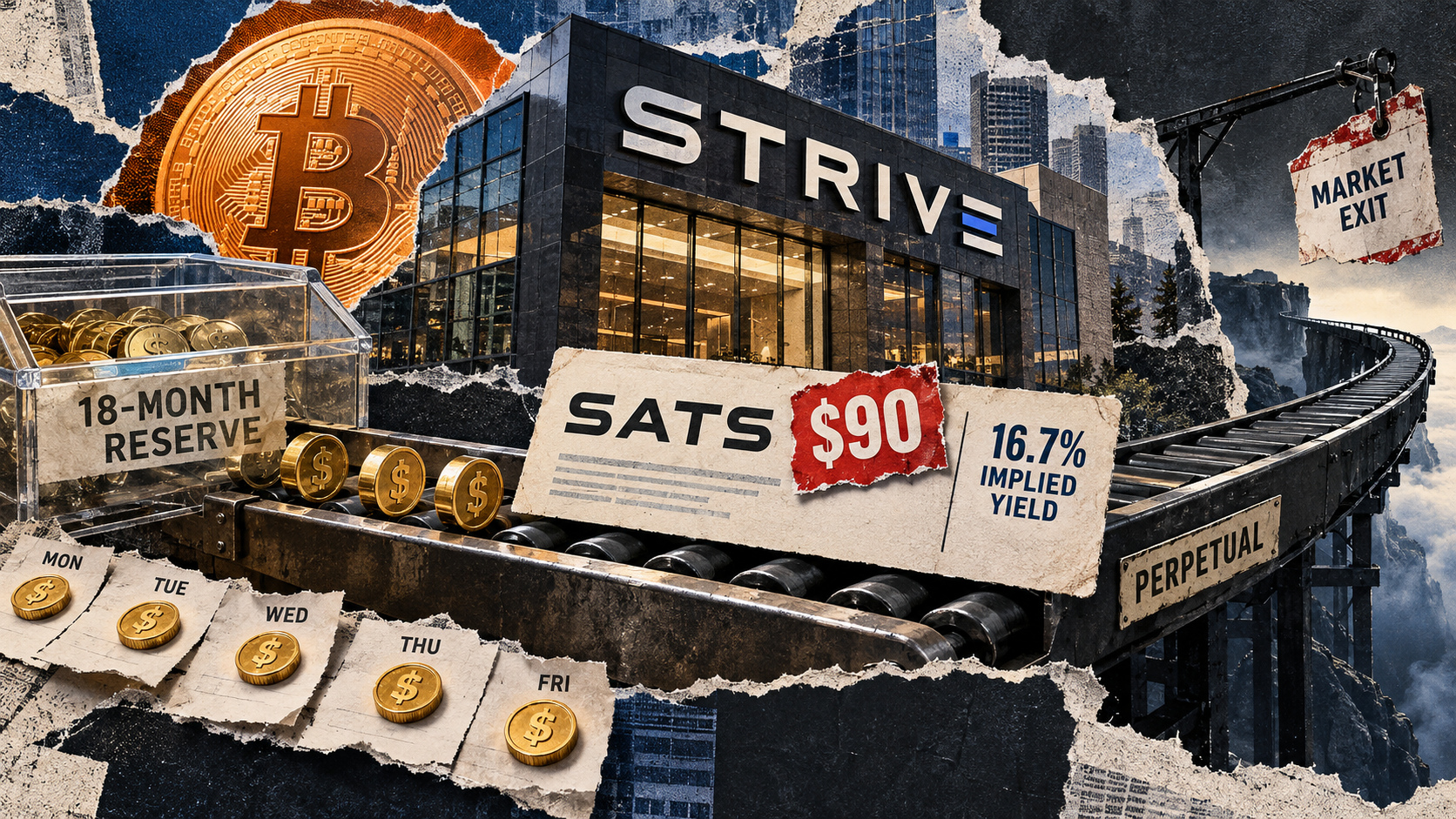
Strive has priced a new class of preferred stock at $90 a share, giving investors exposure to a contractual annual dividend of $15 while leaving them to bear the risks associated with a perpetual security, corporate liquidity and resale value. According to CryptoSlate, the Bitcoin-focused company priced seven million SATS shares on Oct. 15, targeting $630 million in gross proceeds before expenses.
At the offering price, the annual dividend implies a cash yield of 16.67% if the full $15 payment is made. The dividend is scheduled to start on Nov. 9 and to be paid in small amounts on each business day. Strive says it plans to use the proceeds for several possible purposes, including buying Bitcoin, supporting its operations, acquiring income-generating assets or repurchasing other shares. Settlement is scheduled for Oct. 20.
The headline yield is unusually high, but it does not by itself describe the total return an investor will receive. SATS is perpetual preferred stock, meaning it has no fixed maturity date at which Strive must return the original purchase price. The market value of the shares can therefore rise or fall depending on how investors assess the dividend, the company’s finances and the price they are willing to pay for the security.
Why the $100 stated amount is not a guaranteed exit price
Each SATS share has an initial liquidation preference of $100, subject to adjustments that cannot reduce that amount below $100 under the terms described in the prospectus. That figure represents a claim used in specified liquidation circumstances. It does not give an investor an everyday right to sell the share back to Strive for $100.
In ordinary trading, the exit price is determined by the market. An investor paying $90 could eventually sell for $100 or more if buyers become more comfortable with Strive’s financial position or accept a lower yield. The share could also trade at $75 even if Strive continues making its scheduled payments.
For example, collecting $15 over a year and selling a share purchased for $90 at $75 would produce $90 in total before fees and taxes. The investor would have received the advertised dividend but would not have earned a gain overall. A higher resale price could increase the total return, while a lower price could more than offset the income.
The $15 figure is therefore a contractual dividend rate, not a guaranteed investment return. It excludes the effect of price changes, transaction costs and taxes.
Where SATS ranks in Strive’s capital structure
Preferred shareholders generally rank ahead of common shareholders for dividends and liquidation distributions, but they are not first in line against every company obligation. SATS ranks behind Strive’s existing SATA preferred stock. Debt and certain liabilities at subsidiaries also have priority, and Strive retains the ability to issue securities that rank equally with or above SATS.
That ranking gives SATS holders some protection if the company’s value declines: common equity can absorb losses before the preferred claim is affected. However, the protection becomes weaker as senior obligations increase or the value of the company’s assets falls.
The terms also include additional provisions. In certain defined fundamental-change events, holders generally have a repurchase right at the $100 stated amount plus accumulated unpaid dividends. Strive has limited redemption rights under specified conditions. Neither provision creates a general right to receive $100 whenever an investor wants to exit.
Dividend funding and the Bitcoin connection
The seven million shares would require $105 million in annual SATS dividends if the $15 rate is paid in full. Strive intends to establish a reserve of $22.50 per share at closing, equal to $157.5 million in total, or about 18 months of scheduled dividends.
That reserve provides an initial payment buffer, but Bitcoin itself does not generate a cash dividend or interest payment. Beyond the reserve period, Strive’s prospectus anticipates that additional capital raising could be a primary source of dividend funding. Other possible sources include investment income, asset sales or cash held by the company.
This creates a distinction between the value of Strive’s Bitcoin holdings and its ability to make cash payments. Bitcoin appreciation may increase the company’s balance-sheet value, but it becomes spendable cash only when the company sells assets or otherwise converts that value into funds.
Strive can also raise capital to buy more Bitcoin, increasing both its holdings and the claims attached to the business. The source material notes that October purchases increased gross Bitcoin per effective common share by 1.72%, despite a much larger increase in total Bitcoin holdings. The point is that growth in total assets does not automatically improve every shareholder’s position by the same amount.
Moneyiar market picture
Moneyiar data at 21:59 on Oct. 17, 2026, showed Bitcoin at $80,986.59, down 0.73% over 24 hours and 2.40% over seven days. Bitcoin remained the market’s No. 1 cryptocurrency by market capitalization in the supplied data.
SATS investors are not buying Bitcoin directly. They are buying a perpetual preferred claim on Strive, whose ability to pay depends on liquidity, asset value, capital raising and market confidence. The offering’s 16.7% implied cash yield reflects that collection of risks rather than free income, while the eventual resale price will be determined by what another buyer is prepared to pay.




